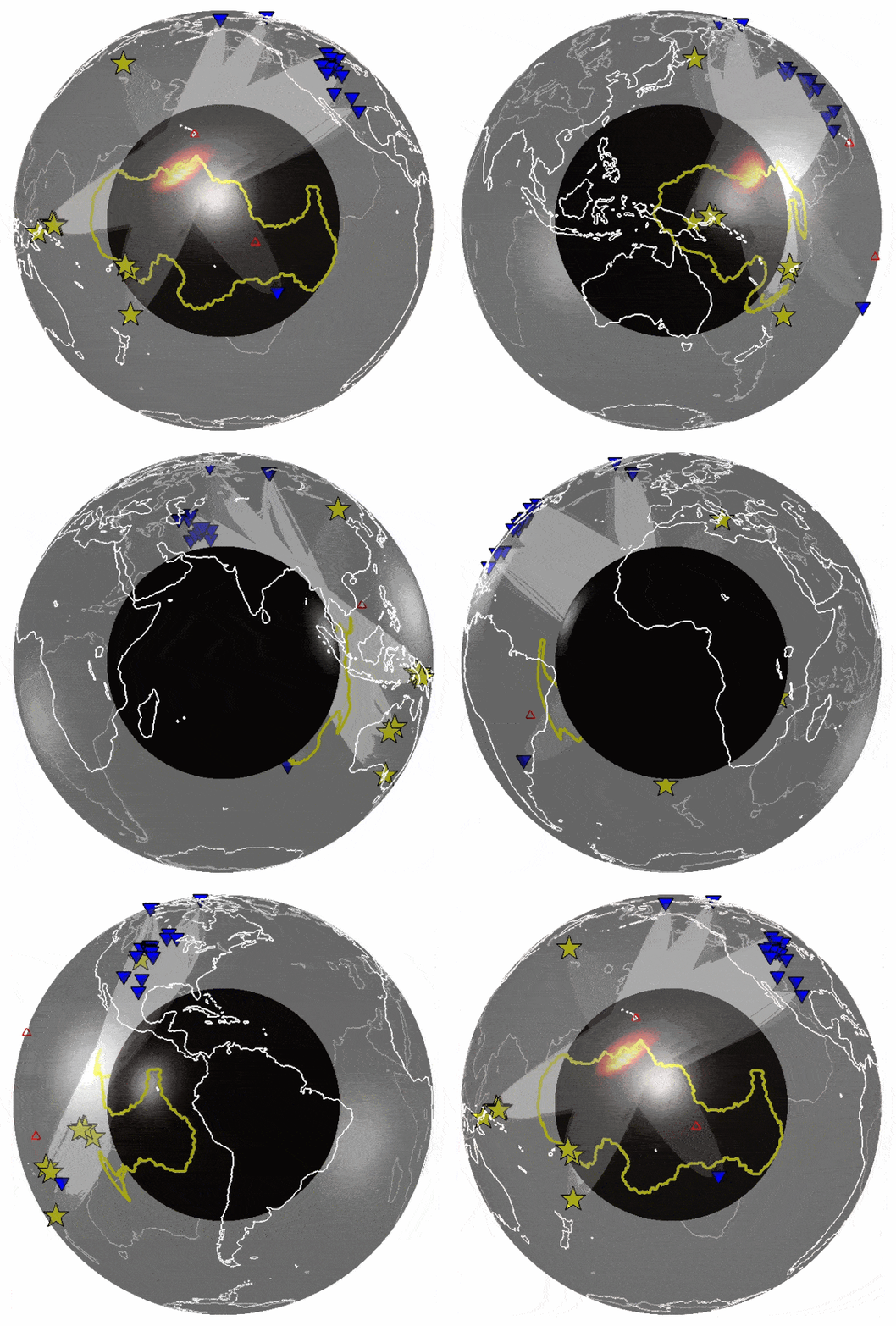
Earthquakes (stars) send seismic waves rippling through the planet. Seismometers (blue triangles) detect them on the other side. Thirty years of seismic data revealed where those seismic waves slowed down (purple and orange splotches), pointing to mysterious inner-Earth structures called ultralow-velocity zones.
Deep within Earth, where the solid mantle meets the molten outer core, strange continent-size blobs of hot rock jut out for hundreds of miles in every direction. These underground mountains go by many names: "thermo-chemical piles," "large low-shear velocity provinces" (LLSVPs), or sometimes just "the blobs."
Geologists don't know much about where these blobs came from or what they are, but they do know that they're gargantuan. The two biggest blobs, which sit deep below the Pacific Ocean and Africa, account for nearly 10% of the entire mantle's mass, one2016 study found — and, if they sat on Earth's surface, the duo would each extend about 100 times higher thanMount Everest. However, new research suggests, even those lofty analogies may be underestimating just how big the blobs really are.
In a study published June 12 in the journalScience, researchers analyzed the seismic waves generated by earthquakes over nearly 30 years. They found several massive, never before-detected features along the edges of the Pacific blob.
"The structures we located are … thousands of kilometers across in scale," lead study author Doyeon Kim, a postdoctoral fellow at the University of Maryland, told Live Science in an email. According to Kim, that's an order of magnitude larger than typical features found along the blob's edge.
Because the blobs live deep, deep inEarth's interior, geologists can only begin to understand their shape and size by looking at theseismic waves (sound waves generated by earthquakes) that travel through them. These hot, dense regions can slow incoming waves by up to 30% relative to the surrounding mantle; the hottest, slowest regions are known as ultralow-velocity zones (ULVZs), and they typically occur near the edges of the blobs, Kim said.
In their study, Kim and his colleagues created a new map of ULVZs below the Pacific Ocean using an algorithm called "the Sequencer," which was originally developed to find patterns in stellar radiation. With this algorithm, the team analyzed 7,000 seismograms, or measures of seismic waves, collected between 1990 and 2018, created by hundreds ofearthquakes of magnitude 6.5 or greater. The earthquakes occurred in Asia and Oceania, the researchers wrote; but as their seismic waves shuddered across the globe, they passed clearly through the Pacific Ocean mantle blob before reaching seismometers in the United States.
Sign up for the Live Science daily newsletter now
Get the world’s most fascinating discoveries delivered straight to your inbox.
A map of inner Earth showing the new ultralow-velocity zones (yellow outline) mapped through 30 years of seismic data.
(Image credit: Doyeon Kim/University of Maryland)
The algorithm revealed enormous sections of ULVZs never detected before, including a blobby region below the Marquesas Islands in the South Pacific Ocean, which measured more than 620 miles (1,000 kilometers) across. The Sequencer also showed that a segment of the blob deep below the Hawaiian Islands is considerably larger than previously thought.
"By looking at thousands of core-mantle boundary [seismograms] at once, instead of focusing on a few at a time, we have gotten a totally new perspective," Kimsaid in a statement.
The enormous size of these structures suggests that blobs along the core-mantle boundary — and particularly the hottest, densest ULVZs — are probably more widespread than previous research indicates. What's more, Kim added, the fact that these large zones lurk near knownvolcanic hotspots could also reveal some clues about their impact on Earth's geology.
It's possible, for example, that ULVZs deep down in the mantle could feed into the large "plumes" of hot rock in the upper mantle that create volcanic hot spots on the surface, Kim said. Those mantle plumes might "suck on" the melty material collected in ULVZs and pull it upward, which could explain why the largest ULVZs are located deep under volcanic island chains like the Hawaiian and Marquesas islands.
That's just one theory, Kim said; even with algorithms designed to pierce the void of space, the mysteries near the center of the Earth remain just as murky as ever.
"In short, everything is unsure at the moment," Kim said, "but this is what makes our field of study so exciting."
For a limited time, you can take out a digital subscription to any of our best-selling science magazines for just $2.38 per month, or 45% off the standard price for the first three months.
Brandon is the space / physics editor at Live Science. With more than 20 years of editorial experience, his writing has appeared in The Washington Post, Reader's Digest, CBS.com, the Richard Dawkins Foundation website and other outlets. He holds a bachelor's degree in creative writing from the University of Arizona, with minors in journalism and media arts. His interests include black holes, asteroids and comets, and the search for extraterrestrial life.