Seismic Waves Shed Light on Earth's Weak Mantle

A mysterious drop in the speed of seismic waves as they zip through the Earth could shed light on why the hot, flowing rock the planet's tectonic plates rest on is so weak, researchers say.
These seismic clues could also provide insights into the geology of Mars, Venus and other planets, scientists added.
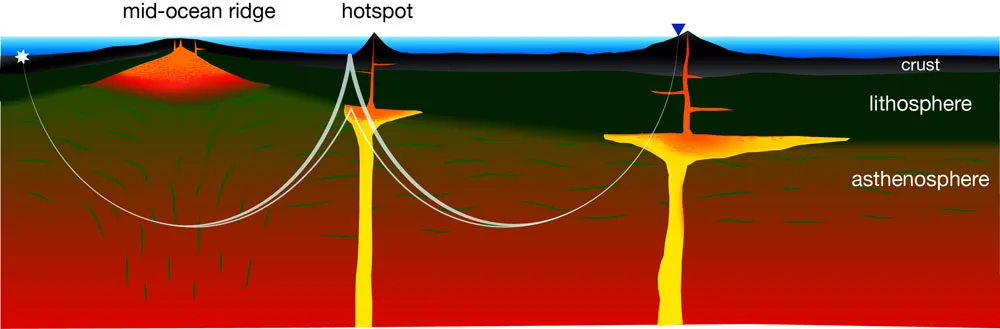
The Earth's rigid, outermost layer, the lithosphere, is up to 150 miles (250 kilometers) thick and is made up of Earth's crustand the uppermost portion of the mantle. It forms the continental and oceanic platesthat shift around the planet's surface over eons. Below the lithosphere lies the asthenosphere, the portion of the mantle that is made up of hot, weak, flowing rock, but that is nevertheless solid.
"A longstanding question in geophysics is why the lithosphere is strong and the asthenosphere is weak," said planetary seismologist Nicholas Schmerr at the Carnegie Institution of Washington and NASA Goddard Space Flight Center. "Some have posed that small amounts of partially molten rock help to weaken the asthenosphere; others that it is weak because the rocks are relatively hot and therefore easier to deform, and others that it has a different composition that changes its strength as compared to the rocks of the lithosphere."
A strange layer
One way to solve this mystery is by investigating the boundary between the lithosphere and asthenosphere with seismic waves rippling through Earth. Seismic waves slow down significantly by 5 to 10 percent between the lithosphere and asthenosphere. This dip in speed has become known as the Gutenberg discontinuity, a layer no more than about 12 miles (20 km) thick. The discontinuity lies at depths of 20 miles to 75 miles (35 km to 120 km), and is named after Beno Gutenberg, who first detected the feature beneath the oceans nearly a century ago.
Past analyses of the Gutenberg discontinuity under the oceans, where it is closest to the surface, were limited to regions beneath islands and seismometers on the ocean bottom. "This gave an incomplete picture of where the Gutenberg discontinuity occurs," Schmerr said.
Get the world’s most fascinating discoveries delivered straight to your inbox.
To unravel the nature of the Gutenberg discontinuity, Schmerr applied a new signal-processing technique that helped him analyze high-frequency seismic waves across the Pacific Plate, Earth's largest tectonic plate. "This painted the first platewide picture of what is happening at the lithosphere-asthenosphere boundary," he said.
These seismic waves at times slowed drastically when they were about 25 to 47 miles (40 to 75 km) below the ocean. That depth is associated not only with the lithosphere-asthenosphere boundary, but also molten rock that feeds into volcanoes.
"My research found that Gutenberg discontinuity only appears beneath regions of recent surface volcanism," Schmerr told OurAmazingPlanet.
This magma might be generated by mantle plumes— giant upwellings of hot rock emerging from near Earth's core. Another possibility might be the roiling occurring within the asthenosphere, which would churn hot rock against the base of the lithosphere, perhaps melting it.
Questions remain
These findings suggest that molten rock helps explain why the asthenosphere is weak. However, there are large regions of the Pacific where the Gutenberg discontinuity is not seen, "implying molten rock can be ruled out as the primary mechanism for the weak asthenosphere," Schmerr said. "This means that the majority of Earth's asthenosphereis weak either because it is hot, or because the rocks have a different composition, or both."
The next logical step for this research "is to look under a whole variety of different types of plates and see if there are differences between each plate, or if a similar story is present across the Earth," Schmerr said.
But the implications aren't confined to our own planet.
"I am particularly interested in exploring what my results mean for other planets, as it is possible the mantle of Mars or Venus might be too cold or lack the compositional variation that allows a weak asthenosphere to form and enable plate tectonics on these planets, giving them a completely different evolutionary history than the Earth," Schmerr said.
Schmerr details his findings in tomorrow's (March 23) issue of the journal Science.