 Live Science Plus





You are now subscribed
Your newsletter sign-up was successful
Want to add more newsletters?

Delivered Daily
Daily Newsletter
Sign up for the latest discoveries, groundbreaking research and fascinating breakthroughs that impact you and the wider world direct to your inbox.

Once a week
Life's Little Mysteries
Feed your curiosity with an exclusive mystery every week, solved with science and delivered direct to your inbox before it's seen anywhere else.

Once a week
How It Works
Sign up to our free science & technology newsletter for your weekly fix of fascinating articles, quick quizzes, amazing images, and more

Delivered daily
Space.com Newsletter
Breaking space news, the latest updates on rocket launches, skywatching events and more!

Once a month
Watch This Space
Sign up to our monthly entertainment newsletter to keep up with all our coverage of the latest sci-fi and space movies, tv shows, games and books.

Once a week
Night Sky This Week
Discover this week's must-see night sky events, moon phases, and stunning astrophotos. Sign up for our skywatching newsletter and explore the universe with us!
Join the club
Get full access to premium articles, exclusive features and a growing list of member rewards.
Oganesson is a radioactive, artificially produced element about which little is known. It is expected to be a gas and is classified as a non-metal. It is a member of the noble gas group.
The element, No. 118 on the Periodic Table of Elements, had previously been designated ununoctium, a placeholder name that means one-one-eight in Latin. In November 2016, the International Union of Pure and Applied Chemistry (IUPAC) approved the name oganesson for element 118.
The name oganesson honors Yuri Oganessian "for his pioneering contributions to transactinide elements research," IUPAC officials said, referring to elements with atomic numbers 104 through 120. "His many achievements include the discovery of super-heavy elements and significant advances in the nuclear physics of super-heavy nuclei, including experimental evidence for the 'island of stability,'" an idea suggesting that super-heavy elements can become stable at some point in their existence.
Just the facts
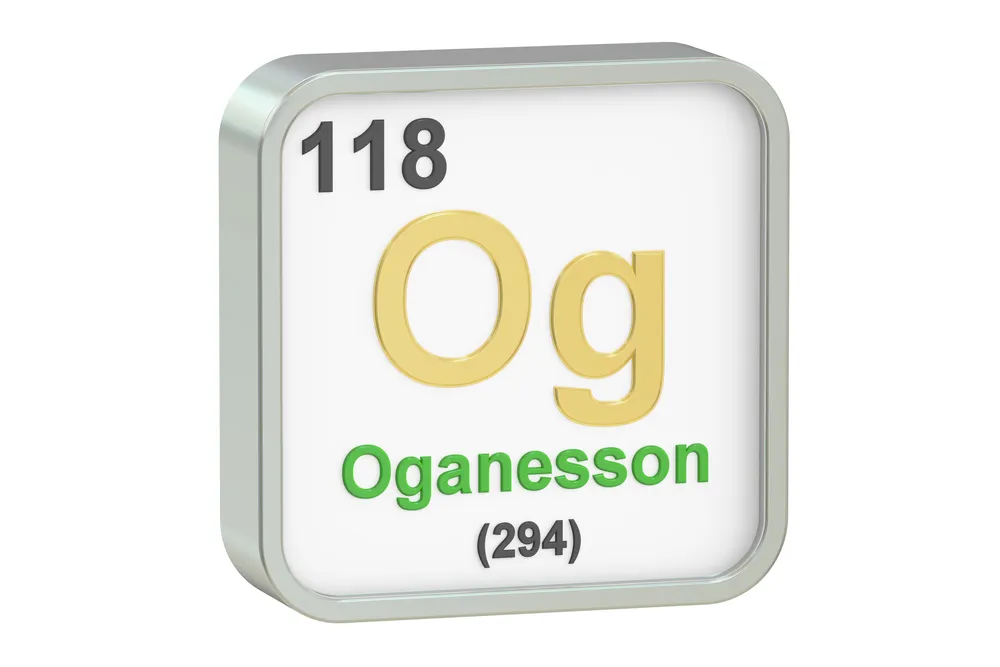
Atomic Number: 118 Atomic Symbol: Og Atomic Weight: [294] Melting Point: Unknown Boiling Point: Unknown
Discovery
Oganesson was discovered in 2002 by Russian scientists at the Joint Institute for Nuclear Research in Dubna, Russia. Three years prior, in 1999, the team at the Lawrence Berkeley Labs in California published a paper announcing the discovery of element 118, but their results could not be replicated and the team retracted their paper. In 2006, the element was officially announced by the Dubna team and by the Lawrence Livermore National Laboratory team, who had been working with the Dubna scientists.
Properties of oganesson
Oganesson has one known isotope, 294Og, with a half-life of about 0.89 milliseconds. Through alpha decay, it turns into 290Lv (livermorium-290).
The atomic weight for manmade transuranium elements is based on the longest-lived isotope. These atomic weights should be considered provisional since a new isotope with a longer half-life could be produced in the future. [See Periodic Table of the Elements]
Sources of oganesson
The Russian scientists who produced oganesson bombarded atoms of californium with ions of calcium for 1,080 hours. This resulted in three atoms of oganesson.
Uses of oganesson
Since only a few atoms of oganesson have ever been made, it has no practical uses outside of scientific study.
