













Facts About Moscovium (Element 115)
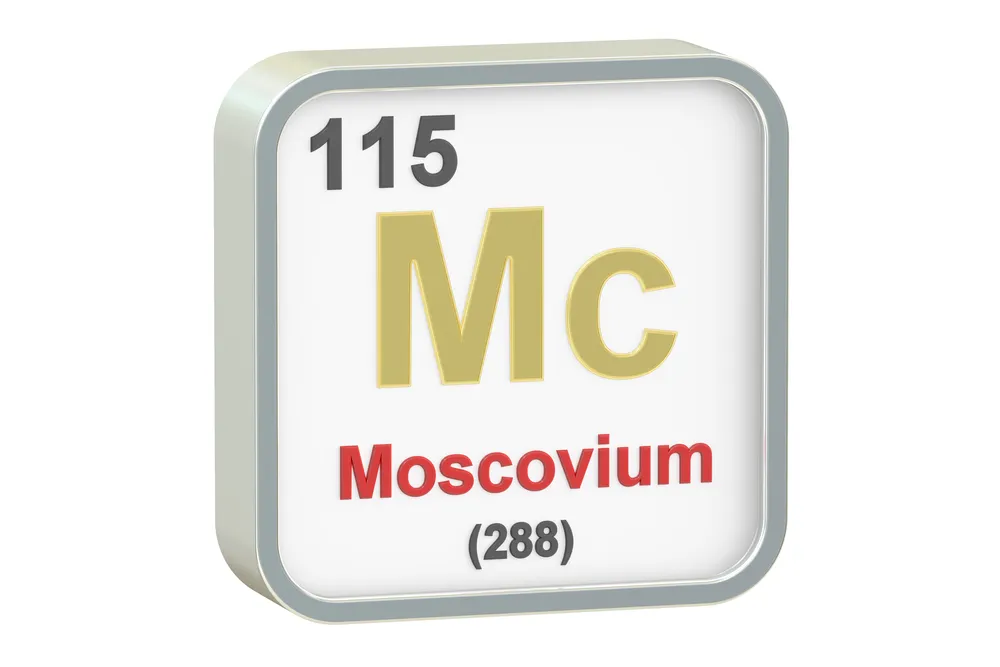
Moscovium is a radioactive, synthetic element about which little is known. It is classified as a metal and is expected to be solid at room temperature. It decays quickly into other elements, including nihonium.
The element had previously been designated ununpentium, a placeholder name that means one-one-five in Latin. In November 2016, the International Union of Pure and Applied Chemistry (IUPAC) approved the name moscovium for element 115.
The IUPAC also approved names for elements 113 (nihonium, with atomic symbol Nh), 117 (tennessine, Ts) and 118 (oganesson, Og).
Names for elements 115 and 117 were proposed by their discoverers at the Joint Institute for Nuclear Research in Dubna, Russia; the Oak Ridge National Laboratory in Tennessee; Vanderbilt University in Tennessee; and Lawrence Livermore National Laboratory in California. Both element names, moscovium and tennessine, honor regions where experiments linked to creating the elements took place.
Just the facts
Atomic Number: 115 Atomic Symbol: Mc Atomic Weight: [288] Melting Point: Unknown Boiling Point: Unknown
Discovery
Moscovium was discovered in 2003 and officially announced on Feb. 2, 2004. It was created and announced by scientists at the Joint Institute for Nuclear Research in Dubna, Russia, and scientists at the Lawrence Livermore National Laboratory in the United States.
Properties
Moscovium has four isotopes with known half-lives, the most stable of which is 289Mc, with a half-live of about 220 milliseconds.
Get the world’s most fascinating discoveries delivered straight to your inbox.
The atomic weight for manmade transuranium elements is based on the longest-lived isotope. These atomic weights should be considered provisional since a new isotope with a longer half-life could be produced in the future. [See Periodic Table of the Elements]
Sources of moscovium
To make moscovium, the scientists in Russia and the United States bombarded atoms of americium with ions of calcium in a cyclotron. This produced four atoms of moscovium.
Uses of moscovium
Only a few atoms of moscovium have ever been made, and they are only used in scientific study. It is used to make nihonium.
Additional resources
Tim Sharp was Live Science’s reference editor from 2012 to 2018. Tim received a degree in Journalism from the University of Kansas. He worked for a number of other publications, including The New York Times, Des Moines Register and Tampa Bay Times, and as an editor for the Hazelden Foundation, among others.