Live Science Plus





You are now subscribed
Your newsletter sign-up was successful
Want to add more newsletters?

Delivered Daily
Daily Newsletter
Sign up for the latest discoveries, groundbreaking research and fascinating breakthroughs that impact you and the wider world direct to your inbox.

Once a week
Life's Little Mysteries
Feed your curiosity with an exclusive mystery every week, solved with science and delivered direct to your inbox before it's seen anywhere else.

Once a week
How It Works
Sign up to our free science & technology newsletter for your weekly fix of fascinating articles, quick quizzes, amazing images, and more

Delivered daily
Space.com Newsletter
Breaking space news, the latest updates on rocket launches, skywatching events and more!
Once a month
Watch This Space
Sign up to our monthly entertainment newsletter to keep up with all our coverage of the latest sci-fi and space movies, tv shows, games and books.

Once a week
Night Sky This Week
Discover this week's must-see night sky events, moon phases, and stunning astrophotos. Sign up for our skywatching newsletter and explore the universe with us!
Join the club
Get full access to premium articles, exclusive features and a growing list of member rewards.
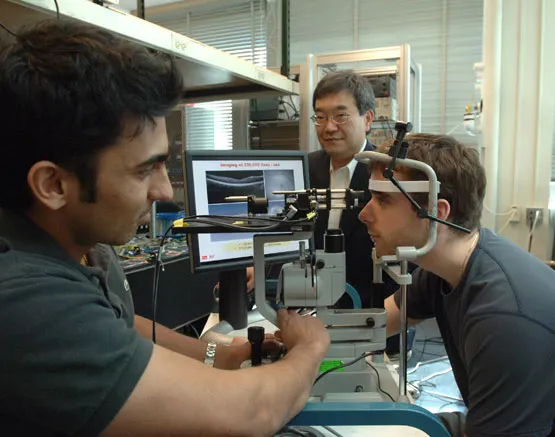
A new way to use lasers to snap highly detailed 3-D pictures of the eye could help improve diagnoses of many ocular diseases, engineers say. The MIT researchers who developed the approach say they now can scan the retina at record speeds of up to 236,000 lines per second, 10 times faster than current technology. Currently, the state of the art is slower laser technology that takes pictures of the retina, the part of the eye that converts light to electrical signals that travel the brain. The aim is to spot any subtle changes that occur because of diseases of the retina, such as diabetic retinopathy, glaucoma and age-related macular degeneration. These are the leading causes of blindness. Retinal pictures are taken by scanning a near-infrared laser beam back and forth across the eye and analyzing the reflected light to build up high-resolution images row by row. This yields a series of 2-D cross-sectional images of the retina that can then be combined to form a 3-D picture of the eye. This method, dubbed optical coherence tomography (OCT), was developed more than a decade ago by MIT electrical engineer James Fujimoto and his colleagues. "It's impossible to test the retina by removing tissue from it with a biopsy," Fujimoto said. "Our technique allows ophthalmologists to non-invasively image the eye to perform earlier and more sensitive diagnosis." Commercial OCT systems scan the eye at rates ranging from several hundred to several thousand lines per second. However, a typical patient can only keep the eye still for about one second, limiting the amount of 3-D data that can get acquired. Now Fujimoto and his colleagues reveal they can scan the retina 10 times faster than current OCT technology with a novel laser they developed, which they will detail on May 10 at the Conference on Lasers and Electro-Optics and the Quantum Electronics and Laser Science Conference in Baltimore. The new laser can rapidly vary the wavelength of the beam it fires. In a crude sense, the wavelength of the laser is the length of the ruler used to measure details about the eye. Rapidly varying the laser's wavelength returns more 3-D data about the eye, enabling the boost in speed. "We can generate detailed 3-D images with unprecedented speed," Fujimoto said. However, he cautioned the work is still five years or more away from commercialization.