 Live Science Plus





You are now subscribed
Your newsletter sign-up was successful
Want to add more newsletters?

Delivered Daily
Daily Newsletter
Sign up for the latest discoveries, groundbreaking research and fascinating breakthroughs that impact you and the wider world direct to your inbox.

Once a week
Life's Little Mysteries
Feed your curiosity with an exclusive mystery every week, solved with science and delivered direct to your inbox before it's seen anywhere else.

Once a week
How It Works
Sign up to our free science & technology newsletter for your weekly fix of fascinating articles, quick quizzes, amazing images, and more

Delivered daily
Space.com Newsletter
Breaking space news, the latest updates on rocket launches, skywatching events and more!

Once a month
Watch This Space
Sign up to our monthly entertainment newsletter to keep up with all our coverage of the latest sci-fi and space movies, tv shows, games and books.

Once a week
Night Sky This Week
Discover this week's must-see night sky events, moon phases, and stunning astrophotos. Sign up for our skywatching newsletter and explore the universe with us!
Join the club
Get full access to premium articles, exclusive features and a growing list of member rewards.
Something is not quite right inside the Earth's core. When seismic waves from earthquakes ripple through its solid center, they hit a speed bump.
The seismic vibrations should zip along about 30 percent faster than their actual speed, according to experiments and computer models recreating the conditions inside the inner core. Scientists have tried to explain this odd observation by playing around with the core's properties — adding metal such as nickel, or suggesting that iron acts strangely deep inside the planet.
Now, a new computer model of Earth's inner core explains the seismic wave slowdown via changes in iron's strength just before the metal melts. The findings were published Oct. 10 in the journal Science.
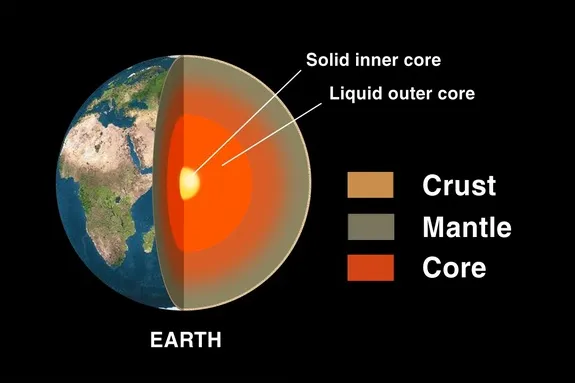
Scientists think the Earth's outer core is liquid, but the heart is solid iron and nickel, plus traces of elements such as sulfur and gold. Seismic waves passing through the core provide a snapshot view, similar to a CT scan, of its structure. The planet's magnetic field and the rotation of the Earth also offer clues to the core's composition and structure.
The new model indicates that inside the inner core, just before iron melts, the metal's strength weakens dramatically, according to researchers at University College London in the United Kingdom. Weaker iron is less stiff, so one kind of seismic wave that passes through the core, called a shear wave, can travel more quickly. In the team's computer model of the inner core, when iron is at about 99 percent of its melting temperature, the seismic velocities match the speeds picked up by instruments that monitor earthquakes.
"The proposed mineral models for the inner core have always shown a faster wave speed than that observed in seismic data," Lidunka Vočadlo, a co-author of the study, said in a statement. "This mismatch has given rise to several complex theories about the state and evolution of the Earth's core."
"The strong premelting effects in iron shown in our paper are an exciting new development in understanding the Earth's inner core," said Vočadlo, a geophysicist at University College London. "We are currently working on how this result is affected by the presence of other elements, and we may soon be in a position to produce a simple model for the inner core that is consistent with seismic and other geophysical measurements."
Email Becky Oskin or follow her @beckyoskin. Follow us @livescience, Facebook & Google+. Original article on LiveScience.

