Live Science Plus





Satellite Spies California Fire's Scars
You are now subscribed
Your newsletter sign-up was successful
Want to add more newsletters?

Delivered Daily
Daily Newsletter
Sign up for the latest discoveries, groundbreaking research and fascinating breakthroughs that impact you and the wider world direct to your inbox.

Once a week
Life's Little Mysteries
Feed your curiosity with an exclusive mystery every week, solved with science and delivered direct to your inbox before it's seen anywhere else.

Once a week
How It Works
Sign up to our free science & technology newsletter for your weekly fix of fascinating articles, quick quizzes, amazing images, and more
Delivered daily
Space.com Newsletter
Breaking space news, the latest updates on rocket launches, skywatching events and more!

Once a month
Watch This Space
Sign up to our monthly entertainment newsletter to keep up with all our coverage of the latest sci-fi and space movies, tv shows, games and books.

Once a week
Night Sky This Week
Discover this week's must-see night sky events, moon phases, and stunning astrophotos. Sign up for our skywatching newsletter and explore the universe with us!
Join the club
Get full access to premium articles, exclusive features and a growing list of member rewards.
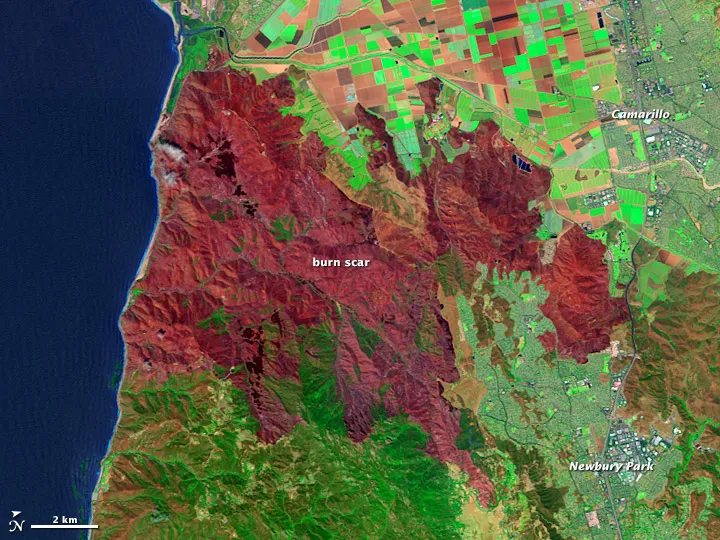
A fire that swept through 240,000 acres in Southern California over the past week is visible from space in a new image from a NASA satellite.
The Springs Fire rushed through scrubland in Ventura County, Calif., starting on May 2, triggering hundreds of evacuations and threatening the towns of Camarillo and Newbury Park. Strong winds and low humidity helped fan the flames.
Firefighters brought the blaze under control within a week, and only 16 buildings were damaged, according to NASA's Earth Observatory. But after a fire, danger still remains — particularly the threat of landslides in areas where vegetation has burned off.
That's where satellite imagery comes in. The Landsat Data Continuity Mission, NASA's eighth Landsat satellite, launched this February and passed over the Springs Fire burn area on May 4. Burned areas appear in red, with the darkest maroons representing the worst-affected spots. Unburned vegetation is green and plowed farmland is brown. An earlier image from 2010 shows the landscape before the Springs Fire blazed through.

Burned Area Emergency Response (BAER) teams use this imagery to pinpoint problem areas for erosion and water run-off.
"Having a new Landsat satellite on orbit is critically important," Randy McKinley, a U.S. Geological Survey geographer who makes burn maps, told NASA's Earth Observatory. "We have to deliver our maps to the BAER teams within a week for them to be most useful, and our odds of getting timely high-quality cloud and smoke-free image acquisitions just went up dramatically."
The new satellite passes over most wildfire areas at least every eight days, McKinley said. That's twice as often as earlier satellites. The satellite also collects about 400 images per day compared to 250 from earlier versions.
Follow Stephanie Pappas on Twitter and Google+. Follow us @livescience, Facebook & Google+. Original article on LiveScience.com.