














Greenland's Glacial Melt May Slow, Study Suggests

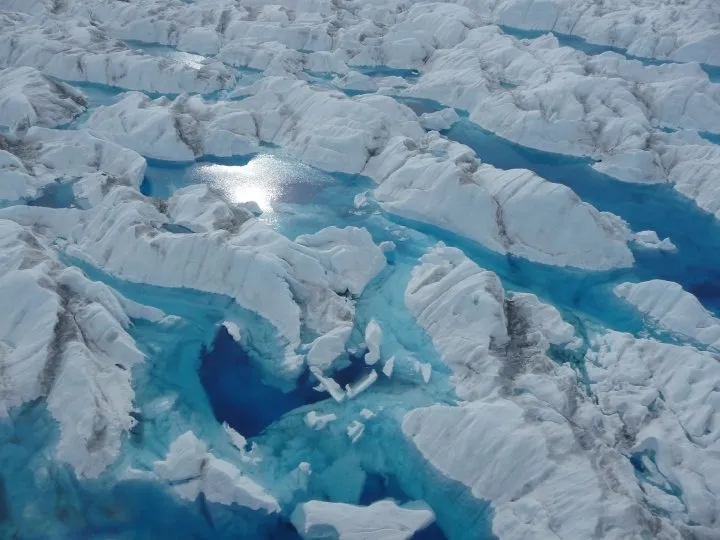
Greenland's galloping glaciers will likely slow their rapid retreat in the coming century, scientists project based on a new computer modeling study.
In the study, published today (May 8) in the journal Nature, researchers resolve one of the biggest uncertainties about Greenland's future contributions to sea-level rise: the behavior of its outlet glaciers. These massive ice rivers drain to the ocean, adding both surface runoff water and icebergs to the sea. The researchers discovered that Greenland's outlet glaciers retreat in episodic pulses, which account for the past 10 years of dramatic ice loss.
"We now have a good estimate of what's going to happen in the next 100 years," said lead study author Faezeh Nick, a glaciologist at The University Centre in Svalbard, Norway.
According to the model, which looked at four swiftly shrinking outlet glaciers, today's breakneck retreat will soon hit the brakes, thanks to natural processes like narrow fjords that choke glacial retreat and increased iceberg production that cools warm ocean water. But that doesn't mean Greenland's overall ice loss will stop, Nick warns. [Image Gallery: Greenland's Melting Glaciers]
"It's very important to know that these glaciers respond to warming scenarios," Nick told OurAmazingPlanet. "Now we know for sure that the warmer atmosphere and ocean will result in further mass loss. But just looking at the changes from the last 10 years and extrapolating them is wrong," she said. "It's not science."
Modeling the melt
The study predicts that outlet glaciers will add 0.74 to 1.2 inches (19 to 30 millimeters) to sea-level rise by 2200 with 5 degrees Fahrenheit (2.8 degrees Celsius) of warming, a modest scenario. With a more extreme warming estimate of 8.1 Fahrenheit (4.5 Celsius) by 2100, the loss would rise by 50 percent, to 1.2 to 1.9 inches (29 to 49 mm) by 2200.
Get the world’s most fascinating discoveries delivered straight to your inbox.
Capped with a thick cladding of ice, Greenland holds enough water to raise sea levels by 22 feet (7 meters).
In recent decades, the rate of ice loss in Greenland has accelerated, raising fears of irreversible melting and rapid sea-level rise. In August 2012, the Greenland Ice Sheet shattered a 30-year seasonal record.
One 2008 study, a worst-case scenario, suggested Greenland's retreating glaciers could contribute up to 19 inches (48 centimeters) of sea-level rise by 2100. The 2007 Intergovernmental Panel on Climate Change omitted outlet glaciers from its sea-level-rise projections due to the difficulty of modeling the glaciers’ behavior. The new study is the first to model and predict sea-level rise from the dynamic behavior of outlet glaciers, Nick said.
Choke points
The researchers took a close look at four swiftly shrinking outlet glaciers, all of which drain to the ocean: Jakobshavn in western Greenland, Helheim and Kangerdlugssuaq glaciers in southeastern Greenland, and Petermann Glacier in northern Greenland.
The team modeled complex factors governing how the massive ice rivers respond to climate change — including warmer ocean and air temperatures, the sea ice damming the glacier's fronts, where icebergs calve, and the shape of their rock walls. Even the size and shape of crevasses (deep cracks in the ice) must be considered.
The model finds that mass loss (surface melt and iceberg calving) will plateau after the initial increase in the early 21st century. The unique width and depth of each glacier's fjord (a steep, U-shaped valley) largely controls how they respond to warming, which may explain the large degree of variability seen in melting today, the researchers found.
"If a glacier goes into a narrow part of a fjord, it just hangs there and stops [retreating]," Nick said. "But if the climate gets warmer, it can pass through that narrow part and melt anyway."
Email Becky Oskin or follow her @beckyoskin. Follow us @OAPlanet, Facebook & Google+. Original article on LiveScience's OurAmazingPlanet.
