













Image Gallery: Greenland's Melting Glaciers

Recent history

In recent years, Greenland's ice loss has accelerated, raising fears of irreversible melting and rapid sea-level rise. Now, scientists say its time to revise dire predictions based on the last 10 years of glacial retreat. Here, GPS units are being deployed on fast flowing Greenland outlet glaciers in August 2011.
Losing a Chunk of Ice

Greenland's Jakobshavn Isbrae glacier, which drains some 6.5 percent of the Greenland ice sheet, is losing ice. At some time between May 9, 2014, when the Landsat 8 satellite acquired this image (left), and June 1, 2014, when it acquired the right image, the glacier shed a significant amount of ice. Some estimates put the loss at between 5 and 10 square kilometers (1.9 and 3.8 square miles), a couple hundred times thicker than sea ice, according to the Arctic Sea Ice blog.
Tracking the ice

GPS units being deployed on fast flowing Greenland outlet glaciers, Store Glacier and Kangiata Nunata Sermia in west Greenland, in August 2011. These units store glacier speed as they move together with the ice surface.

Gathering the data

GPS unit being retrieved after one year. Stored data in the unit show how fast the ice has moved during the year and can be used to validate and calibrate scientists' numerical model.
Data shows the impact

Deployment of a transmitting GPS unit on Petermann glacier, in May 2012. Data show how the glacier responded to warm summer seasons and to large calving events. This information helps scientists to validate their model results as well as to improve the model.
Kangiata Sermia glacier calving

Calving front of Kangiata Nunata Sermia glacier, one of the large fast flowing outlet glaciers in west Greenland.
New calving

Another image showing the calving front of Kangiata Nunata Sermia glacier.
Get the world’s most fascinating discoveries delivered straight to your inbox.
Calving in 2012

Calving front of Kangiata Nunata Sermia, in August 2012.
Rink Glacier calving

Frequent calving event in front of Rink Glacier in west Greenland.
Measuring the environment

Scientists on the sailing vessel Gambo are measuring water temperature and salinity in the fjord in front of Store Glacier in west Greenland. These data are used to estimate the amount of submarine melt at the glacier front when the warm currents enter the fjord.
Calving created
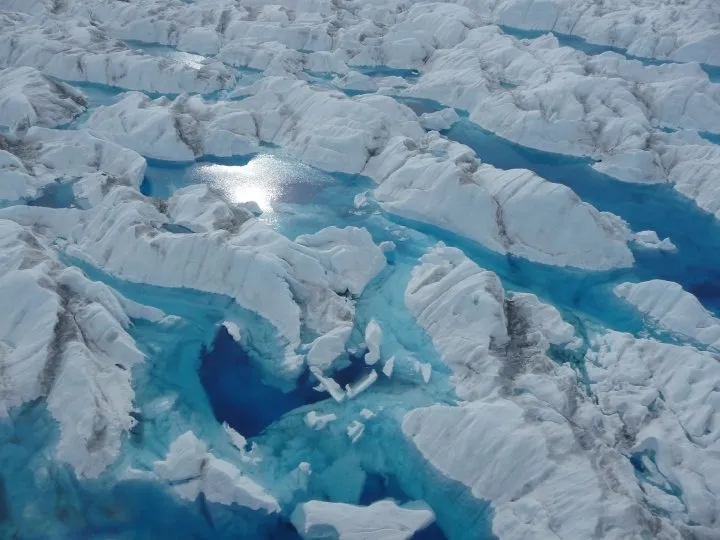
Water-filled surface crevasses on Greenland outlet glaciers. Every summer surface meltwater enters in the surface crevasses and forces the crevasses to penetrate deeper, which eventually results in higher calving rate.
