 Live Science Plus




You are now subscribed
Your newsletter sign-up was successful
Want to add more newsletters?

Delivered Daily
Daily Newsletter
Sign up for the latest discoveries, groundbreaking research and fascinating breakthroughs that impact you and the wider world direct to your inbox.

Once a week
Life's Little Mysteries
Feed your curiosity with an exclusive mystery every week, solved with science and delivered direct to your inbox before it's seen anywhere else.

Once a week
How It Works
Sign up to our free science & technology newsletter for your weekly fix of fascinating articles, quick quizzes, amazing images, and more
Delivered daily
Space.com Newsletter
Breaking space news, the latest updates on rocket launches, skywatching events and more!

Once a month
Watch This Space
Sign up to our monthly entertainment newsletter to keep up with all our coverage of the latest sci-fi and space movies, tv shows, games and books.

Once a week
Night Sky This Week
Discover this week's must-see night sky events, moon phases, and stunning astrophotos. Sign up for our skywatching newsletter and explore the universe with us!
Join the club
Get full access to premium articles, exclusive features and a growing list of member rewards.
The blanket of snow that covers Arctic regions for most of the year has been shrinking at an increasing pace over the past decade, researchers say.
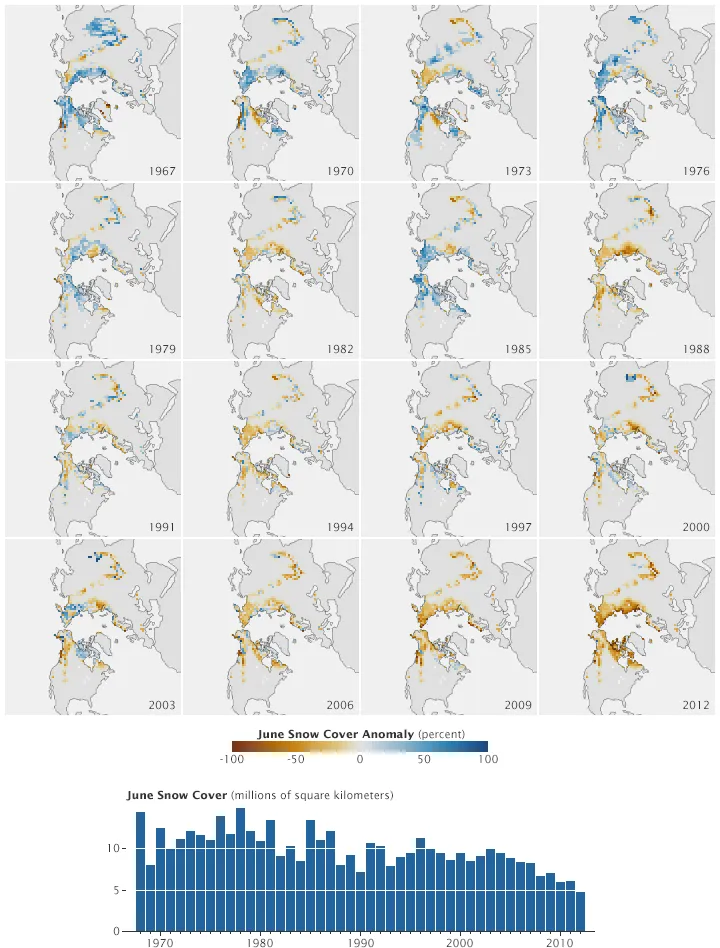
A recent study found an overall decrease in Arctic snow-cover extent (snow that covers the Arctic at the end of the spring) from 1967 through 2012, and an acceleration of snow loss after the year 2003. The rate of snow-cover loss in June between 1979 and 2012 was 17.6 percent per decade (relative to the 1979-2000 mean), which is greater than the rate of September sea-ice decline during that same period, the researchers say.
In fact, sea-ice extent — the area of ocean with at least 15 percent ice cover — reached a new record low in September, dwindling to 1.32 million square miles (3.41 million square kilometers), according to the U.S. National Snow & Ice Data Center, which tracks sea ice with satellite data.
The link between snow-cover and sea-ice extent is not completely understood. "But if you remove snow cover earlier, you're creating the potential to send warmer air out over the ocean. It can't be good for sea ice if you lose the snow early," study researcher Chris Derksen, a cryosphere scientist at Environment Canada in Toronto, told Nature News. [10 Key Facts About Arctic Sea Ice]
North America experienced three record-low Arctic snow-cover extents between June 2008 and June 2012, while in Eurasia, each June during those five years set a new record for the lowest extent ever recorded for that month, according to the study detailed in the journal Geophysical Research Letters.
"We were surprised at the continued broken records of June Arctic snow cover extent over the past five years," researcher Ross Brown, of Environment Canada at Ouranos Inc., said in a statement. "Arctic spring snow cover typically fluctuates over cycles of about three to four years so you don't expect to see sequences of decreasing snow cover persisting through these natural cycles."
NASA's Earth Observatory illustrated the trend with a series of maps based on data from the Rutgers University Global Snow Lab. The graphics show June snow-cover extent anomalies for every third year from 1967 through 2012, with above-average extent appearing in shades of blue, and below-average extent in shades of orange.
As with the loss of sea ice, the loss of snow cover can aggravate global warming through what is known as the albedo effect. White ice and snow reflect much of the sun's energy back out into space, while dark water and soils absorb it, bringing more heat into the natural system.
Follow LiveScience on Twitter @livescience. We're also on Facebook & Google+.

