
 Live Science Plus


July Was the Hottest Month Ever Recorded on Earth
As climate change ramps into high gear, global temperature records are being smashed left and right.

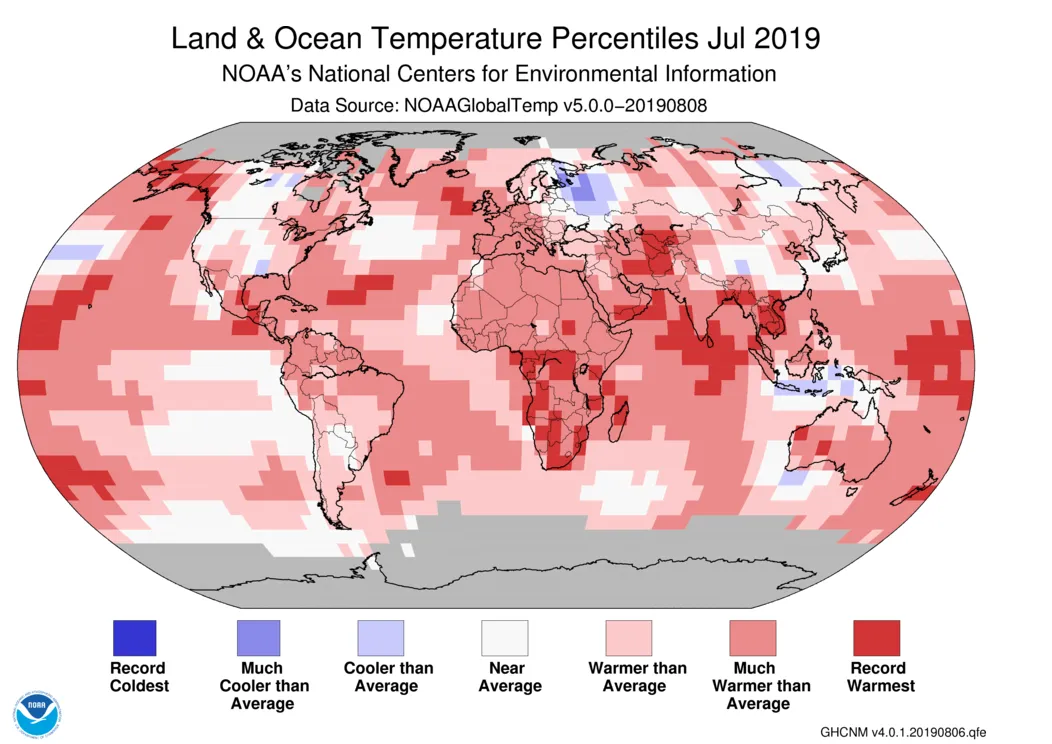
July was the hottest month ever recorded on Earth.
That's the word from the National Oceanic and Atmospheric Administration (NOAA), which tallied up global land and sea temperature recordings from 2019's seventh month and compared them to its 140-year data set, stretching back to 1880. The global average temperature for the month was 1.71 degrees Fahrenheit (0.95 degrees Celsius) above the 20th century average of 60.4 F (15.8 C). It was 0.05 F (0.03 C) warmer than the previous record, set in July 2016.
This new global heat record shouldn't be too surprising to anyone who read the news last month. A punishing heat wave swept across Europe and then settled over Greenland, where it triggered hundreds of billions of tons of ice melt. Sea ice in both the Arctic and Antarctic regions reached 41-year lows as well, according to NOAA.

January to July 2019 on land was the third warmest such period on record, NOAA reported, with global temperatures reaching 2.63 F (1.46 C) above average, behind only 2016 and 2017 marks. Sea temperatures during that period were the second highest ever, behind only 2016's.

Another global temperature map shows that early the entire planet has been much warmer than average in 2019 so far.
In 2018, the Intergovernmental Panel on Climate Change (IPCC), made up of scientists from all over the world, said that it's crucial to stop global temperatures from warming beyond 2.7 F (1.5 C) above average.
"One of the key messages that comes out very strongly from this report is that we are already seeing the consequences of 1 C [1.8 F] of global warming through more extreme weather, rising sea levels and diminishing Arctic sea ice, among other changes," Panmao Zhai, co-chair of IPCC Working Group I, said at the time.
To hold warming below that 2.7 F threshold, the IPCC said, will require "rapid, far-reaching and unprecedented changes in all aspects of society."
Ongoing efforts to reduce carbon are good news, but they're not enough, the IPCC said.
- Images of Melt: Earth's Vanishing Ice
- The Reality of Climate Change: 10 Myths Busted
- Top 10 Ways to Destroy Earth
Originally published on Live Science.
