Study: Civilization Doomed by Overconsumption, Wealth Inequality (Infographic)
Get the world’s most fascinating discoveries delivered straight to your inbox.
You are now subscribed
Your newsletter sign-up was successful
Want to add more newsletters?
Delivered Daily
Daily Newsletter
Sign up for the latest discoveries, groundbreaking research and fascinating breakthroughs that impact you and the wider world direct to your inbox.
Once a week
Life's Little Mysteries
Feed your curiosity with an exclusive mystery every week, solved with science and delivered direct to your inbox before it's seen anywhere else.
Once a week
How It Works
Sign up to our free science & technology newsletter for your weekly fix of fascinating articles, quick quizzes, amazing images, and more
Delivered daily
Space.com Newsletter
Breaking space news, the latest updates on rocket launches, skywatching events and more!
Once a month
Watch This Space
Sign up to our monthly entertainment newsletter to keep up with all our coverage of the latest sci-fi and space movies, tv shows, games and books.
Once a week
Night Sky This Week
Discover this week's must-see night sky events, moon phases, and stunning astrophotos. Sign up for our skywatching newsletter and explore the universe with us!
Join the club
Get full access to premium articles, exclusive features and a growing list of member rewards.
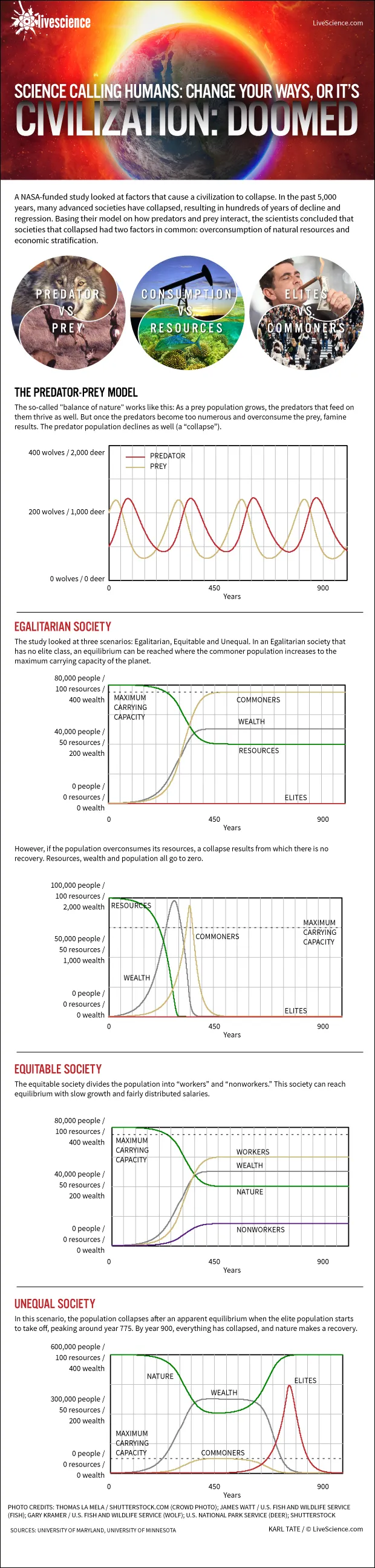
A NASA-funded study looked at factors that cause a civilization to collapse. In the past 5,000 years, many advanced societies have collapsed, resulting in hundreds of years of decline and regression. Basing their model on how predators and prey interact, the scientists concluded that societies that collapsed had two factors in common: overconsumption of natural resources and economic stratification.
The so-called "balance of nature" works like this: As a prey population grows, the predators that feed on them thrive as well. But once the predators become too numerous and overconsume the prey, famine results. The predator population declines as well (a “collapse”).
The study looked at three scenarios: Egalitarian, Equitable and Unequal. In an Egalitarian society that has no elite class, an equilibrium can be reached where the commoner population increases to the maximum carrying capacity of the planet.
However, if the population overconsumes its resources, a collapse results from which there is no recovery. Resources, wealth and population all go to zero.
The Equitable society divides the population into “workers” and “nonworkers.” This society can reach equilibrium with slow growth and fairly distributed salaries.
In the Unequal scenario, the population collapses after an apparent equilibrium when the elite population starts to take off, peaking around year 775. By year 900, everything has collapsed, and nature makes a recovery.
Get the world’s most fascinating discoveries delivered straight to your inbox.