













How Parked Cars Could Power the Future

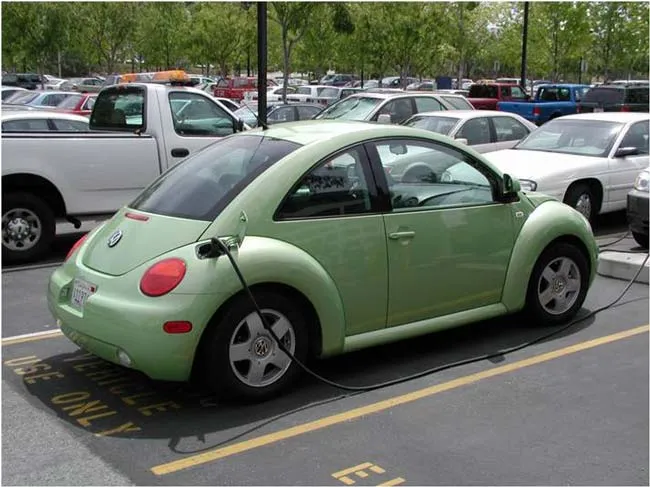
Editor's Note: Each Wednesday LiveScience examines the viability of emerging energy technologies — the power of the future.
Imagine running a parking meter backwards and actually being paid to park your car. Along those lines, electric vehicles might one day make money for their owners by providing electrical storage for the nation's power grid.
The monthly income could add up to a lot more than what you pay for a big-city parking ticket and many moving violations.
The concept, called vehicle to grid (V2G), is based on the fact that your car is typically not being used 90 percent of the time. "What if it could work for you while it sits there?" said Jeff Stein from the University of Michigan.
Of course the car has to plug into a socket, so that electricity can flow both into and back out of the battery. Renting out electrical storage in this way could make electric vehicles more affordable, while also removing the need for backup electricity generators.
Stein and his colleagues have just received a $2 million grant from the National Science Foundation to explore the possibility of V2G technology using plug-in hybrid electric vehicles (PHEVs).
"We want to show that it doesn't have to be a one-way street between vehicles and the grid," Stein told LiveScience. "Utility companies could benefit from having a million batteries for storing electricity."
Get the world’s most fascinating discoveries delivered straight to your inbox.
Grid operations
A network of little batteries spread throughout the grid has certain advantages over a single centralized electrical storage facility. If you can get some of the juice to run your appliances from your neighbor's electric vehicle, then that electricity doesn't have to travel as far.
"Electricity consumption is widely distributed, so it makes sense to inject electricity at multiple sites," explained Tom Gage, CEO of AC Propulsion, a California company that manufactures electric vehicles.
A number of small V2G demonstrations have taken place with cars from AC Propulsion and other companies, but the amount of electricity drawn was insignificant. Even as larger projects come on line, the goal is not to have these batteries on wheels provide the grid's primary (baseload) power, but only extra power to smooth out fluctuations.
Fluctuations can occur in the outlet frequency (60 Hertz in the United States) if supply does not match demand. For this reason, grid operators pay to have extra electricity generators that can respond to any sudden changes in electricity consumption.
This so-called "regulation" power is purchased in blocks of 1 megawatt each. One megawatt could be supplied by 100 or so pure electric vehicles (EVs) or 1,000 or so PHEVs, Gage said. It takes more PHEVs because they have a smaller battery, which is supplemented by a gas-powered engine.
(Typically, an EV can store roughly 30 kilowatt-hours on its battery from which it can supply around 10 kilowatts of electric power, while a PHEV can store about 5 kilowatt-hours and supply around 1 kilowatt, Gage said.)
Because not all the electric vehicles will be plugged in at the same time, studies are currently looking into just how many EVs or PHEVs need to be grouped together to ensure that there will always be 1 megawatt of power available to the grid from the ensemble of vehicles.
Can I charge that?
Simulations have shown that an EV owner could get $300 per month as part of a group of cars that offer their batteries for regulation power, Gage said. A PHEV would presumably earn about a tenth of this rate.
Even with that extra dough, though, no one is going to want to come out to their car and have their battery dead. This is unlikely, Gage said, because the grid operator would only be shuffling power in and out of vehicles, so the net effect would be at most a 20 percent drop.
However, a lot of the details have yet to be worked out for V2G. Gage said there will need to be some long-term field trials to see whether battery life is shortened by the constant ebb and flow of charge between grid and vehicle. And work continues on how best to keep track of which cars are supplying power to the grid and for how long.
Gage thinks it might take five to 10 years for enough electric cars to be on the road and for V2G to be truly viable.
