















What Are Coral Reefs?

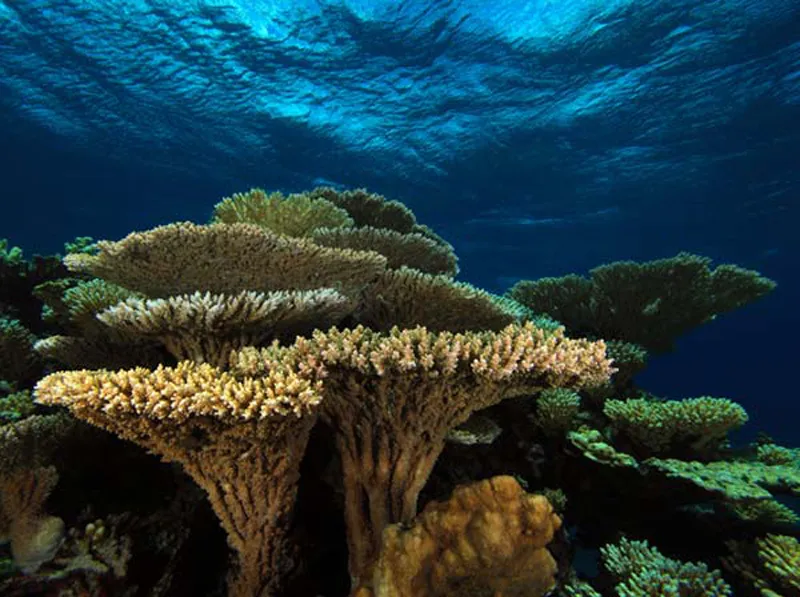
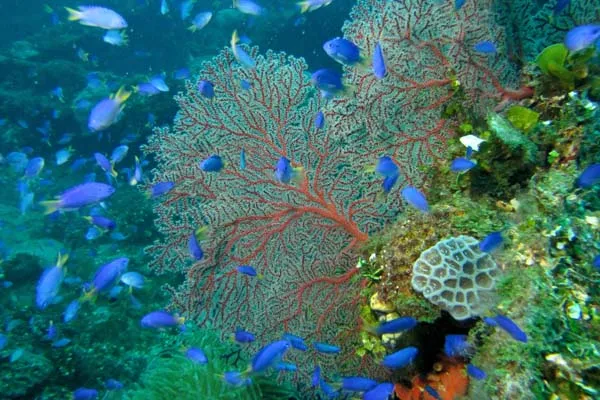
Coral reefs are large underwater structures composed of the skeletons of colonial marine invertebrates called coral. The coral species that build reefs are known as hermatypic, or "hard," corals because they extract calcium carbonate from seawater to create a hard, durable exoskeleton that protects their soft, sac-like bodies. Other species of corals that are not involved in reef building are known as “soft” corals. These types of corals are flexible organisms often resembling plants and trees and include species such as sea fans and sea whips, according to the Coral Reef Alliance (CORAL), a nonprofit environmental organization.
Each individual coral is referred to as a polyp. Coral polyps live on the calcium carbonate exoskeletons of their ancestors, adding their own exoskeleton to the existing coral structure. As the centuries pass, the coral reef gradually grows, one tiny exoskeleton at a time, until they become massive features of the marine environment.
Corals are found all over the world's oceans, from the Aleutian Islands off the coast of Alaska to the warm tropical waters of the Caribbean Sea. The biggest coral reefs are found in the clear, shallow waters of the tropics and subtropics. The largest of these coral reef systems, the Great Barrier Reef in Australia, is more than 1,500 miles long (2,400 kilometers).
Scientists have explored only about 20 percent of the ocean's floor, according to the National Oceanic and Atmospheric Administration (NOAA). As such, ocean explorers continue to discover previously unknown coral reefs that have likely existed for hundreds of years.
The lives of coral
There are hundreds of different species of coral, according to CORAL. Coral have a dazzling array of shapes and colors, from round, folded brain corals (named for their resemblance to a human brain) to tall, elegant sea whips and sea fans that look like intricate, vibrantly colored trees or plants.
Corals belong to the phylum cnidaria (pronounced ni-DAR-ee-uh), a group that includes jellyfish, anemones, Portuguese man o' war and several other gelatinous and stinging marine invertebrates.
Corals feed by one of two ways. Some species catch small marine life, like fish and plankton, by using the stinging tentacles on the outer edges of their bodies. Most corals, however, depend on algae called zooxanthellae to provide energy via photosynthesis.
Get the world’s most fascinating discoveries delivered straight to your inbox.
The corals have a symbiotic, or mutually beneficial, relationship with the zooxanthellae, according to the U.S. Environmental Protection Agency (EPA). These algae live inside the coral polyp's body where they photosynthesize to produce energy for themselves and the polyps. The polyps, in turn, provide a home and carbon dioxide for the algae. Additionally, the zooxanthellae provide the coral with their lively colors — most coral polyp bodies are clear and colorless without zooxanthellae.
Some coral species, such as brain coral, are hermaphrodites, which means they produce eggs and sperm at the same time. Sexual reproduction occurs during a mass coral spawning event that, for some species, happens only once a year.
Other species, such as elkhorn coral, are gonochoric, which means they create colonies composed of either all males or all females. Within each coral colony all the polyps will produce only eggs or only sperm. For successful reproduction, the colony must rely on a neighboring colony that produces the other reproductive cell.
The world of coral reefs
Most of the substantial coral reefs found today are between 5,000 and 10,000 years old, according to CORAL. They are most often found in warm, clear, shallow water where there's plenty of sunlight to nurture the algae that the coral rely on for food.
Coral reefs cover less than 1 percent of the ocean floor — all the reefs combined would equal an area of about 110,000 square miles (285,000 square km), only about the size of the state of Nevada. Nonetheless, they are among the most productive and diverse ecosystems on Earth.
About 25 percent of all known marine species rely on coral reefs for food, shelter and breeding. Sometimes referred to as "the rainforests of the sea" for their biodiversity, coral reefs are the primary habitat for more than 4,000 species of fish, 700 species of coral and thousands of other plants and animals, according to CORAL.
Coral reefs are typically divided into four categories, according to CORAL: fringing reefs, barrier reefs, patch reefs and atolls. Fringing reefs are the most commonly seen reef and grow near coastlines. Barrier reefs differ from fringing reefs in that they are separated from the coastlines by deeper, wider lagoons. Patch reefs typically grow between fringing and barrier reefs on the island platform or continental shelf. The rings of coral that make up atolls create protected lagoons in the middle of the oceans, typically around islands that have sunk back down into the ocean.
Coral reefs under siege
Coral reefs are critical marine habitat on which many ocean species depend. Additionally, coral reefs provide an estimated $30 billion annually in direct economic benefit to people worldwide though food, fisheries and tourism, according to the Hopkins Marine Station of Stanford University.
But coral reefs are imperiled by several threats.
The increasing acidification of the ocean — caused when oceans absorb immense amounts of carbon dioxide released into the atmosphere through the burning of fossil fuels — inhibits coral's ability to produce the calcium carbonate exoskeletons they rely on for shelter.
Water pollution, too, is wreaking havoc on coral reefs. Agricultural pesticides and fertilizers, oil and gasoline, sewage discharge and sediment from eroded landscapes make it difficult for coral to thrive, and therefore damage the complex relationships that exist among the plants, coral and other animals that are part of the reef ecosystem.
As the temperatures of the world's oceans increase due to global warming, coral polyps expel the zooxanthellae they depend on for food. Once the zooxanthellae are gone, the coral loses its brilliant color, and all that can be seen is the white exoskeleton; this is referred to as coral bleaching. Coral colonies subject to bleaching usually die off, according to CORAL.
Fishing practices such as cyanide fishing (spraying cyanide in the water stuns the fish to make them easier to catch), "blast fishing" with explosives and overfishing with trawlers can destroy a thousand-year-old coral reef in a matter of minutes.
"Overfishing, ocean acidification and pollution are pushing coral reefs into oblivion," Roger Bradbury, an ecologist at the Australian National University in Canberra, wrote in his New York Times opinion article. "Each of those forces alone is fully capable of causing the global collapse of coral reefs; together, they assure it."
The future of the Great Barrier Reef
The largest coral reef in the world, the Great Barrier Reef, is home to at least 400 individual species of coral and thousands of different species of fish, mollusks, sea snakes, sea turtles, whales, dolphins, birds and more. As with the other coral reefs of the world, this incredible ecological hotspot is under threat.
A heat wave in 2016 caused a large percentage of the corals in the Great Barrier Reef to undergo severe bleaching and death. A 2018 study in the journal Nature Communications found that in just the northern third of the reef, over 60 percent of the shallow-water corals (those below 49 feet, or 15 meters) experienced some degree of bleaching, and 30 percent of the coral died. The study also found that even in the deeper, less-explored areas of the reef (down to about 131 feet or 40 m), nearly 40 percent of the corals had at least partial bleaching.
Healthy reefs lead to healthy oceans, and healthy oceans are vital to all life on Earth. The destruction facing not only the Great Barrier Reef, but also every reef around the world, can lead to the extinction of thousands of species of marine life. In turn, coastlines currently protected by reefs would more readily flood during storms, some islands and low-lying countries would vanish under the water, and the $30 billion industry that coral reefs provide could collapse.
The Australian government has put forth a long-term plan to sustain the Great Barrier Reef. The plan outlines efforts to greatly reduce and eventually eliminate dumping materials and chemicals, reduce fishing and poaching, and monitor the water quality of run-off directed toward reef.
There are also many attempts to rebuild the reef. Scientists are working to breed stronger species of coral that are less susceptible to the warmer waters and grow at an accelerated rate, reported the New York Times. They grow various coral species in the lab and place them in experimental environments designed to reflect the predicted temperature and acidity of the ocean decades from now.
Another group of coral reef ecologists are experimenting with growing corals on steel frames placed over the damaged parts of a reef. Electrical currents sent through the steel frames, accelerates the corals' growth by three to four times, reported New Scientist. It's possible this technique could help rebuild the reef and make the coral more likely to survive bleaching events.

Rachel Ross is a science writer and editor focusing on astronomy, Earth science, physical science and math. She holds a Bachelor of Arts in Philosophy from the University of California Davis and a Master's degree in astronomy from James Cook University. She also has a certificate in science writing from Stanford University. Prior to becoming a science writer, Rachel worked at the Las Cumbres Observatory in California, where she specialized in education and outreach, supplemented with science research and telescope operations. While studying for her undergraduate degree, Rachel also taught an introduction to astronomy lab and worked with a research astronomer.