Live Science Plus





You are now subscribed
Your newsletter sign-up was successful
Want to add more newsletters?

Delivered Daily
Daily Newsletter
Sign up for the latest discoveries, groundbreaking research and fascinating breakthroughs that impact you and the wider world direct to your inbox.

Once a week
Life's Little Mysteries
Feed your curiosity with an exclusive mystery every week, solved with science and delivered direct to your inbox before it's seen anywhere else.

Once a week
How It Works
Sign up to our free science & technology newsletter for your weekly fix of fascinating articles, quick quizzes, amazing images, and more

Delivered daily
Space.com Newsletter
Breaking space news, the latest updates on rocket launches, skywatching events and more!

Once a month
Watch This Space
Sign up to our monthly entertainment newsletter to keep up with all our coverage of the latest sci-fi and space movies, tv shows, games and books.

Once a week
Night Sky This Week
Discover this week's must-see night sky events, moon phases, and stunning astrophotos. Sign up for our skywatching newsletter and explore the universe with us!
Join the club
Get full access to premium articles, exclusive features and a growing list of member rewards.
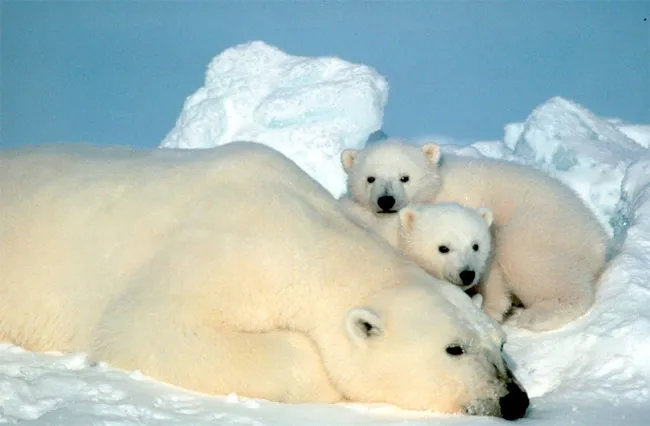
Polar bears, considered doomed if the Arctic sea ice continues to melt, have a fighting chance at survival if humans cut back on their emission of greenhouse gases, according to a new study.
"Our research offers a very promising, hopeful message, but it's also an incentive for mitigating greenhouse emissions," Cecilia Bitz, an atmospheric scientist at the University of Washington in Seattle, said in a statement.
Polar bears were marked as a threatened species in 2008, the year after a study projected that two-thirds of the world's polar bears would be dead within decades if the warming climate kept melting their icy habitat. That study was based on current emissions, according to Steven Armstrup, emeritus researcher with the U.S. Geological Survey, who is also a Polar Bear International senior scientist.
"That was a pretty dire outlook, but it didn't consider the possibility of greenhouse gas mitigation," Armstrup, who led the new study, said in a statement.
Earlier models found that large areas of Arctic ice could disappear in less than a decade. If greenhouse emissions continued as they are now, those studies found, the ice would not recover and could disappear entirely.
Arctic sea ice is crucial to polar bears, providing them access to their favorite food, seals. Without food, polar bears would lose two pounds per day on their way toward starving.
However, the new study, reported Dec. 16 in the journal Nature, finds that if greenhouse gases drop significantly in the near future, bears may not lose their icy hunting grounds. The remaining ice would stay intact through the remainder of the century, and some of the lost ice would re-form, according to the researchers’ new model. That would be enough to ensure the survival of the polar bear species, they wrote.
The 2007 study identified two Arctic regions where polar bears were at particular risk.
"There's still a fairly high probability in both of those regions that polar bears could disappear," Armstrup said. "But with mitigation and aggressive management of hunting and other direct bear/human interactions, the probability of extinction would now be lower than the probability that polar bear numbers will simply be reduced."
- 10 Species Success Stories
- Gallery: The World's Biggest Beasts
- In a Warming Climate, Geese & Polar Bears Strike a Balance
You can follow LiveScience Senior Writer Stephanie Pappas on Twitter @sipappas