 Live Science Plus





You are now subscribed
Your newsletter sign-up was successful
Want to add more newsletters?

Delivered Daily
Daily Newsletter
Sign up for the latest discoveries, groundbreaking research and fascinating breakthroughs that impact you and the wider world direct to your inbox.

Once a week
Life's Little Mysteries
Feed your curiosity with an exclusive mystery every week, solved with science and delivered direct to your inbox before it's seen anywhere else.

Once a week
How It Works
Sign up to our free science & technology newsletter for your weekly fix of fascinating articles, quick quizzes, amazing images, and more

Delivered daily
Space.com Newsletter
Breaking space news, the latest updates on rocket launches, skywatching events and more!

Once a month
Watch This Space
Sign up to our monthly entertainment newsletter to keep up with all our coverage of the latest sci-fi and space movies, tv shows, games and books.

Once a week
Night Sky This Week
Discover this week's must-see night sky events, moon phases, and stunning astrophotos. Sign up for our skywatching newsletter and explore the universe with us!
Join the club
Get full access to premium articles, exclusive features and a growing list of member rewards.
This Valentine's Day, mischievous Cupid will be fluttering about with bow in hand, seeking out mortal hearts to pierce with his love-tinged arrows. But the winged god isn't the only one known for this kind of behavior — oddly, land snails are also known to shoot "love darts."
Land snails belong to the gastropod class, which includes thousands of snail and slug species that sport a wide range of reproductive behaviors.
All land snails are hermaphrodites, meaning that the animals have both male and female reproductive organs. The snails spend their days looking for food and seeking out potential mates using chemical (scent) cues. [Photos: Bizarre Sex Lives of Hermaphrodite Sea Slugs]
"They have eyes at the tips of their tentacles, but they don't really see that well, and their hearing is also pretty much absent," Koene told Live Science. "So one way of finding partners is by locating slime trails that they leave and hopefully following in the right direction."
Courtship and darts
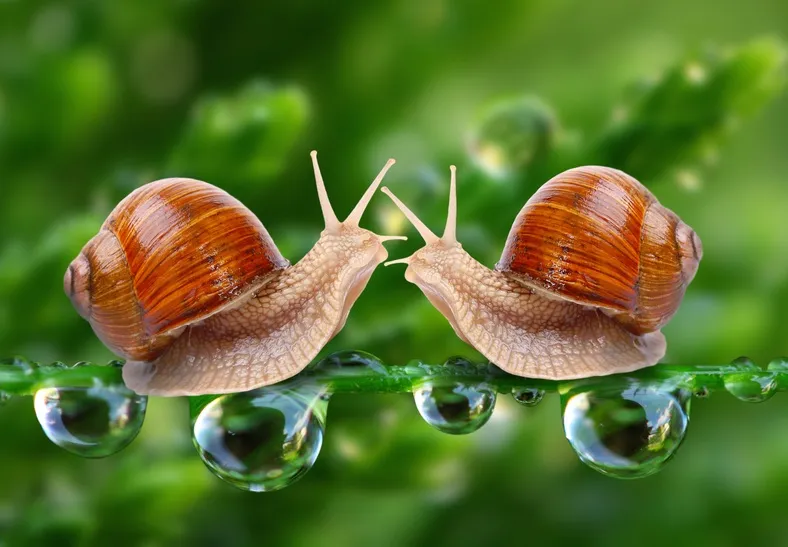
When two adult land snails meet up, they engage in a courtship dance, in which they circle around each other and touch each other with their tentacles. "When you look at them from the top, they look like like yin and yang," Koene said.

During this ritual, the snails look for traits that they find appealing, such as a large body size, which is suggestive of good fitness and being able to invest more energy into egg production.
For many species, the next step in the mating process is to shoot their love darts into each other.
At least nine families of land snails produce love darts, though the exact number really depends on your definition of the structure, Koene said. Some species have dart structures made of hard calcium carbonate (the same material that makes up their shells), while others have softer structures made of a fibrous substance called chitin. "I tend to not call those [chitin structures] love darts," he said.
Though it's said the snails "shoot" their love darts, the calcium carbonate structures don't actually fly through the air. Rather, the love darts are formed within a muscular sac in the body that forcefully everts when a snail comes into contact with its mate, piercing its body and hopefully reaching the hemolymph (bloodlike fluid in invertebrates).
These love darts come in all shapes and sizes — and numbers.
Many species shoot a single dart, while others may shoot multiple darts. Some snails, such as the Japanese species Euhadra subnimbosa, will repeatedly jab their mates with the same dart over and over again for nearly an hour.
In a 2006 study in the journal The American Naturalist, Joene and his colleague Satoshi Chiba found that E. subnimbosa stabs its partner, on average, a staggering 3,311 times.
Improving the odds
When the muscular sac everts, two glands attached to it squirt a kind of mucus onto the dart, which enters the female-acting snail's hemolymph. "This mucus modulates contraction in the female reproductive system," Koene said.

The mucus closes off the entrance to a certain organ in the receptive snail's body that would otherwise "digest" a mate's sperm, allowing more of the sperm to reach the sperm storage organ and increasing the male-acting snail's chance of fatherhood.
Until now, the makeup of this mucus has remained unknown. But in a study published recently in the Journal of Biological Chemistry, Koene and his colleagues identified, for the first time, one of the compounds in the mucus. "We are trying to get some idea of how these compounds evolve, but first you need to know what they are," he said.
After a snail shoots its partner with its love darts, its partner will do the same (sometimes this exchange is done simultaneously).
Next, the pair will copulate by pushing their genital openings together and simultaneously everting their "penises" into each other. They then pass a spermatophore (sperm packets) to one another, a process that can take up to 6 hours. [#JunkOff: Why Animal Genitals Are Important to Science]
After mating, the land snails will go their own ways, and possibly mate with other snails.
But a 2012 study in the journal Animal Behavior found that the love darts of E. quaesita have a secondary function: It makes the snails reluctant to mate again.
Follow Joseph Castro on Twitter. Follow us @livescience, Facebook & Google+.

