













Gassy Blob: Biggest US Methane Source Spotted from Space

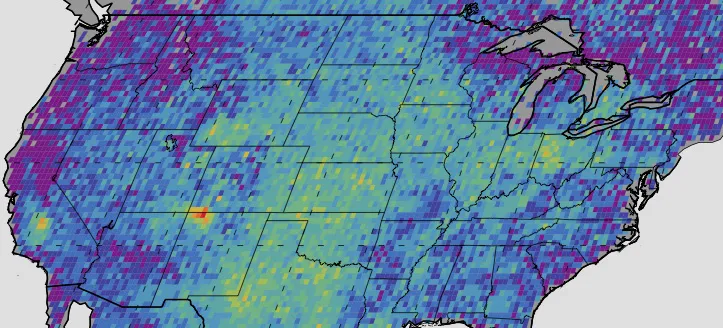
A remote, coal-rich patch of the Southwest produces the highest methane concentrations in the United States, a new study reports.
The methane hotspot is centered over New Mexico's San Juan Basin, where some 40,000 wells suck out natural gas trapped in coal seams. (Natural gas is almost entirely methane.) The tiny patch covers 2,500 square miles (6,500 square kilometers) near the Four Corners intersection of Arizona, Colorado, New Mexico and Utah.
Between 2003 and 2009, the hotspot spewed 0.59 million metric tons (0.65 million tons) of methane each year, scientists report today (Oct. 9) in the journal Geophysical Research Letters. That's about 10 percent of all U.S. methane emissions each year.
The leaks likely come from natural gas drilling and production, the researchers said. The study predates the use of hydraulic fracturing, also known as fracking, in San Juan Basin, lead study author Eric Kort, of the University of Michigan, Ann Arbor, said in a statement. "There's been so much attention on high-volume hydraulic fracturing, but we need to consider the industry as a whole," Kort said.
Methane is one of the four greenhouse gases primarily responsible for global warming. The gas is more effective than carbon dioxide at trapping infrared radiation (the greenhouse effect). However, methane breaks down more quickly, disappearing after about a decade, compared with carbon dioxide's life span of hundreds to thousands of years. [8 Ways Global Warming Is Already Changing the World]
The Environmental Protection Agency (EPA) has come under fire this year from independent scientists and its own inspector general for failing to control methane leaks from natural gas production and distribution.
Recent studies have found that total methane emissions in the United States are nearly twice the amount estimated by the EPA and by the International Emissions Database for Global Atmospheric Research (EDGAR).
Get the world’s most fascinating discoveries delivered straight to your inbox.
The Four Corners methane levels reported in the new study are 1.8 times higher than EPA's "bottom-up" estimates from surveying methane sources on the ground. The mismatch is even higher (3.5 times as much) for the widely used EDGAR database.
Kort and his co-authors measured methane levels in the atmosphere with the European Space Agency's Scanning Imaging Absorption Spectrometer for Atmospheric Cartography (SCIAMACHY) instrument. The measurements were checked against a ground instrument in the Four Corners region that is part of a worldwide greenhouse gas monitoring network.
"Satellite data cannot be as accurate as ground-based estimates, but from space, there are no hiding places," said study co-author Christian Frankenberg, of NASA's Jet Propulsion Laboratory in Pasadena, California.
The natural gas industry is one of the biggest methane emitters in the United States, according to a Feb. 13, 2014, study published in the journal Science. Leaks come from drilling, refining plants and transport and distribution, such as pipelines. While there are about 500,000 wells and some 2 million miles (3.2 million km) of pipeline in the United States, the authors of the earlier Science study said just a small number of "super-emitters" are responsible for most of the leaking methane.
Email Becky Oskin or follow her @beckyoskin. Follow us @livescience, Facebook & Google+. Original article on Live Science.
