 Live Science Plus





You are now subscribed
Your newsletter sign-up was successful
Want to add more newsletters?

Delivered Daily
Daily Newsletter
Sign up for the latest discoveries, groundbreaking research and fascinating breakthroughs that impact you and the wider world direct to your inbox.

Once a week
Life's Little Mysteries
Feed your curiosity with an exclusive mystery every week, solved with science and delivered direct to your inbox before it's seen anywhere else.

Once a week
How It Works
Sign up to our free science & technology newsletter for your weekly fix of fascinating articles, quick quizzes, amazing images, and more
Delivered daily
Space.com Newsletter
Breaking space news, the latest updates on rocket launches, skywatching events and more!

Once a month
Watch This Space
Sign up to our monthly entertainment newsletter to keep up with all our coverage of the latest sci-fi and space movies, tv shows, games and books.

Once a week
Night Sky This Week
Discover this week's must-see night sky events, moon phases, and stunning astrophotos. Sign up for our skywatching newsletter and explore the universe with us!
Join the club
Get full access to premium articles, exclusive features and a growing list of member rewards.
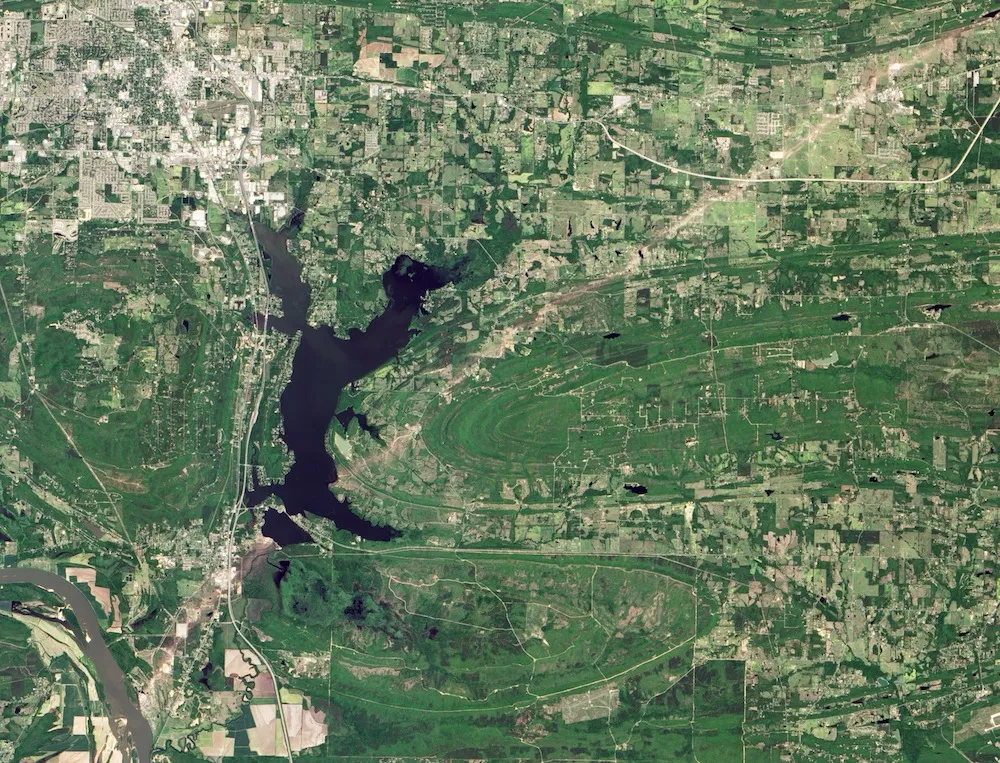
A new satellite image reveals the damage wrought by an EF4 tornado as it tore through Arkansas on April 27.
The tornado track runs from the upper right to the lower left of the image, traveling through the towns of Mayflower and Vilonia, Arkansas. This image, released yesterday (May 6), was taken on May 2 by NASA's Advanced Land Imager on the Earth-Observing-1 satellite, according to NASA's Earth Observatory.
A tornado is born
One storm northwest of Little Rock turned into a supercell storm. In a supercell, a cold front forces warm, moist air to rise. But as this moist air cools and condenses, it creates a downdraft of cold air. When warm updrafts are balanced by cool downdrafts, the storm can churn along for hours — and form tornadoes.
At around 7 p.m. local time on April 27, the supercell northwest of Little Rock did just that. The resulting twister had winds of between 166 and 200 miles per hour (267 to 322 km/h). The estimated wind speeds and high levels of damage gave the tornado a rating of EF4 on the Enhanced Fujita (EF) tornado scale.
The tornado traveled northeast more than 41 miles (66 km) and remained on the ground for an hour. Hundreds of homes were destroyed, some swept entirely from their foundations. Sixteen people died in the tornado, including an Iraq war veteran who died shielding his 5-year-old daughter from a falling beam when their home was destroyed and 7- and 8-year-old brothers whose parents were seriously injured.
The tornado was the deadliest in Arkansas since 1968, according to the NWS.
Weather damage
The Mayflower-Vilonia tornado was not the only twister spawned by the April 27 storm. Another tornado hit Quapaw, Oklahoma, that evening, killing one person before crossing the state line into Baxter Springs, Kansas. Another tornado hit in Tennessee not far from the Alabama state line.
Floods also affected many areas in Arkansas, Missouri, Alabama and Florida as a result of the storm. As the system moved east, it brought moisture to the mid-Atlantic and Northeast, causing localized flooding in Virginia, Maryland and Delaware.
Follow Stephanie Pappas on Twitter and Google+. Follow us @livescience, Facebook & Google+. Original article on Live Science.

