 Live Science Plus





You are now subscribed
Your newsletter sign-up was successful
Want to add more newsletters?

Delivered Daily
Daily Newsletter
Sign up for the latest discoveries, groundbreaking research and fascinating breakthroughs that impact you and the wider world direct to your inbox.

Once a week
Life's Little Mysteries
Feed your curiosity with an exclusive mystery every week, solved with science and delivered direct to your inbox before it's seen anywhere else.

Once a week
How It Works
Sign up to our free science & technology newsletter for your weekly fix of fascinating articles, quick quizzes, amazing images, and more

Delivered daily
Space.com Newsletter
Breaking space news, the latest updates on rocket launches, skywatching events and more!

Once a month
Watch This Space
Sign up to our monthly entertainment newsletter to keep up with all our coverage of the latest sci-fi and space movies, tv shows, games and books.

Once a week
Night Sky This Week
Discover this week's must-see night sky events, moon phases, and stunning astrophotos. Sign up for our skywatching newsletter and explore the universe with us!
Join the club
Get full access to premium articles, exclusive features and a growing list of member rewards.
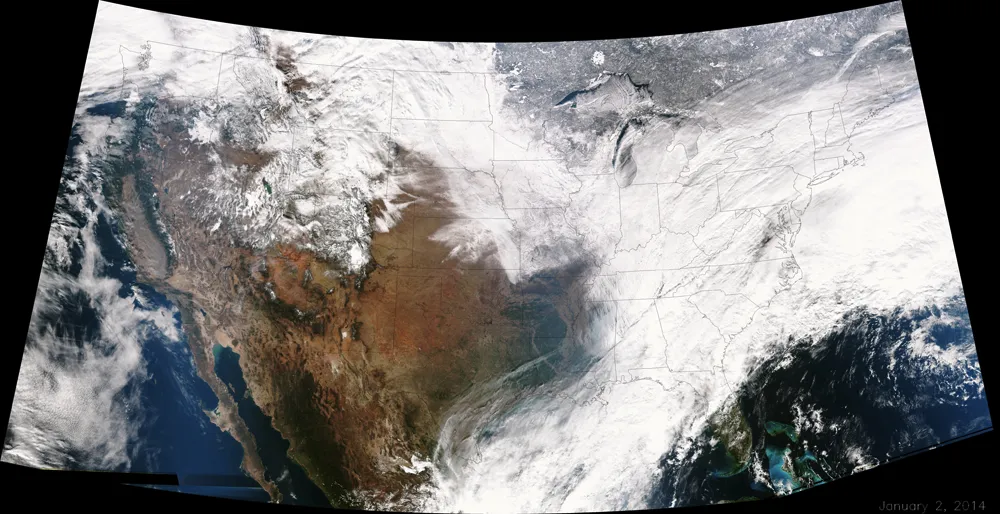
The winter storm that lashed the Midwest and Northeast over the last couple of days and has left a blanket of snow in its wake also brought with it sub-zero, bone-chilling winds that are keeping the snow fresh and frozen. The storm's huge expanse across nearly two-thirds of the country was clearly visible in satellite imagery.
The blizzard — which produced white-out conditions with gusts of winds reaching greater than 39 mph (63 km/h) in some regions — brewed overnight as two weather systems, one bringing cold air from Canada and the other moist air from the Gulf of Mexico, collided over the eastern portions of the country yesterday. [The Snowiest Places on Earth]
"One storm was moving from the west to east with some limited moisture and atmospheric energy and as that storm was moving across the country, it was basically transferring energy to a brand new storm that has taken over and has been strengthening overnight," Chris Vaccaro, a spokesman for the National Weather Service, told LiveScience.
The National Weather Service commonly uses satellite imagery to track the path and extent of storms and to collect atmospheric data that they use to produce storm forecasts. Vaccaro said that, while imagery from this storm is impressive, it is not uncommon to see storms this large at this time of the year.
"It is a disruptive storm on the roads and airports, but we are not necessarily seeing a crippling snowstorm," Vaccaro said, comparing it to a larger blizzard that hit the Northeast in February 2013 and dumped between 2 to 3 feet (0.5 to 1 meter) of snow on parts of New England.
Most accumulation readings for this week's storm have hovered below 12 inches (30 centimeters) across the country this morning, though parts of coastal Massachusetts experienced maritime effects that brought more moisture and dumped closer to 24 inches (60 cm) of powder.
The National Weather Service will continue analyzing National Oceanic and Atmospheric Administration (NOAA) satellite imagery throughout the rest of the day today to track the extent of snow cover, which Vaccaro said should be made easier as clouds part and the storm travels northeastward into the Canadian Maritimes.
Editor's note: This story was update to correct the source of the satellite imagery, which was NOAA.
Follow Laura Poppick on Twitter. Follow us @livescience, Facebook & Google+. Original article on LiveScience.

