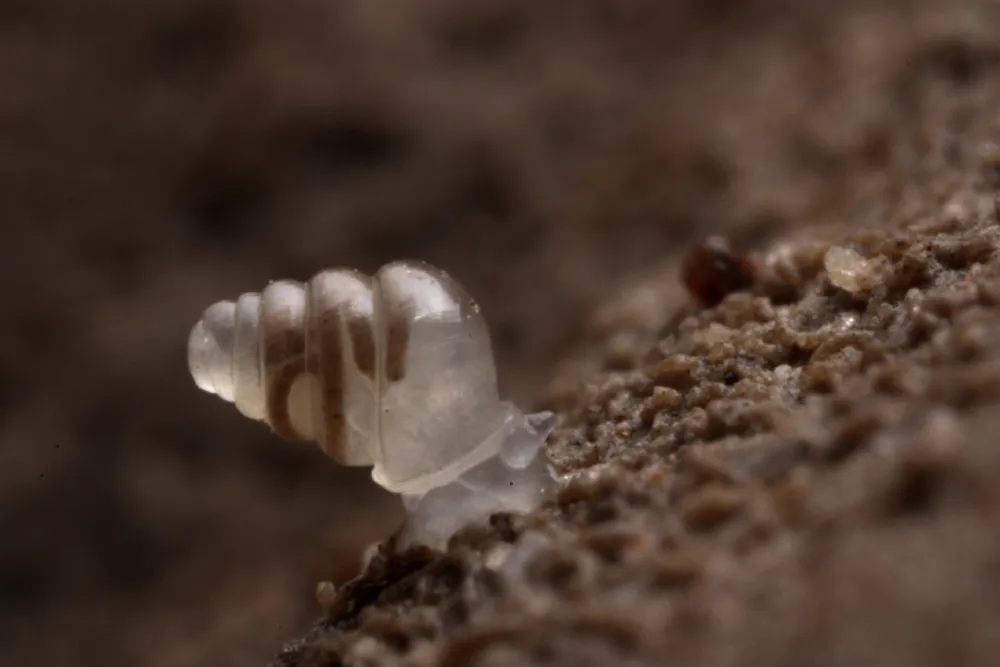
A new snail species with a beautifully translucent shell was recently discovered more than 3,000 feet (914 meters) underground in a Croatian cave.
A team of cavers and biologists with the Croatian Biospeleological Society discovered Zospeum tholussum in the Lukina Jama-Trojama cave systems of western Croatia — one of the 20 deepest cave systems in the world — on an expedition to determine the cave's depth. The team collected all animal specimens found along the way, since deep cave crevices are often promising places to find new species, and happened upon one live sample of the new snail, along with eight empty shells. [The 7 Longest Caves in the World]
The team presented the elegant snail to taxonomist Alexander Weigand at Goethe-University in Frankfurt, Germany, for help in identification. Weigand determined that this particular species had never before been found, but that it is related to other known species.
Different views of the living specimen (solid border) and empty shell (dotted border).
(Image credit: Alexander Weigand, Subterranean Biology)
The new snail and other related species are particularly slow-moving, even by snail standards.
"They only creep a few millimeters or centimeters a week, and mainly in circles, grazing at one point where they live," Weigand said.
Weigand suspects that the snail travels in water currents or catches a ride on other cave animals, such as bats or crickets, to get from one place to another more efficiently.
Laura Poppick is a contributing writer for Live Science, with a focus on earth and environmental news. Laura has a graduate certificate in science communication from the University of California, Santa Cruz, and a Bachelor of Science degree in geology from Bates College in Lewiston, Maine. Laura has a good eye for finding fossils in unlikely places, will pull over to examine sedimentary layers in highway roadcuts, and has gone swimming in the Arctic Ocean.