













Why Doesn't the Moon Have a Name?

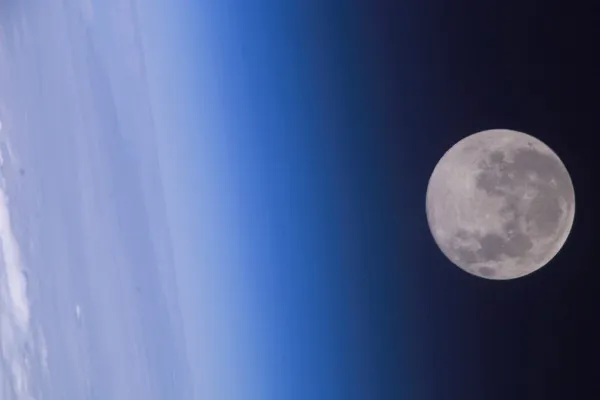
Earth's moon does have a name: In English, it's "the moon." The word moon is Proto-Germanic in origin, deriving from a similar-sounding word that came into use a few thousand years ago in Northern Europe.
For most of human history, there didn't need to be a more specific term to differentiate our moon from other moons that orbit other planets in the solar system, and for good reason: we didn't know there were any other moons. "Until Galileo discovered that Jupiter had moons in 1610, people thought that the moon was the only moon that existed," NASA's lunar science website states.
"After other moons were discovered," the NASA site continues, "they were given different names so that people would not confuse them with each other. We call them moons because they orbit planets the same way that the moon orbits around Earth." [Read: How the Moon Got There ]
The four biggest of Jupiter's 64 moons — the ones discovered by Galileo in 1610 — are named Io, Europa, Ganymede and Callisto.
In Latin, our satellite's name is "Luna." Because a significant chunk of English comes from Latin, many terms associated with the moon are related to this Latin name — for example, the adjective "lunar," and the noun "lunatic," an old-fashioned word for a mentally ill person. (Madness was thought to be correlated with the phases of the moon.)
In Greek, our moon is named "Selene," as is the moon goddess of ancient Greek mythology. The English word "selenology," or the study of the moon's geology, derives from it.
Follow Natalie Wolchover on Twitter @nattyover. Follow Life's Little Mysteries on Twitter @llmysteries, then join us on Facebook.
Get the world’s most fascinating discoveries delivered straight to your inbox.

Natalie Wolchover was a staff writer for Live Science from 2010 to 2012 and is currently a senior physics writer and editor for Quanta Magazine. She holds a bachelor's degree in physics from Tufts University and has studied physics at the University of California, Berkeley. Along with the staff of Quanta, Wolchover won the 2022 Pulitzer Prize for explanatory writing for her work on the building of the James Webb Space Telescope. Her work has also appeared in the The Best American Science and Nature Writing and The Best Writing on Mathematics, Nature, The New Yorker and Popular Science. She was the 2016 winner of the Evert Clark/Seth Payne Award, an annual prize for young science journalists, as well as the winner of the 2017 Science Communication Award for the American Institute of Physics.