Get the world’s most fascinating discoveries delivered straight to your inbox.
You are now subscribed
Your newsletter sign-up was successful
Want to add more newsletters?
Join the club
Get full access to premium articles, exclusive features and a growing list of member rewards.
An account already exists for this email address, please log in.
The moon has been secretly feasting on Earth's atmosphere for billions of years
A new study reveals that tiny fragments of Earth's atmosphere are transported to and absorbed by the moon via gusts of solar wind and our planet's magnetic field, upending a 20-year-old theory based on NASA's Apollo lunar samples.
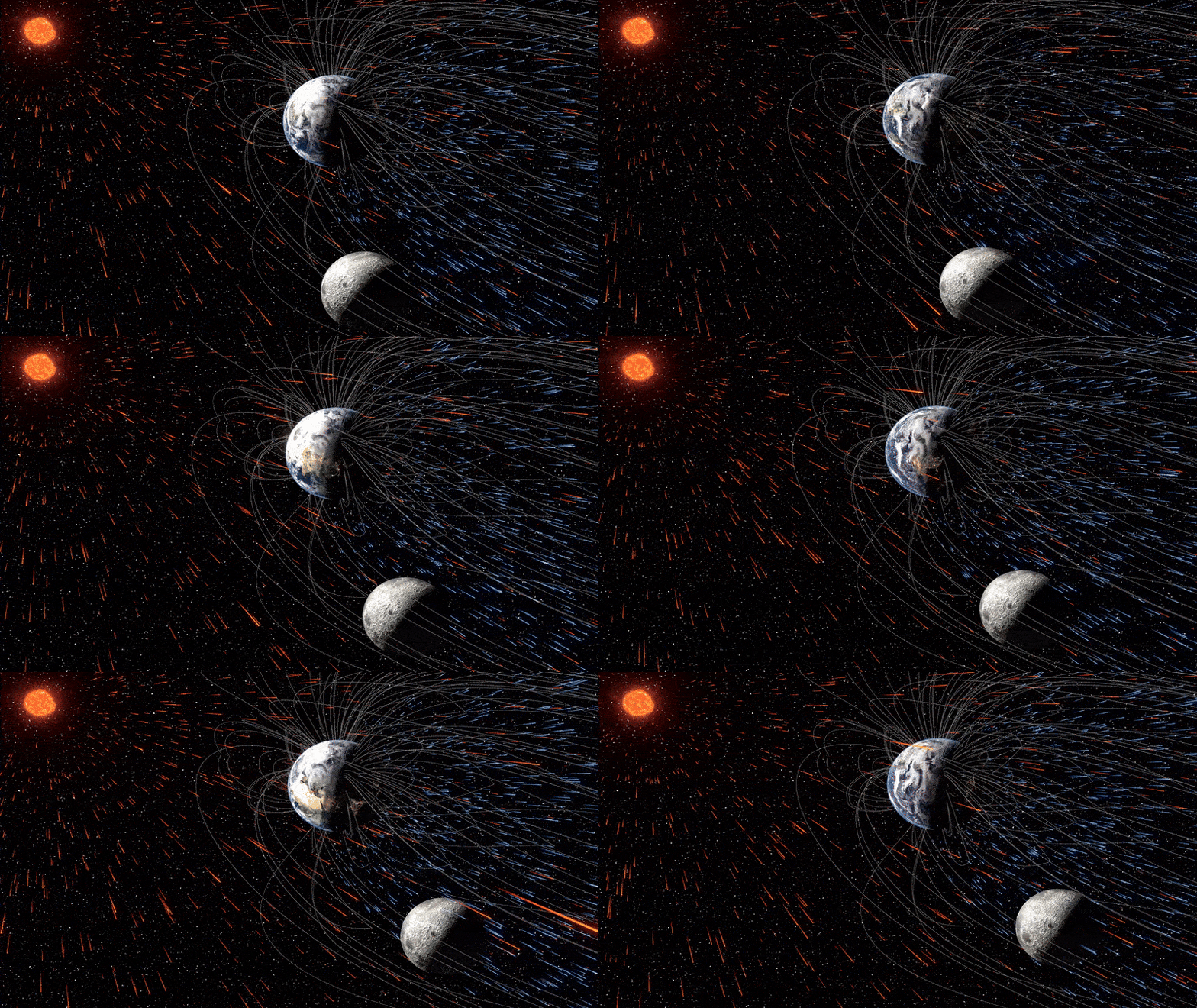
A new study reveals that ions from Earth's atmosphere (blue) get transported to the moon by the solar wind (red) via the invisible magnetic field lines (white) in Earth's magnetic tail. This occurs when our satellite passes through the tail around its "full moon" phase.
(Image credit: University of Rochester illustration / Shubhonkar Paramanick)
The moon is quietly absorbing tiny fragments of Earth's atmosphere — and has been doing so for billions of years, a new study reveals. This surprising case of cosmic cannibalism is thanks to supercharged solar winds and, more importantly, our own planet's magnetic field.
The findings upend a 20-year-old theory about how certain charged particles, known as ions, ended up on the lunar surface, and could have big implications for upcoming moon missions, researchers say.
Ever since NASA's Apollo missions first returned lunar samples to Earth in the early 1970s, scientists have been puzzled by traces of volatiles — substances that vaporize at relatively low temperatures, including water, carbon dioxide, helium, argon, and nitrogen — that they found within the moon's soil, or regolith. It soon became clear that some of these substances, particularly nitrogen ions, had originated from Earth's upper atmosphere and were most likely blown onto the moon by gusts of solar wind. (Recent research has also shown that some volatiles on the moon, such as water, may be created directly by the solar wind and have no terrestrial ties.)
Since 2005, the leading theory suggests that this material transfer could have only happened before Earth developed its magnetic field, or magnetosphere, because this invisible forcefield would have likely trapped any atmospheric ions being blown away from our planet.
However, in the new study, published Dec. 11 in the journal Communications Earth & Environment, scientists combined data from the Apollo samples with computer models simulating the evolution of Earth's magnetosphere, and found that the transfer of atmospheric ions was greatest whenever the moon passes through our planet's magnetic tail — the largest section of the magnetosphere that always points away from the sun. (This alignment occurs when Earth gets between the moon and sun, near the full moon phase each month).
Samples of the lunar regolith have revealed a surprising amount of volatiles, such as nitrogen ions, that likely originate from Earth's atmosphere. This photo shows Apollo 17 astronaut Harrison Schmitt collecting some of these samples in 1972.
(Image credit: NASA/MSFC History Office)
The models revealed that, rather than blocking atmospheric ions from being blown from our planet, the magnetic field lines within Earth's tail act as invisible highways for charged particles, guiding them toward the moon, where they are then settled into the lunar regolith.
This means that the transfer of atmospheric ions likely began shortly after the magnetosphere took shape around 3.7 billion years ago — and is likely still occurring today.
Sign up for the Live Science daily newsletter now
Get the world’s most fascinating discoveries delivered straight to your inbox.
Until now, scientists had assumed that the lunar regolith would only contain traces of Earth's earliest atmosphere. However, the new study suggests that these samples could actually act as a time capsule for our atmosphere and magnetosphere.
"By combining data from particles preserved in lunar soil with computational modeling of how solar wind interacts with Earth’s atmosphere, we can trace the history of Earth's atmosphere and its magnetic field," study co-author Eric Blackman, a theoretical astrophysicist and plasma physicist at the University of Rochester, said in a statement.
Earth's magnetic tail is the most expansive part of the magnetosphere and forms around our planet's night side, opposite to a sun-facing "bow shock" created by solar wind.
(Image credit: NASA/Goddard Space Flight Center Scientific Visualization Studio/AJ Christensen)
As a result, regolith collected during upcoming lunar missions — such as NASA's Artemis program, which aims to put boots on the moon by 2028, and China's moon missions, which have already returned lunar samples to Earth — could help researchers fill in gaps in our planet's geological history.
"Our study may also have broader implications for understanding early atmospheric escape on planets like Mars, which lacks a global magnetic field today but had one similar to Earth in the past," study lead author Shubhonkar Paramanick, a planetary scientist at the University of Rochester, said in the statement. Future research could help scientists "gain insight into how these processes shape planetary habitability," he added.
Harry is a U.K.-based senior staff writer at Live Science. He studied marine biology at the University of Exeter before training to become a journalist. He covers a wide range of topics including space exploration, planetary science, space weather, climate change, animal behavior and paleontology. His recent work on the solar maximum won "best space submission" at the 2024 Aerospace Media Awards and was shortlisted in the "top scoop" category at the NCTJ Awards for Excellence in 2023. He also writes Live Science's weekly Earth from space series.
You must confirm your public display name before commenting
Please logout and then login again, you will then be prompted to enter your display name.