













The Fish That Nearly Sank Isaac Newton's Career

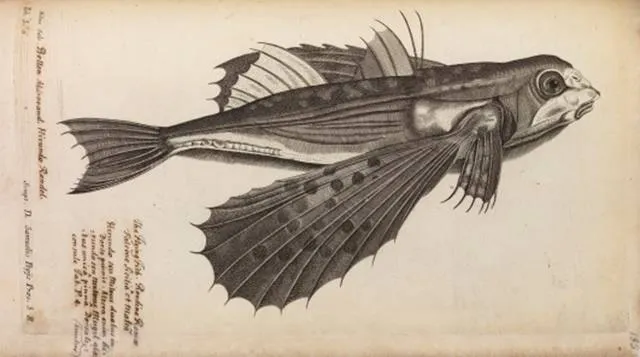
An intricate image of a flying fish is one of hundreds of images now searchable online courtesy of the Royal Society, the United Kingdom's national academy of science.
This striking wood engraving appeared in the 1686 text "Historia Piscium" or "The History of Fishes" by John Ray and Francis Willughby. Now mostly forgotten, the book was groundbreaking for its time. Unfortunately, "The History of Fishes" almost prevented another groundbreaking work from being published: Isaac Newton's "Philosophiae Naturalis Principia Mathematica" ("Mathematical Principles of Natural Philosophy").
The lavish engravings in "The History of Fishes" were so expensive to publish that they nearly bankrupted the young Royal Society, at that time only 26 years old. Short of cash, the Society had to rescind its promise to help pay for the production of Newton's masterpiece.
Fortunately for Newton (and for science), his "Principia" caught astronomer Edmond Halley's eye. Halley would be remembered mainly for computing the orbit of the comet that bears his name, but at the time he was a young Royal Society clerk. Halley took on the "Principia" as a personal project, raising funds (many from his own pocket) to get the work published in 1687. Newton's book included his three laws of motion, which along with his law of universal gravitation, was able to explain the orbits of planets. In fact, his book is still widely considered to be one of the most important scientific works of all time, covering physics and mathematics. [6 Weird Facts About Gravity]
It might seem strange that the Royal Society nearly passed up Newton's work for a book about fish, but the scientific revolution was young, said Jonathan Ashmore, the chair of the Royal Society's library committee.
"Although the Principia may have gone on to achieve lasting fame and glory, we hope that visitors to our new online picture resource will be able to appreciate why early Fellows of the Royal Society were so impressed by Willughby's stunning illustrations of piscine natural history," Ashmore said in a statement.
The new picture library is the first time the Royal Society's image collections have been available online.
Get the world’s most fascinating discoveries delivered straight to your inbox.
The picture library also includes Robert Hooke's 17th-century engravings of microscopic organisms, some of the first images drawn directly from a microscope. There are astronomical illustrations of Captain James Cook's voyages to Tahiti, portraits of various Royal Society scientists and even historical political cartoons satirizing science figures.
You can follow LiveScience senior writer Stephanie Pappas on Twitter @sipappas. Follow LiveScience for the latest in science news and discoveries on Twitter @livescience and on Facebook.

Stephanie Pappas is a contributing writer for Live Science, covering topics ranging from geoscience to archaeology to the human brain and behavior. She was previously a senior writer for Live Science but is now a freelancer based in Denver, Colorado, and regularly contributes to Scientific American and The Monitor, the monthly magazine of the American Psychological Association. Stephanie received a bachelor's degree in psychology from the University of South Carolina and a graduate certificate in science communication from the University of California, Santa Cruz.