Live Science Plus





You are now subscribed
Your newsletter sign-up was successful
Want to add more newsletters?

Delivered Daily
Daily Newsletter
Sign up for the latest discoveries, groundbreaking research and fascinating breakthroughs that impact you and the wider world direct to your inbox.

Once a week
Life's Little Mysteries
Feed your curiosity with an exclusive mystery every week, solved with science and delivered direct to your inbox before it's seen anywhere else.

Once a week
How It Works
Sign up to our free science & technology newsletter for your weekly fix of fascinating articles, quick quizzes, amazing images, and more

Delivered daily
Space.com Newsletter
Breaking space news, the latest updates on rocket launches, skywatching events and more!
Once a month
Watch This Space
Sign up to our monthly entertainment newsletter to keep up with all our coverage of the latest sci-fi and space movies, tv shows, games and books.

Once a week
Night Sky This Week
Discover this week's must-see night sky events, moon phases, and stunning astrophotos. Sign up for our skywatching newsletter and explore the universe with us!
Join the club
Get full access to premium articles, exclusive features and a growing list of member rewards.
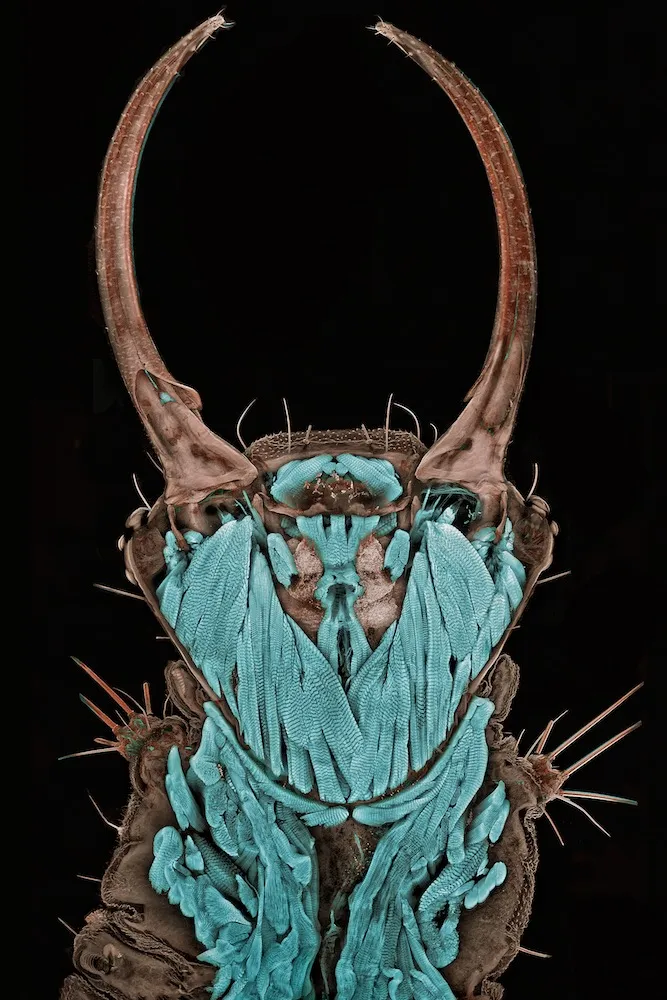
A photo of a tiny teal insect larva with horn-like jaws took top spot at an annual photography competition that focuses on the itsy-bitsy things in life.
The winners of the 2011 Nikon International Small World photography contest were announced Tuesday (Oct. 4), with the winning photograph of a green lacewing larva taken by Igor Siwanowicz of the Max Planck Institute of Neurobiology in Germany. Second prize was an ultra-close look at a blade of grass by Donna Stolz of the University of Pittsburgh. [See a gallery of the winners]
The winning image was the result of a bit of luck for Siwanowicz. The tiny lacewing actually bit the researcher. Instead of swatting it, Siwanowicz plucked the bug off his skin and dropped it into a test tube to photograph later.
"My art causes a dissonance for its viewer — a conflict between the culturally imprinted perception of an insect as something repulsive and ugly with a newly acquired admiration of the beauty of its form," said Siwanowicz, who completed his doctoral studies in protein crystallography but now works in invertebrate photography for research. "My hope is that in some way, my photomicrographs prompt people to realize the presence of cultural programming, question it, and eventually throw it off as an illusion."
Nikon first launched the Small World Competition in 1974. Scientists and photographers of all disciplines enter pictures taken through the microscope called photomicrographs, and a panel of judges picks the top 20, plus honorable mentions, each year.
Award winners this year spanned the gamut from a close-up look at a microchip in neon colors to a delicate black-and-white photograph of a quaking aspen leaf. Gabriel Luna of the University of California, Santa Barbara, won seventh place with a purple-and-red image of mouse nerve fibers. Douglas Moore of the University of Wisconsin won 20th place for his photograph of glassy dinosaur bone cells.
While the panel of judges has had their say, the public still has a chance to pick their favorite photographs. The Small World popular vote contest is open until Oct. 30.
You can follow LiveScience senior writer Stephanie Pappas on Twitter @sipappas. Follow LiveScience for the latest in science news and discoveries on Twitter @livescience and on Facebook.