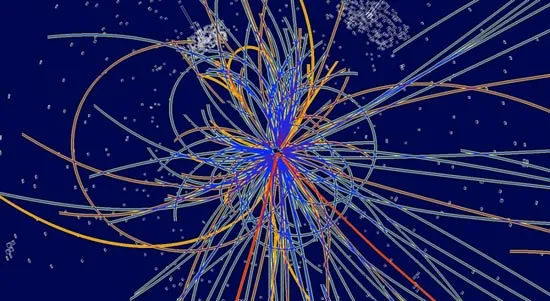
A recent atom smasher experiment may help finally explain why our universe is mostly made of matter, and not its bizarro-universe sibling, antimatter.
Antimatter is a strange kind of stuff with opposite properties from regular matter. When a particle, such as a proton, meets with its antimatter partner, the antiproton, the two annihilate each other in a powerful explosion.
Scientists think the universe was made of roughly equal parts matter and antimatter just after it formed, but these would have quickly destroyed each other. The universe that remains is made of the small surplus of matter that was left over.
Latest Videos From
But why would there have been a surplus of matter to begin with?
To answer that question, scientists sent protons and antiprotons on a collision course in the Fermilab Tevatron particle accelerator in Batavia, Ill. When the particles smashed together, they created debris that included about 1 percent more matter than antimatter. This overabundance may hold clues to the general asymmetry between matter and antimatter in the universe.
"We don't really understand the source of this matter asymmetry," said Don Lincoln, a physicist at Fermilab who worked on the experiment. "The stuff we've observed, we know is just hints. It's not the final story – it doesn't explain everything."
The ratio of matter to antimatter in the experiment was revealed by observing a particular product of the collision, called B mesons. These particles are made up of one quark and one antiquark. B mesons, in turn, decay into other particles, including a type called muons. By studying the kinds of muons created in the collision, the researchers were able to calculate just how much more matter than antimatter resulted.
In fact, the 1-percent relative abundance of matter compared with antimatter in the study was 50 times greater than the small imbalance predicted by the reigning theory of physics, called the Standard Model. If the findings can be confirmed by future experiments, they could point the way toward rewriting the Standard Model, and explaining how our universe came to be.
"We were very surprised," said Fermilab researcher Dmitri Denisov, who led the study along with Stefan Söldner-Rembold of the University of Manchester in the U.K. "It's very exciting. It has direct links to nature, and the attempt of mankind to understand why there is matter around us and not antimatter."
The collisions going on at Fermilab involve some of the most advanced technology available. In particular, the detector used in this project, called DZero, allowed the scientists to reverse the direction of the magnets inside it to compensate for some uncertainties built into the project. This capability enabled the scientists to make measurements more precise than were previously possible.
Still, further verification of the discovery will be needed before the basic laws of physics are rewritten.
"There remains a possibility that we just got unlucky and have a result that looks real, but isn't," Lincoln told LiveScience. "We want the field to verify this, because if it's true, then this will be one of those important measurements that get remembered for all time."
The researchers reported preliminary results, but have refined the findings in two papers published recently in the journals Physical Review Letters and Physical Review D.

 Live Science Plus