

-
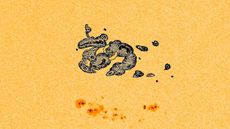 See the 'monster' sunspot that launched the Carrington Event, the most devastating solar storm in recorded history
What did the sun look like before the devastating 1859 Carrington Event? Sketches from astronomer Richard Carrington hold the answer.
the-sun -
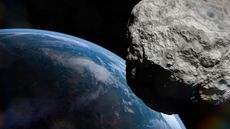 How to watch a 'potentially hazardous' asteroid the size of Earth's tallest building zoom past the planet Sunday
A large, skyscraper-size asteroid will pass close to Earth Sunday night (June 11), missing our planet by a few million miles.
asteroids -
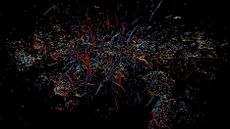 Hundreds of ancient, invisible structures discovered near our galaxy's center
Radio astronomers have discovered hundreds of long, thin structures emanating from our galaxy's supermassive black hole.
black-holes -
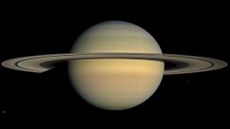 Scientists discover 62 new moons around Saturn, raising total to 145 — the most in the solar system
The discovery of 62 'irregular' moons orbiting Saturn brings the planet’s total to 145 — and hints at a chaotic past.
saturn -
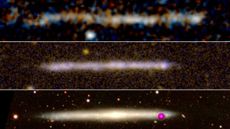 'Runaway black hole,' or sneaky galaxy in disguise? Experts are conflicted.
A rogue black hole may not be to blame for a mysterious streak of stars coursing through space, a new study suggests.
black-holes -
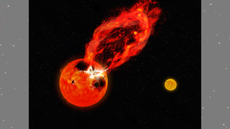 Gargantuan 'superflare' from distant star may have launched one of the strongest solar storms ever seen
Scientists studying a star system in Orion witnessed one of the most powerful stellar eruptions ever seen — and it could be devastating to nearby planets.
the-sun -
 'Hidden' rings of Uranus revealed in dazzling new James Webb telescope images
Astronomers zoomed in on the dusty rings around Uranus in a new series of stunning James Webb Space Telescope images.
planets -
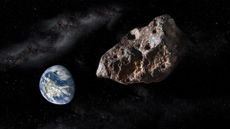 'Potentially hazardous' skyscraper-size asteroid will zip past Earth Thursday
The potentially hazardous asteroid 2023 FM is larger than a 40-story building and will zoom within 7.5 lunar distances from Earth on Thursday, April 6, according to NASA.
asteroids -
 Enormous 'hole' in the sun's atmosphere will trigger stunning auroras Friday
An enormous coronal hole wider than 20 Earths has opened in the sun's atmosphere, and NOAA experts predict a moderate geomagnetic storm Friday (March 24) as a result.
the-sun -
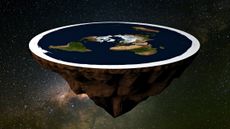 How do flat-Earthers explain the equinox? We investigated.
Equinoxes would be physically impossible over a flat Earth, but that doesn't stop conspiracy theorists from trying to explain them.
conspiracies-paranormal -
 10 discoveries that prove Einstein was right about the universe — and 1 that proves him wrong
Albert Einstein's theories of relativity have been proven to be true time and again in the more than 100 years following their publication.
physics-mathematics -
 Newly discovered asteroid the size of a swimming pool has a 1-in-600 chance of colliding with Earth, NASA says
The newly discovered asteroid 2023 DW could collide with Earth in February 2046, although the odds of an impact are low.
asteroids -
 Ghostly scraps of oldest recorded supernova revealed in stunning telescope image
The National Science Foundation zooms in on the tattered scraps of SN 185, which appeared over our planet 1,800 years ago and was the first supernova ever recorded in Earth's skies.
astronomy -
 NASA confirms success of DART mission, proving humanity can deflect killer asteroids with rockets
Four new studies confirm that NASA's DART mission, which crashed a rocket into the asteroid Dimorphos, changed the asteroid's trajectory and could potentially save Earth one day, given enough time to prepare.
asteroids -
 'Unreal' auroras cover Earth in stunning photo taken by NASA astronaut
NASA astronaut Josh Cassada photographed a gorgeous green aurora from space, capturing the impacts of a solar storm that swept over our planet.
space -
 Jupiter and Venus 'kiss' in a stunning planetary conjunction tonight. Here's how to watch.
On March 1 and 2, Jupiter and Venus will appear side by side in the night sky in an event called a conjunction, which is visible without a telescope or binoculars.
planets -
NASA warns of 3 skyscraper-sized asteroids headed toward Earth this week. Thankfully, they'll all miss.
A trio of enormous asteroids, including two 'potentially hazardous' ones, will cross Earth's orbit around the sun this week, according to NASA. Here's what that means.
asteroids -
 Cosmic 'tadpole' points to ultra-rare black hole hiding near the Milky Way's center
Scientists detected a cloud of gas sculpted into a wonky tadpole shape near the Milky Way's center, possibly pointing to a rare intermediate-mass black hole.
black-holes -
 Why are we seeing so many UFOs over America all of a sudden?
The U.S. military shot down three unidentified objects in a single weekend. Why are America's skies so filled with UFOs all of a sudden?
extraterrestrial-life -
 Enormous 'polar vortex' on the sun is unprecedented, scientists say
A long, looping filament of plasma snapped over the sun's north pole, creating a 'polar vortex' that scientists can't explain.
the-sun -
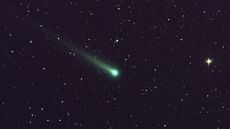 Green comet C/2022 E3 will make its closest approach to Earth in 50,000 years this week. Here's how to watch.
The green comet C/2022 E3 (ZTF) will make a close approach to Earth on Feb. 1/Feb. 2 before sailing off into deep space, possibly never to return.
comets -
 NASA spies Martian rocks that look just like a teddy bear
A broken hill, an ancient crater and the human tendency to find faces everywhere may explain the teddy bear on Mars.
mars -
 South Korea's lunar orbiter unveils jaw-dropping images of Earth and the moon
The Danuri spacecraft arrived in lunar orbit in Dec. 2022, and its first image dump is out of this world.
the-moon -
 Stunning images capture the moment a green comet's tail is blasted away by the sun
An amateur astronomer witnessed the moment that the green comet C/2022 E3 had part of its tail blasted away by a coronal mass ejection.
comets


