













Baby Pterosaurs Could Fly. So, Did They Need Their Parents?

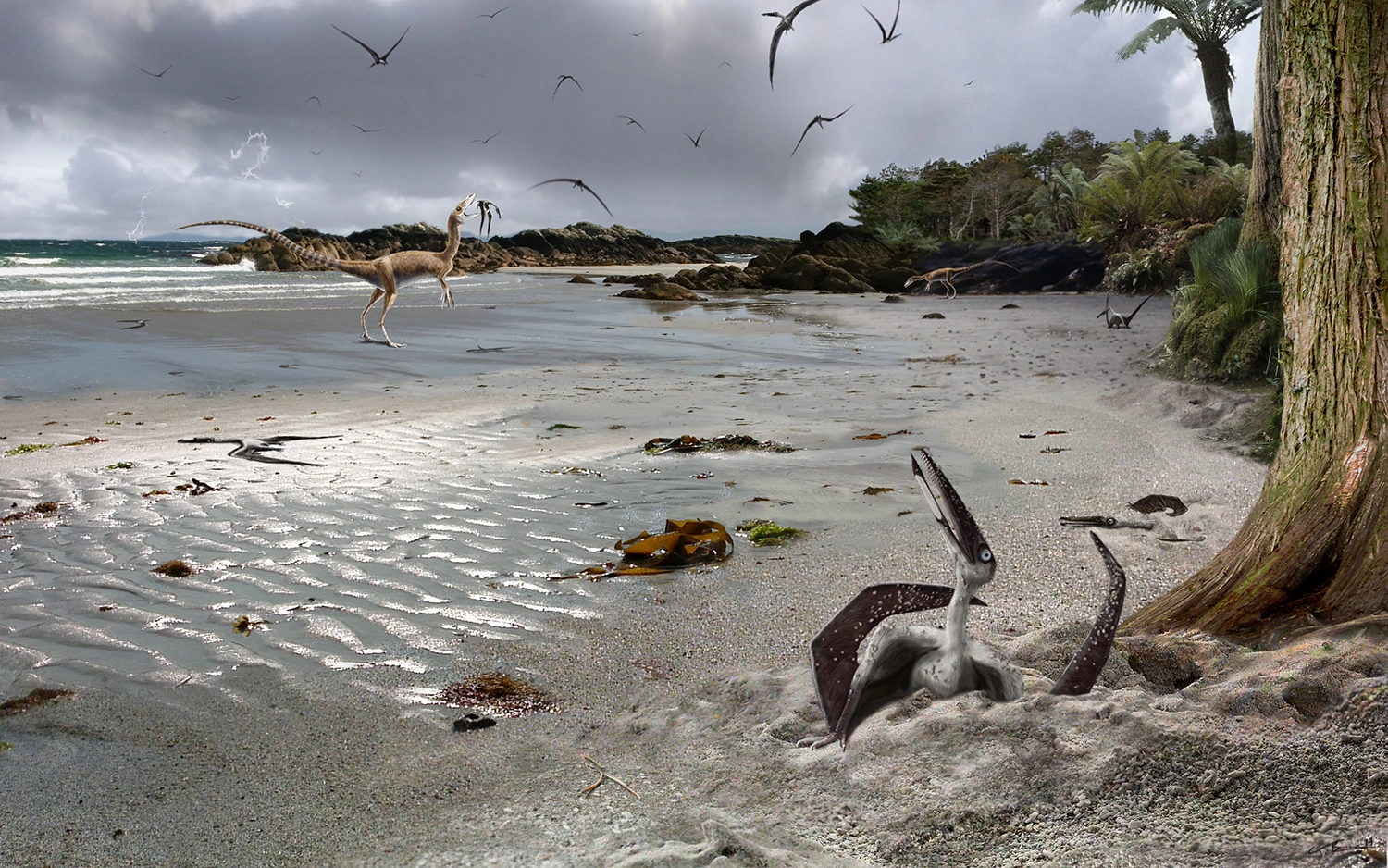
Baby pterosaurs — flying reptiles that lived alongside dinosaurs — were probably able to spread their leathery wings and fly shortly after emerging from their eggs, scientists reported in a new study.
Preserved eggs and embryos from Argentina and China suggested that pterosaur babies, or "flaplings," according to the researchers, had skeletons and wing membranes that were already flight-capable when the flaplings were freshly hatched.
Previously, other researchers had suggested that hatchling pterosaurs' bones and wings weren't developed enough for the animals to take to the air. But this new analysis presents a greater range of developmental stages, delivering a more complete picture of the embryos as they grew. This suggests that embryos described in earlier studies were not yet fully developed; by the time the pterosaurs were ready to hatch, they would be ready to flap away on their own, the authors wrote in the new study. [Photos of Pterosaurs: Flight in the Age of Dinosaurs]
Prior conclusions about flapling flight were also shaped by comparisons with modern animals that fly: birds and bats. Neither of those groups can fly as newborns, so it was thought that newly hatched pterosaurs probably couldn't fly either, lead study author David Unwin, an associate professor with the School of Museum Studies at the University of Leicester in the United Kingdom, told Live Science in an email.
Unwin and co-author D. Charles Deeming, a principal lecturer with the School of Life Sciences at the University of Lincoln in the U.K., examined 19 embryos and 37 eggs from Hamipterus tianshanensis, which had been found in Argentina and China. Some embryos were in middle to late stages of development, while others were fully developed, the study authors reported.

To determine embryonic stages and calculate the pterosaurs' potential wing power, the researchers looked at ossification in the embryos' skeletons; this process shapes the skeletons as the embryos grow. They found that late-stage and near-term embryos had all the skeletal elements required for flight, while hatchlings showed fossilized evidence of wing membranes "with a complex internal structure related to how the membrane is used in flight," Unwin said in the email.
The scientists also discovered that the shapes of the eggs could hold clues about developmental stages. Pterosaurs laid leathery, soft-shelled eggs, like those of modern reptiles. Lizard and snake eggs are known to change their shapes as they absorb water to nourish the embryo over time, increasing the egg's mass, length and width.
Get the world’s most fascinating discoveries delivered straight to your inbox.
According to the study, pterosaur eggs did the same; the shape and size of the eggs could therefore reveal how close they were to hatching. [See Photos of the Remains of Baby Pterosaurs]
"It matches what we know of soft-shelled eggs in living animals," said Michael Habib, an assistant professor of clinical integrative anatomical sciences with the Keck Institute of Medicine at the University of Southern California. Habib, who studies pterosaurs, wasn't involved in the new study.
Powering up
However, questions remain about whether skeletal ossification in the embryos' limbs is a reliable indicator of flight ability, said Armita Manafzadeh, a doctoral candidate in the Department of Ecology and Evolutionary Biology at Brown University in Rhode Island.
"Living birds (and bats) whose limb bones are well-ossified in late embryonic and early post-hatching stages still cannot yet fly — largely invalidating a key premise of the authors' argument," Manafzadeh told Live Science in an email.
According to Manafzadeh, who also wasn't part of this new study, recent research has shown that birds capable of early flight have bones that are well-ossified before and after hatching — yet flight muscles and joint surfaces in these birds' forelimbs change dramatically after they hatch, suggesting that ossification alone is not enough to power their flight.

"It's only after these additional musculoskeletal changes take place that juvenile birds are capable of generating the aerodynamic forces necessary for flight, which is the most power-demanding mode of locomotion, Manafzadeh said.
If flaplings were able to fly after hatching, that could mean that they were able to feed and take care of themselves, negating the need for extensive parental care, the researchers wrote in the study. In that scenario, baby pterosaurs would be active participants in their ecosystems and not helpless hatchlings wholly dependent on their parents. This new perspective has implications for scientists working to reconstruct the environments where pterosaurs lived, Habib said.
If the flaplings could fly right out of the gate, that brings up another challenge: How could they grow and fly at the same time? And how would they weather the metabolic and mechanical demands of flight on their small bodies, Habib asked.
"While our findings help solve one problem, they have also opened up many more interesting questions," Unwin said. "We are only at the beginning of understanding these extraordinary creatures."
The findings were published online June 12 in the journal Proceedings of the Royal Society B.
- Photos: Ancient Pterosaur Eggs & Fossils Uncovered in China
- In Images: A Butterfly-Headed Winged Reptile
- In Photos: Bizarre 'Bat Dinosaur' Discovered in China
Originally published on Live Science.

Mindy Weisberger is a science journalist and author of "Rise of the Zombie Bugs: The Surprising Science of Parasitic Mind-Control" (Hopkins Press). She formerly edited for Scholastic and was a channel editor and senior writer for Live Science. She has reported on general science, covering climate change, paleontology, biology and space. Mindy studied film at Columbia University; prior to LS, she produced, wrote and directed media for the American Museum of Natural History in NYC. Her videos about dinosaurs, astrophysics, biodiversity and evolution appear in museums and science centers worldwide, earning awards such as the CINE Golden Eagle and the Communicator Award of Excellence. Her writing has also appeared in Scientific American, The Washington Post, How It Works Magazine and CNN.