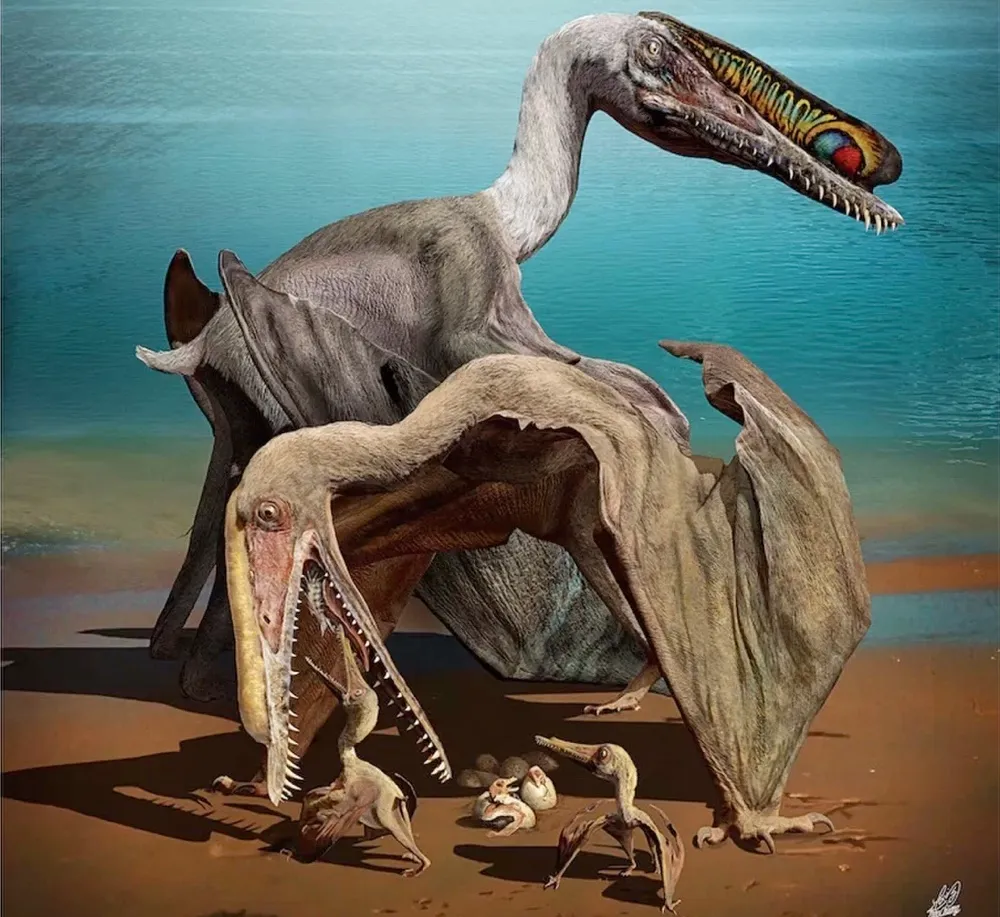
The discovery of 215 fossilized pterosaur eggs has revealed a new finding about the young of these ancient reptiles: Pterosaur babies likely couldn't fly after hatching and probably needed their parents to take care of them.
An examination of 16 embryos within these eggs shows that the little pterosaurs had well-developed thigh bones, suggesting that the reptiles could walk shortly after hatching, according to a new study describing the findings. But because the embryos had underdeveloped bones supporting the pectoral muscle — the muscle that helps power flight — it's unlikely that newborn pterosaurs could fly, the study researchers said.
"Bones related to flight were less developed, or ossified, than bones of the hind limb, which indicates that hatchlings might be able to walk, but not fly," study co-researcher Alexander Kellner, a paleontologist at the National Museum of Brazil and the Federal University of Rio de Janeiro, told Live Science in an email. [Photos: Baby Pterosaurs Couldn't Fly as Hatchlings]
Pterosaurs lived during the dinosaur age, but they weren't dinosaurs. Rather, they were winged reptiles that went extinct when a 6-mile-long (10 kilometers) asteroid slammed into Earth about 66 million years ago. The fact that these flying reptiles laid eggs wasn't confirmed until 2004, when researchers announced that they had found two pterosaur eggs in China and one egg in Argentina that held well-developed embryos, according to D. Charles Deeming, a principal lecturer in the School of Life Sciences at the University of Lincoln in the United Kingdom, who wrote a perspective on the new study, but wasn't involved with the new research.
Researchers found the pterosaur eggs and fossils in a bone bed (literally, a site with many bones) in the Hami region of northwest Xinjiang, China.
(Image credit: Alexander Kellner/Museu Nacional/UFRJ)
Researchers found the newly described trove of pterosaur eggs in the Hami region of Xinjiang, in northwestern China, during a long field survey lasting from 2006 to 2017. In addition to finding the 120-million-year-old eggs, the researchers uncovered fossil remains of male and female pterosaurs known as Hamipterus tianshanensis. (The genus name combines the "Hami" region with "pteros," the Greek word for wing, while the species name honors the Tian Shan mountains, which are near the site of discovery, the researchers said in a 2014 study published in the journal Current Biology.)
The eggs are small — just 2.3 to 3.1 inches (6 to 8 centimeters) long — but they were preserved in three dimensions, meaning that many weren't crushed. To investigate the embryos within, the scientists used a computed tomography (CT) scanner, a machine that takes hundreds of X-rays and then arranges them in a virtual 3D image.
The scans revealed that none of the 16 embryos had teeth, suggesting that either the embryos hadn't developed teeth yet or that dental growth was delayed in H. tianshanensis compared with other modern reptiles, including lizards and crocodiles, the researchers said.
Sign up for the Live Science daily newsletter now
Get the world’s most fascinating discoveries delivered straight to your inbox.
The team also found other evidence that H. tianshanensis was slow to develop. As pterosaurs grew, their bones developed lines that, like the growth rings of a tree, indicated how old they were. The anatomy of one bone from a 2-year-old pterosaur showed that it was still growing at the time of its death, suggesting that these reptiles took a while to reach adulthood, the researchers said.
The egg-cellent discovery also provides clues that these Early Cretaceous pterosaurs nested in colonies, since so many eggs were found together, said study lead researcher Xiaolin Wang, a paleontologist at the Institute of Vertebrate Paleontology and Paleoanthropology at the Chinese Academy of Sciences in Beijing.
"Our study implies colonial breeding for Hamipterus, and indicate[s] that gregarious behavior might have been widespread among derived [more evolved] pterosaurs," Wang told Live Science in an email.
In addition, the eggs themselves revealed hints about egg-laying behavior. The eggs have soft, parchment-like shells, indicating that they needed to be buried in a moist place to keep them from drying out and killing the embryo, Deeming wrote in the perspective. If these eggs were buried, that means the parents didn't sit on them as many modern birds do, he said.
"However, adults may have attended or defended nests, which would explain the presence of adult skeletons [at the site]," Deeming said.
The study was published online today (Nov. 30) in the journal Science.
Laura is the managing editor at Live Science. She also runs the archaeology section and the Life's Little Mysteries series. Her work has appeared in The New York Times, Scholastic, Popular Science and Spectrum, a site on autism research. She has won multiple awards from the Society of Professional Journalists and the Washington Newspaper Publishers Association for her reporting at a weekly newspaper near Seattle. Laura holds a bachelor's degree in English literature and psychology from Washington University in St. Louis and a master's degree in science writing from NYU.