













Perfect Running Pace Revealed
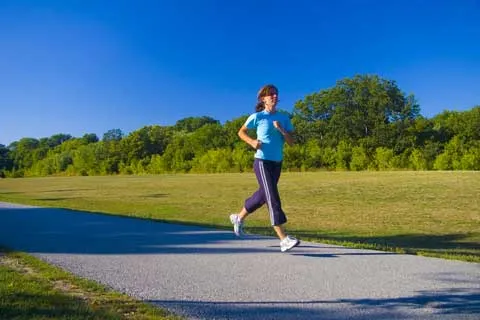
Most regular runners can tell you when they reach that perfect equilibrium of speed and comfort. The legs are loose, the heart is pumping and it feels like you could run at this pace forever.
Researchers at the University of Wisconsin-Madison now have an explanation for this state of running nirvana, and we can thank our ancestors and some evolutionary biology for it.
For years, it has been thought that humans have a constant metabolic energy rate. It was assumed that you would require the same total energy to run one mile, no matter if you ran it in 5 minutes or 10 minutes. Even though your energy burn rate would be higher at faster speeds, you would get there in half the time. Turns out, however, that each person has an optimal running pace that uses the least amount of oxygen to cover a given distance. The findings, by Karen Steudel, a zoology professor at Wisconsin, and Cara Wall-Scheffler of Seattle Pacific University, are detailed in latest online edition of the Journal of Human Evolution.
{{ video="04_Sports" title="Sports in Slow Motion" caption="Balls, skateboards, and some violent sporting mechanisms...At Colorado State, Dr. David G. Alciatore dissects each second up to 10,000x, revealing surprising processes and effects. Credit: Dr. David G. Alciatore/Colorado State University" }}
Steudel's team tested both male and female runners at six different speeds on a treadmill while measuring their oxygen intake and carbon dioxide output. As expected, each runner had different levels of fitness and oxygen use but there were ideal speeds for each runner that required the least amount of energy.
Overall, the optimal speeds for the group were about 8.3 mph (about a 7:13 minutes per mile) for males and 6.5 mph (9:08 min/mile) for females.
The most interesting finding: At slower speeds, about 4.5 mph (13 min/mile), the metabolic efficiency was at its lowest. Steudel explains that at this speed, halfway between a walk and a jog, the runner's gait can be awkward and unnatural. "What that means is that there is an optimal speed that will get you there the cheapest," Steudel says. So, why is a zoology professor studying running efficiency? Steudel's previous work has tried to build a theory of why our early ancestors evolved from moving on four limbs to two limbs, also known as bipedalism. She has found that human walking is a more efficient method of getting from point A to point B than on all fours. It might also have been an advantage for hunting.
Get the world’s most fascinating discoveries delivered straight to your inbox.
This latest research could offer some more clues of how we moved on to running. Steudel explains, "This is a piece in the question of whether walking or running was more important in the evolution of the body form of the genus Homo."
- Video: Sports in Slow Motion
- Walk This Way: The Amazing Complexity of Getting Around
- Robots Learn to Walk Like Humans
Dan Peterson writes about sports science at his site Sports Are 80 Percent Mental.