













Roots of Running Go Way, Way Back
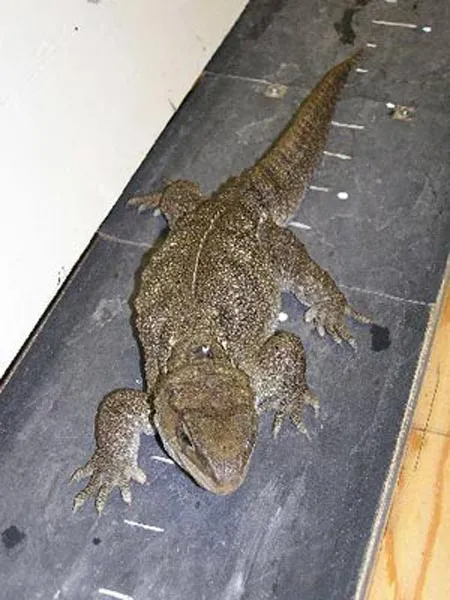
Despite appearing to lumber around, reptiles that have been on this planet longer than any four-legged land creatures can actually run in a manner similar to more modern mammals.
The new finding gives fresh insight to how four-legged animals got around way back when.
Researchers coaxed lizard-like tuataras, the oldest living lineage of four-legged land creatures, onto a treadmill and observed their gaits. A scale measured how much force the animals exerted on the ground with each step.
Do the locomotion
When mammals walk, their center of mass vaults up and over the limbs with each step; when running, the center of mass dips with each step with leg tendons and joints working as biological springs.
The force measurements for both tuataras and salamanders revealed that they can walk and run, despite the outward appearance of a slow, lumbering gait.
Well, at least mechanically they run. Neither of these animals has what it takes to sprint, and their walking and running speeds are virtually identical and require the same amount of energy.
Get the world’s most fascinating discoveries delivered straight to your inbox.
Walking and running are energy-saving mechanisms that scientists generally thought were reserved for fast-running animals such as mammals and birds. Skeletons of ancient land animals have long led scientists to believe that these creatures used energy-inefficient techniques for getting around, perhaps crawling like an inch worm.
Tuataras have been around for 225 million years and haven't changed much, the fossil record shows. Since they can walk and run, both energy-saving mechanisms probably appeared when the first vertebrates moved onto land, said study coauthor Steve Riley of Ohio University. The results are detailed in the March 8 issue of the journal Proceedings of the Royal Society B: Biological Sciences.
Just not turtles
The discovery also suggests that all terrestrial vertebrates can walk and run, except for turtles, which are hindered by their shells.
Tuataras grow up to 2 feet long, have green or brown scales with short spikes on their backs, and have many unique anatomical features that fall somewhere between lizards and birds.
The ornery-looking critters live only in New Zealand, where the cool climate is ideal for their survival. Individuals can live to be a century old. Riley plans more field studies.
"Knowing more about how these animals move in nature is critical to our understanding of vertebrate evolution," he said.
- Mammal Swam with Dinosaurs
- First Four-Legged Animals Inched Along
- Ancient Swimming Reptiles Uncovered
- Why We Walk and Run vs. Hopping and Skipping
- Researchers Find Every Body is Doing the Locomotion
- Yikes! Vampire Bats Can Run, Too