













Air Bag Recall Highlights Need for Smarter Cars

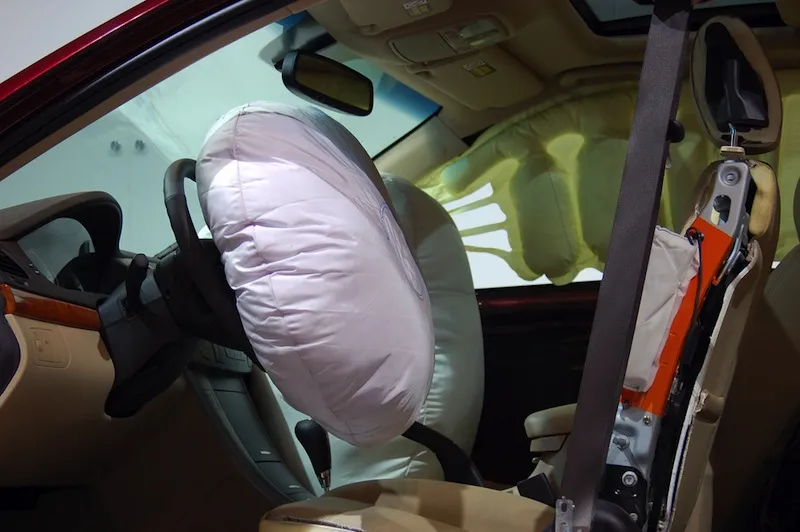
Air bags of the future will react to multiple cues within and outside a car before deploying, making them more adaptable to different types of crashes and reducing the risk of air bag-induced injuries and deaths, researchers say.
Defective air bags manufactured by the Japanese company Takata Corporation have resulted in the largest auto recall in U.S. history, with nearly 34 million vehicles recalled as of last week, according to a statement from the National Highway Traffic Safety Administration (NHTSA).
The faulty air bags can explode with too much force, tearing and potentially spraying shrapnel into the car cabin. Six deaths worldwide have been attributed to the defect, but the root cause of the malfunction has yet to be determined, the NHTSA reported. [9 Odd Ways Your Tech Devices Might Injure You]
But even properly functioning air bags can cause serious injury, including partial blindness, ear damage and sometimes death, depending on a person's size and physical position at the time of a crash.
Safety first
Air bags were introduced in the 1970s but did not become mandated in all U.S. cars until 1998. While air bags have made vehicles safer, the technology has been under scrutiny over the years for the unintended harm they can cause. To address these shortcomings, researchers are now developing smarter air bag systems that deploy with varying amounts of force depending on several factors, including the severity of a crash, where the car's occupants are positioned and the characteristics of the car's occupants.
"A large man driving at a fast speed would need a more forceful deployment than a small woman going at a lower speed," said Matthew Reed, head of the Biosciences Group at the University of Michigan Transportation Research Institute (UMTRI) in Ann Arbor.
Get the world’s most fascinating discoveries delivered straight to your inbox.
So-called multi-stage air bags that adjust pressure within the device already exist in some cars. And that technology is improving, so that it can help control the rate at which gas enters an air bag during a crash, and the rate that gas vents from the bag to absorb the energy of the person hitting it, Reed told Live Science. This could help reduce injuries due to excessive force in the case of low-speed crashes or crashes involving lighter-weight people, Reed said.
Emerging tech
But beyond the benefits of "smarter" air bags, smarter cars promise to help prevent crashes from happening in the first place, said Dan Blower, a UMTRI researcher. For example, sensor-based electronic stability control systems — required in all U.S. vehicles made since 2012 — can detect when a car starts to skid off course and will automatically compensate by gently braking and veering the car back in its intended direction
"Every evaluation I have looked at has shown that this is a big win," Blower said, explaining that this technology has proven to be at least 10 times more effective at preventing crashes than are many previous safety innovations.
Vehicle-to-vehicle communication (V2V) has become another promising and potentially pivotal development, Blower said. This technology allows cars to wirelessly communicate with each other and prevent crashes before they happen.
For example, a broken-down car could theoretically send signals to cars behind it so that those cars start slowing down gradually, avoiding an abrupt stop that could cause a collision. "If your vehicle knew that there was an obstruction up ahead four vehicles, it could let you know and could pre-charge the breaks and start slowing down," Blower said.
The U.S. Department of Transportation plans to propose rules that would mandate V2V in all new cars by the end of 2015, the NHTSA announced last month.
Beyond air bags
While V2V technology follows a technological trend toward increasingly automated vehicles, Reed says the world is still decades away from fully automated vehicles that don't require air bags.
"Anyone who knows anything about automated driving technology knows that it is way far out," he said. "We are still decades away from being able to consider removing air bags."
Even so, Reed said he is optimistic about the direction and speed at which air bag and car safety technology is heading.
"It is a really exciting time," Reed said. "It is possible to know so much more about the type of crash before it even happens, and the more you know about the crash the more you can do to tailor the [air bag] deployment."
Follow Laura Poppick on Twitter. Follow us @livescience, Facebook & Google+. Original article on Live Science.
