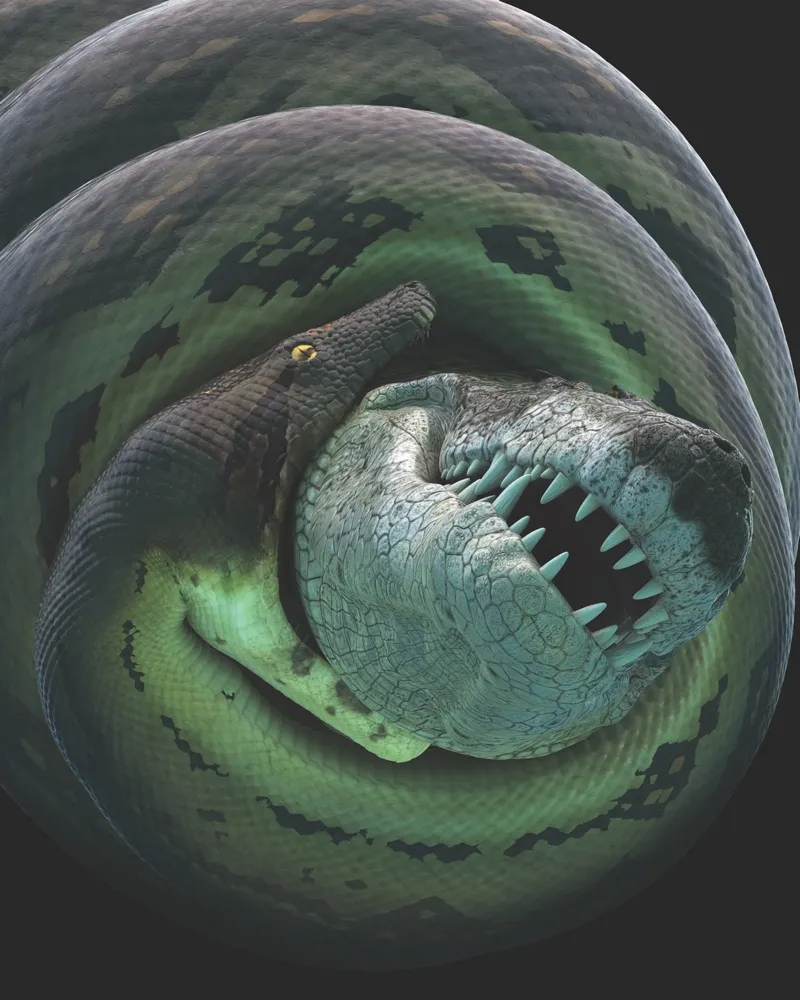
It was 16 feet (4.8 meters) long and tipped the scales at 900 lbs. (408 kilograms). With a blunt snout and powerful bite, it ate turtles and battled monster snakes. Now this extinct dyrosaur, a type of crocodilian, which roamed an ancient rainforest a few million years after the dinosaurs died, has a scientific name.
It's called Anthracosuchus balrogus after the fiery Balrog that lurked deep in the Middle-Earth mines of Moria in J.R.R. Tolkien's novel "The Lord of the Rings."
"Much like that giant beast, Anthracosuchus balrogus was [awakened] from deep within a mine after 60 million years trapped within the rocks of tropical South America," study researcher Jonathan Bloch, associate curator of vertebrate paleontology at the Florida Museum of Natural History, told Live Science in an email. [Image Gallery: 25 Amazing Ancient Beasts]
A specimen of Anthracosuchus balrogus is prepared next to an alligator skull.
(Image credit: Alex Hastings)
Four specimens of the new species were unearthed in a layer of rock in the fossil-rich Cerrejón coal mine of northern Colombia, where scientists previously have found huge turtles with shells as thick as high-school textbooks and skeletons of the world's largest snake, Titanoboa, a 48-foot-long (14.6 m) beast that recently starred in a Smithsonian Channel documentary.
A. balrogus is the third new species of ancient crocodilian found at Cerrejón, scientists say. (Another, Acherontisuchus guajiraensis, was described in the journal Palaeontology in 2011.) The newly named croc belonged to an intrepid family known as the dyrosaurids.
These creatures arose in Africa, paddled across the Atlantic Ocean to South America about 75 million years ago and remarkably survived the mass extinction that wiped out the dinosaurs about 65 million years ago, scientists say. Some dyrosaurid species, such as A. balrogus, adapted to freshwater ecosystems like the rainforest of Cerrejón, which was much warmer and swampier 60 million years ago than it is today.
"This group offers clues as to how animals survive extinctions and other catastrophes," Alex Hastings, a postdoctoral researcher at Martin Luther Universität Halle-Wittenberg and former graduate student at the Florida Museum of Natural History, said in a statement. "As we face climates that are warmer today, it is important to understand how animals responded in the past. This family of crocodyliforms in Cerrejón adapted and did very well despite incredible obstacles, which could speak to the ability of living crocodiles to adapt and overcome."
Sign up for the Live Science daily newsletter now
Get the world’s most fascinating discoveries delivered straight to your inbox.
Hastings and colleagues described the new species last month in the journal Historical Biology. Compared with its cousins, A. balrogus has an unusually short, blunt snout. Paired with the large jaw muscles that are characteristic of dyrosaurids, this feature would give A. balrogus an incredibly powerful bite, Hastings explained.
"It quickly became clear that the four fossil specimens were unlike any dyrosaur species ever found," Hastings said. "Everyone thinks that crocodiles are living fossils that have remained virtually unchanged for the last 250 million years. But what we're finding in the fossil record tells a very different story."
Megan has been writing for Live Science and Space.com since 2012. Her interests range from archaeology to space exploration, and she has a bachelor's degree in English and art history from New York University. Megan spent two years as a reporter on the national desk at NewsCore. She has watched dinosaur auctions, witnessed rocket launches, licked ancient pottery sherds in Cyprus and flown in zero gravity. Follow her on Twitter and Google+.