 Live Science Plus






5 Strange Sightings in the Peruvian Amazon
You are now subscribed
Your newsletter sign-up was successful
Want to add more newsletters?

Delivered Daily
Daily Newsletter
Sign up for the latest discoveries, groundbreaking research and fascinating breakthroughs that impact you and the wider world direct to your inbox.
Once a week
Life's Little Mysteries
Feed your curiosity with an exclusive mystery every week, solved with science and delivered direct to your inbox before it's seen anywhere else.

Once a week
How It Works
Sign up to our free science & technology newsletter for your weekly fix of fascinating articles, quick quizzes, amazing images, and more

Delivered daily
Space.com Newsletter
Breaking space news, the latest updates on rocket launches, skywatching events and more!
Once a month
Watch This Space
Sign up to our monthly entertainment newsletter to keep up with all our coverage of the latest sci-fi and space movies, tv shows, games and books.
Once a week
Night Sky This Week
Discover this week's must-see night sky events, moon phases, and stunning astrophotos. Sign up for our skywatching newsletter and explore the universe with us!
Join the club
Get full access to premium articles, exclusive features and a growing list of member rewards.
Deep in the Peruvian Amazon lurk strange creatures and unique animals and sights, including spiders that make large spider-shaped decoys in their webs, unusually hairy caterpillars and atmospheric specters called solar halos.
These amazing finds were spotted by Jeff Cremer, marketing director for Rainforest Expeditions, an ecotourism company that hosts guests in the Peruvian Amazon and organizes trips to the jungle, as well as Phil Torres, a collaborating biologist.
1. Spider-shaped decoys
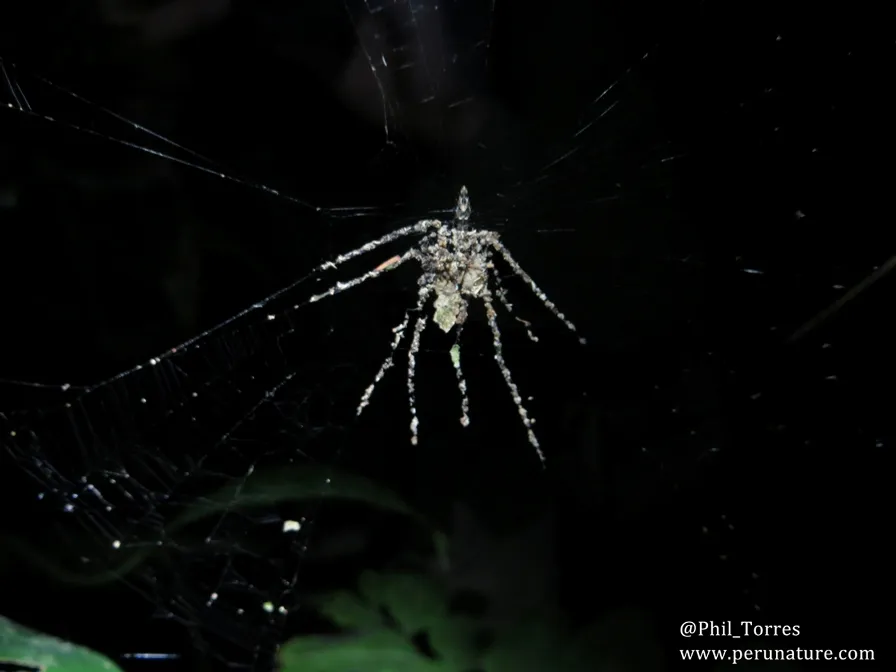
As if spiders weren't frightening enough (to many, anyway), here's a spider that makes designs in its webs that look like spiders, but are much larger than the web-builders themselves. The animal is almost certainly a new species, said Torres, in a release from Rainforest Expeditions. It's thought that the spider-shaped design is a defense mechanism that is meant to distract or confuse predators, wrote Torres, who originally spotted the spiders.
"Because of the spider's behavior and appearance, I thought that it might be a new species," Torres said in the statement. "After contacting spider experts, we think it is likely in the genusCyclosa, which is known for piling debris in its web for defense against predators but has never been recorded to do it in such a defined pattern as this particular discovery."

2. Macaw clay lick
In the middle of the jungle is an exposed hillside with a special type of sodium-rich clay, upon which nine species of parakeets, parrots and macaws feed, according to Cremer. The trace minerals in the clay cannot be obtained anywhere else in the area or from their usual food sources, so the birds flock there in large numbers to ingest small amounts of clay, he said.

3. Basket cocoon
Inside the delicate mesh of a basketlike web, a young urodid moth larva waits to grow to maturity.
"This cocoon is unlike any other I've come across," writes Torres on the blog TheRevScience. "I couldn't find a lot of literature on these guys, but my best guess is the almost 1-foot-long (30 centimeters) silk string it hangs from and the detailed lattice structure would do well to protect against ants while minimizing investment in an all-encompassing cocoon as many moths have."

4. Bizarre puss caterpillar
This strange-looking chap is a larval form of a flannel moth, also known as a puss caterpillar. But don't be fooled by their soft-looking hair: Many flannel moth species' spiny hairs are poisonous.
The insect also resembles the toupee of a rather famous financier. "We found Donald Trump's wig in the Peruvian Amazon," Cremer joked.

5. Solar Halos
These amazing solar halos were spotted above the Tambopata River, and may be the most spectacular photo of the phenomenon ever photographed, Cremer said. These halos are caused by refraction and reflection of the sun's rays by ice crystals high in the atmosphere, in cirrus clouds.
Email Douglas Main or follow him @Douglas_Main. Follow us @OAPlanet, Facebook or Google+. Original article on LiveScience's OurAmazingPlanet.

