













Musical Focus: New Speakers Don't Bother Bystanders

Experts have invented a way for audiophiles to listen to music over loudspeakers that don't annoy people standing nearby.
"You may soon be able to enjoy audio without those uncomfortable earphones or headsets and not bother your neighbors," said researcher Chan-Hui Lee at the Korea Advanced Institute of Science and Technology.
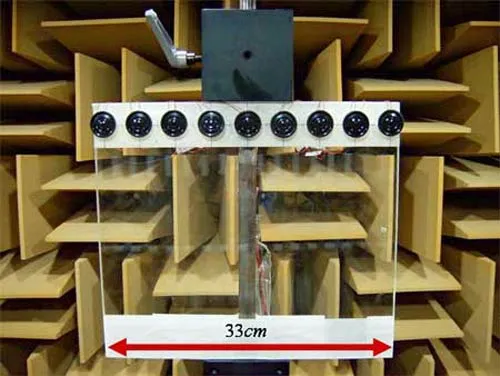
The "personal sound system " that Lee and his colleagues envision focuses sound waves from several loudspeakers onto a listening zone. Outside this zone, the sound waves would be much less audible.
The researchers devised a simple prototype involving half-inch speakers, nine of which were arranged in a row 13 inches (33 centimeters) long. They found there was a 20-decibel or more difference in sound intensity between the listening zone and outside it — the difference between, say, a normal conversation and a whisper.
Lee and his colleagues suggest personal sound systems could find use with laptops and televisions. "But the ultimate goal are mobile phones and PDA systems," Lee told LiveScience.
To fit personal sound systems on portable devices such as mobile phones, obviously smaller speakers are needed. Unfortunately, such speakers generally do not broadcast the wide range of audio frequencies personal sound systems need. "The research there is ongoing," Lee said.
If such portable systems are ever devised, people might listen in, say, by holding players in front of them, although the exact design still needs to be worked out, Lee added.
Get the world’s most fascinating discoveries delivered straight to your inbox.
The researchers detailed their findings Nov. 30 at the Acoustical Society of America meeting in New Orleans.
- Video: The Next Step with Richard Hart
- Planet Earth 2007: Top 10 Science Revelations
- Sound Pulses Exceed Light Speed
