Origin of Vision Discovered
Get the world’s most fascinating discoveries delivered straight to your inbox.
You are now subscribed
Your newsletter sign-up was successful
Want to add more newsletters?
Delivered Daily
Daily Newsletter
Sign up for the latest discoveries, groundbreaking research and fascinating breakthroughs that impact you and the wider world direct to your inbox.
Once a week
Life's Little Mysteries
Feed your curiosity with an exclusive mystery every week, solved with science and delivered direct to your inbox before it's seen anywhere else.
Once a week
How It Works
Sign up to our free science & technology newsletter for your weekly fix of fascinating articles, quick quizzes, amazing images, and more
Delivered daily
Space.com Newsletter
Breaking space news, the latest updates on rocket launches, skywatching events and more!
Once a month
Watch This Space
Sign up to our monthly entertainment newsletter to keep up with all our coverage of the latest sci-fi and space movies, tv shows, games and books.
Once a week
Night Sky This Week
Discover this week's must-see night sky events, moon phases, and stunning astrophotos. Sign up for our skywatching newsletter and explore the universe with us!
Join the club
Get full access to premium articles, exclusive features and a growing list of member rewards.
You are reading these words right now because 600 million years ago, an aquatic animal called a Hydra developed light-receptive genes—the origin of animal vision.
It wasn't exactly 20-20 vision back then though.

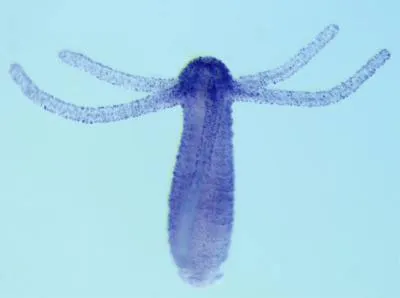
Hydras, a genus of freshwater animals that are kin to corals and jellyfish, measure only a few millimeters in diameter and have been around for hundreds of millions of years.
Scientists at the University of California, Santa Barbara studied the genes associated with vision (called opsins) in these tiny creatures and found opsin proteins all over their bodies.
Though they don't have eyes or any specific light-receptive organs, researchers think that the light-sensing proteins concentrated in the mouth area of the Hydras help them to use light sensitivity to search out prey.
Because studies of animals that evolved earlier, such as sponges, don't show the same light sensitivity, scientists were able to pinpoint the Precambrian date that animal vision first started to evolve.
"We now have a time frame for the evolution of animal light sensitivity," said study leader David Plachetzki, a UC Santa Barbara graduate student. "We know its precursors existed roughly 600 million years ago.
Get the world’s most fascinating discoveries delivered straight to your inbox.
These findings, detailed in a recent issue of the online journal PLoS ONE, counter arguments by anti-evolutionists that evolution can only eliminate traits and cannot produce new features, the authors say.
“Our paper shows that such claims are simply wrong," said co-author Todd Oakley, also a UC Santa Barbara biologist. "We show very clearly that specific mutational changes in a particular duplicated gene (opsin) allowed the new genes to interact with different proteins in new ways. Today, these different interactions underlie the genetic machinery of vision, which is different in various animal groups.”
- Top 10 Amazing Animal Abilities
- Top 10 Useless Limbs (and Other Vestigial Organs)
- Images: Incredible Coral

Andrea Thompson is an associate editor at Scientific American, where she covers sustainability, energy and the environment. Prior to that, she was a senior writer covering climate science at Climate Central and a reporter and editor at Live Science, where she primarily covered Earth science and the environment. She holds a graduate degree in science health and environmental reporting from New York University, as well as a bachelor of science and and masters of science in atmospheric chemistry from the Georgia Institute of Technology.