Huge Lava Collapse Rings in Hawaii's New Year
Get the world’s most fascinating discoveries delivered straight to your inbox.
You are now subscribed
Your newsletter sign-up was successful
Want to add more newsletters?
Delivered Daily
Daily Newsletter
Sign up for the latest discoveries, groundbreaking research and fascinating breakthroughs that impact you and the wider world direct to your inbox.
Once a week
Life's Little Mysteries
Feed your curiosity with an exclusive mystery every week, solved with science and delivered direct to your inbox before it's seen anywhere else.
Once a week
How It Works
Sign up to our free science & technology newsletter for your weekly fix of fascinating articles, quick quizzes, amazing images, and more
Delivered daily
Space.com Newsletter
Breaking space news, the latest updates on rocket launches, skywatching events and more!
Once a month
Watch This Space
Sign up to our monthly entertainment newsletter to keep up with all our coverage of the latest sci-fi and space movies, tv shows, games and books.
Once a week
Night Sky This Week
Discover this week's must-see night sky events, moon phases, and stunning astrophotos. Sign up for our skywatching newsletter and explore the universe with us!
Join the club
Get full access to premium articles, exclusive features and a growing list of member rewards.
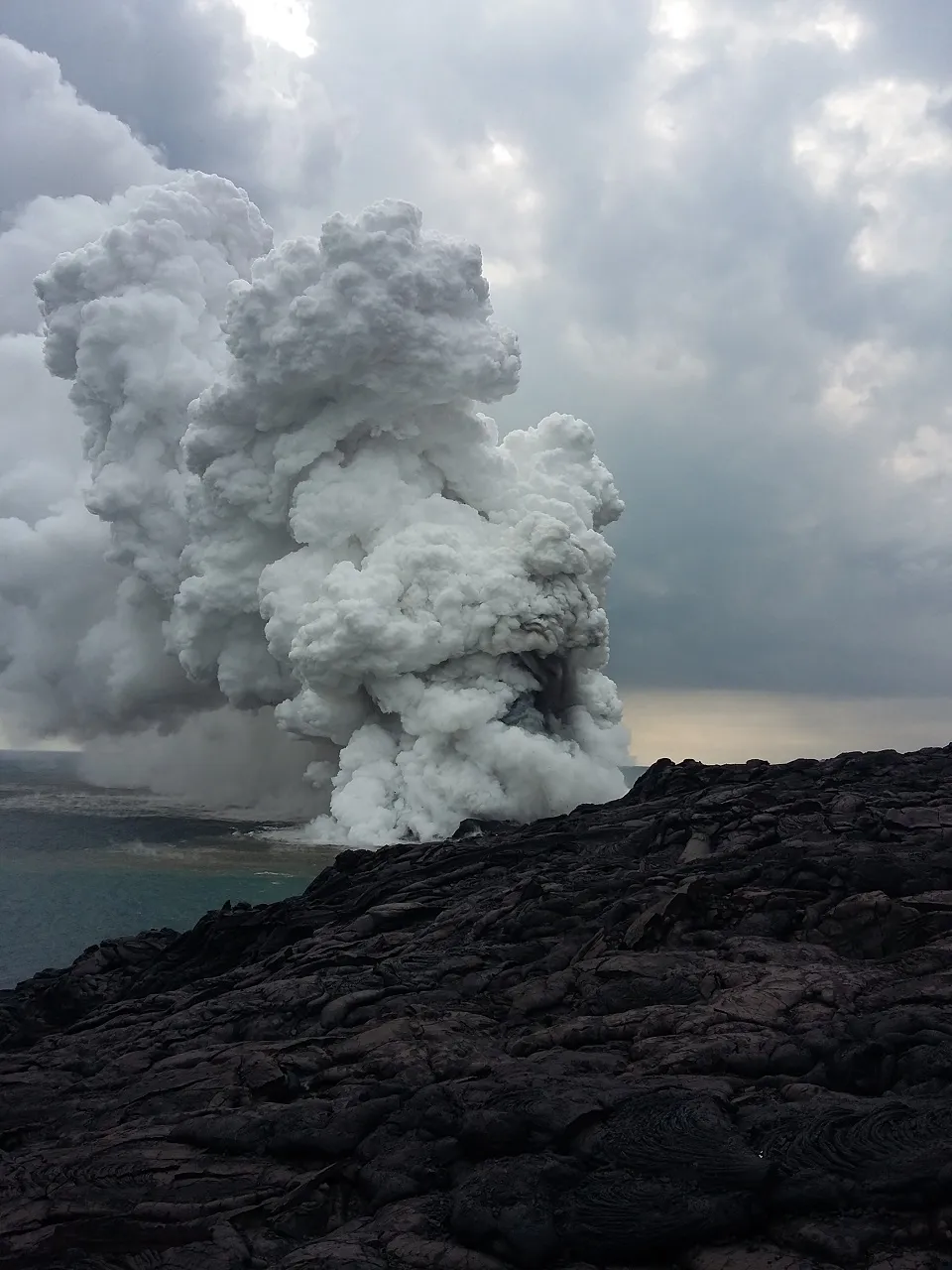
A lava delta — an expanse of unstable rocky terrain formed by cooled lava — in Hawaii Volcanoes National Park collapsed suddenly into the ocean on New Year's Eve, creating a spectacle of volcanic ash, steam and gas to mark the end of 2016.
The 26-acre (11 hectares) delta was created by a recent and massive lava flow from the Kilauea volcano pouring into the sea. The feature's collapse produced towering plumes of ash and sent large waves washing over and eroding the nearby sea cliff, according to the U.S. National Park Service (NPS). [Explosive Images: Hawaii's Kilauea Erupts for 30 Years]
Loud cracks throughout the area were audible after the collapse, which destroyed a public viewing area, park rangers reported in a statement.
After the explosive event, the Kamokuna ocean entry, where the lava met the sea, was closed to the public, and a temporary flight restriction prohibited air travel 1,000 feet (305 meters) above ground level, NPS officials said.
No one was harmed when the delta gave way, though the power of the fracturing rock was considerable, said Park Superintendent Cindy Orlando.
"Fortunately, there were no aircraft or boats reported in the area at the time of the collapse, nor were any visitors on the delta itself, which is closed for public safety," Orlando said in the statement.
"Had anyone been close by on land, water or air, lives would have surely been lost," she added.
Get the world’s most fascinating discoveries delivered straight to your inbox.
However, several tourists experienced an uncomfortably close call hours after the delta collapsed, when they snuck past a barricade to get a closer look at the lava.
Around 7 p.m. local time on Dec. 31, hours after the initial collapse, five park visitors crossed a closure line placed by park rangers and made their way toward the cliffs. Two park rangers chased the visitors down and returned them to safety; the cliff where they had been standing dropped into the sea 15 minutes later.
"It was a really close brush with death for them," Eruption Crew Ranger Travis Delimont said in a statement. "Luckily, they finally listened to us and turned around in time."
Original article on Live Science.

Mindy Weisberger is a science journalist and author of "Rise of the Zombie Bugs: The Surprising Science of Parasitic Mind-Control" (Hopkins Press). She formerly edited for Scholastic and was a channel editor and senior writer for Live Science. She has reported on general science, covering climate change, paleontology, biology and space. Mindy studied film at Columbia University; prior to LS, she produced, wrote and directed media for the American Museum of Natural History in NYC. Her videos about dinosaurs, astrophysics, biodiversity and evolution appear in museums and science centers worldwide, earning awards such as the CINE Golden Eagle and the Communicator Award of Excellence. Her writing has also appeared in Scientific American, The Washington Post, How It Works Magazine and CNN.