













Chimps Outsmart Humans in Simple Strategy Game
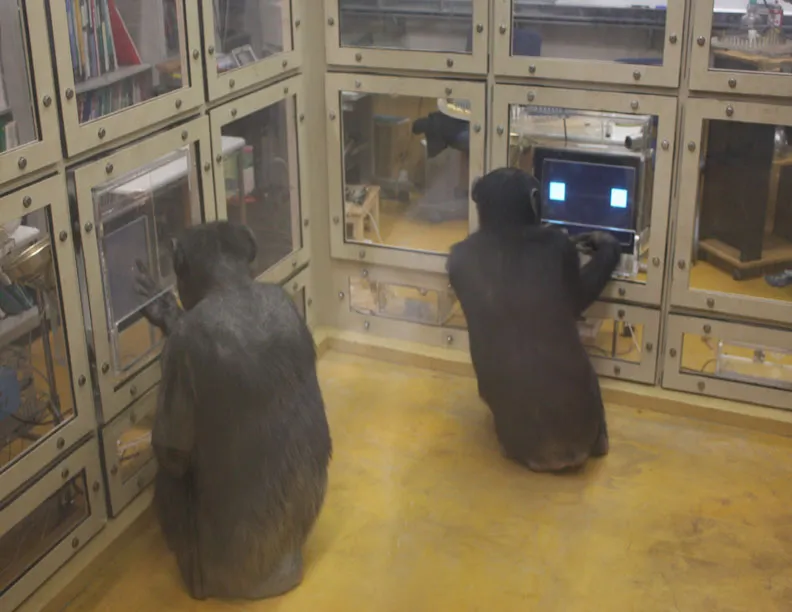
Don’t underestimate the brainpower of a chimp — new research suggests chimpanzees are better than humans at some simple strategy games.
The researchers had chimps play a game in which the animals sat back to back facing computers and took turns selecting one of two blue boxes on the screen. The computer revealed each player’s choice to their opponent, and the player then had to predict what their opponent’s next selection would be based on the last choice. The chimps learned the game more quickly compared to undergraduate students who also played in a separate round.
The game was based on game theory — a field that examines how individuals devise the best strategy based on their opponents' moves in a competitive situation. It's a principle found in many aspects of daily life, from business to sports. When a soccer player decides what angle to take a penalty kick by anticipating the goalie’s response, or a person tries to negotiate a job offer with their boss, these individuals engage in game theory. [Video: Chimps Learn Game Quicker Than Humans]
The researchers speculated that the chimps were able to play so well because they have strong short-term memory and talents for pattern recognition, and they have evolved to be highly competitive.
"Fights with other chimps and dominance hierarchies are central to their lives," said Rahul Bhui, a graduate student at the California Institute of Technology who co-authored the study.
Humans, on the other hand, have evolved to strategize and compete using language — a skill they were not able to use in this silent game, Bhui said. Communicating through language is central to how humans coordinate win-win outcomes.. "We have language and widespread cooperation which [chimps] don't need to worry about, and maybe that impairs our performance in these simple competitions,” said Bhui. “Maybe these were costs we paid for other abilities."
Past research has shown that chimps have excellent short-term memories. In 2013, a Japanese researcher presented a videoof a chimp recalling the exact sequence and location of numbers that had flashed briefly on a screen.
Get the world’s most fascinating discoveries delivered straight to your inbox.
The new findings give researchers an even better understanding of chimpanzees.
"The fact that chimpanzees track their opponents more carefully, [and] gain a competitive edge when they can, illustrates how all species can be surprisingly well adapted to challenges which are crucial for their lives, and less important for [humans]," said Colin Camerer, a behavioral economist at Caltech. "It should humble us a little."
In game theory, there is a limit to how many times a strategic game can be won based on how well a person can predict his or her opponent's move — a concept called the Nash equilibrium, named after mathematician John Forbes Nash Jr. (portrayed by Russell Crowe in the film "A Beautiful Mind"). The researchers found that the chimps were so good at the game that they came very close to hitting the theoretical limit for how many times the game can be won.
Next, the researchers will look at games that involve both competition and cooperation, as well as games with a number of stages, to see how well chimps' short-term memory can help them cooperate.
The study was published online June 5 in the journal Scientific Reports.
Follow Jillian Rose Lim @jillroselim & Google+. Follow us @livescience, Facebook & Google+. Original article on Live Science.