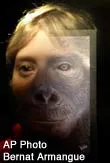
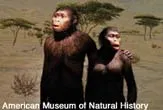
The evolutionary process that Charles Darwin discovered almost 150 years ago, responsible for transforming dinosaurs into birds and allowing the walking ancestors of whales to take to the seas, is still quietly at work in humans today.
Darwin's natural selection is the process by which nature rewards those individuals better adapted to their environments with survival and reproductive success. It works at the level of genes, sections of DNA that encode for proteins serve as the software of life.
In one of the most detailed human DNA studies ever conducted, researchers analyzed nearly 12,000 genes from 39 people and a chimpanzee, our closest living relative.
The findings suggest that about 9 percent of the human genes examined are undergoing rapid evolution.
"Our study suggests that natural selection has played an important role in patterning the human genome," said Carlos Bustamante, a biologist at Cornell University.
A separate study announced last month indicated the human brain is still evolving, too.
Compared to chimps ...
Sign up for the Live Science daily newsletter now
Get the world’s most fascinating discoveries delivered straight to your inbox.
Bustamante's team found that the genes most affected were those involved in immunity, sperm and egg production and sensory perception. A comparison between human and chimpanzee genomes found that these genes have undergone more changes in humans than in chimps, despite the fact that the two species shared a common ancestor some 5 million years ago.
The genes for a group of proteins important for switching other genes on and off, known as "transcription factors," were found to vary significantly in humans and chimps. One reason for this could be that turning a gene on or off is easier than changing the gene itself.
"We believe that if you want to evolve a system, it's usually easier to tweak when the protein gets turns on or the total amount of a protein as opposed to the amino acid itself," Bustamante said.
Negative selection
The validity of Darwin's natural selection has been attacked lately by a small but vocal group who argue that it cannot explain all the complexity seen in nature. They advocate a concept called "intelligent design," in which a higher being is responsible for the variety of life. Scientists dismiss intelligent design as cloaked creationism and say that there are no significant problems with the widely accepted theory of evolution.
While mainstream scientists do not need further evidence that natural selection occurs, Bustamante's work provides examples of its pace and extent and offers the promise of medical advances down the road.
Another 13 percent of the genes examined in the study showed evidence for negative selection, whereby harmful mutations are weeded out of the population. These included some genes implicated in hereditary diseases, such as muscular dystrophy and Usher syndrome. The latter is the most common cause of congenital blindness and deafness in developed countries.
Medical geneticists are interested in finding genes sensitive to negative selection because they might one day be useful for predicting an individual's likelihood of developing a disease if the types of mutation to a gene and the environmental conditions are known.
Being able to determine which classes of genes are particularly vulnerable to negative selections is a first step, Bustamante said.
The findings were detailed in the Oct. 20 issue of the journal Nature.