














One Year Ago Today: Future Superstorm Sandy Formed

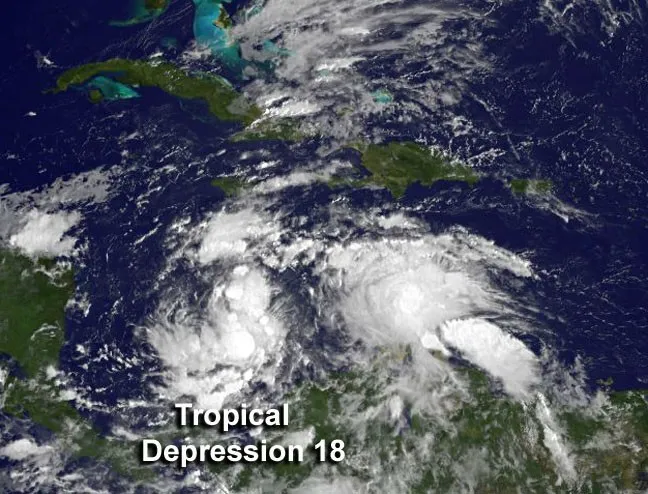
One year ago today, the weather system that would later become Superstorm Sandy, first formed as Tropical Depression 18 in the Caribbean Sea. Before the day was out, it had strengthened into Tropical Storm Sandy, the 18th named storm of the 2012 Atlantic hurricane season.
Two days later, the storm hit Jamaica as a Category 1 hurricane, where it caused millions of dollars in damage. It re-emerged over the warm ocean waters and rapidly strengthened into a Category 3 storm, making it the second major hurricane of the season. After traveling over Cuba, Sandy was weakened, and meandered across the Bahamas, before moving parallel to the U.S. East Coast and regaining strength. It regained hurricane status and became a Category 2 storm before becoming an extratropical cyclone (one powered by the temperature difference across a storm front, instead of the warm water and convection that fuel tropical cyclones).
Sandy made landfall near Atlantic City, N.J., around 8 p.m. EDT on Oct 29, 2012. It caused significant storm surge and flooding along the Jersey coast and up through New York City and along Long Island. Sandy's surge came in part from its considerable size — it was the second largest Atlantic tropical cyclone on record. (Tropical cyclone is the generic term used to describe hurricanes, typhoons and tropical storms.)
Follow Andrea Thompson @AndreaTOAP, Pinterest and Google+. Follow us @livescience, Facebook & Google+.
Get the world’s most fascinating discoveries delivered straight to your inbox.

Andrea Thompson is an associate editor at Scientific American, where she covers sustainability, energy and the environment. Prior to that, she was a senior writer covering climate science at Climate Central and a reporter and editor at Live Science, where she primarily covered Earth science and the environment. She holds a graduate degree in science health and environmental reporting from New York University, as well as a bachelor of science and and masters of science in atmospheric chemistry from the Georgia Institute of Technology.