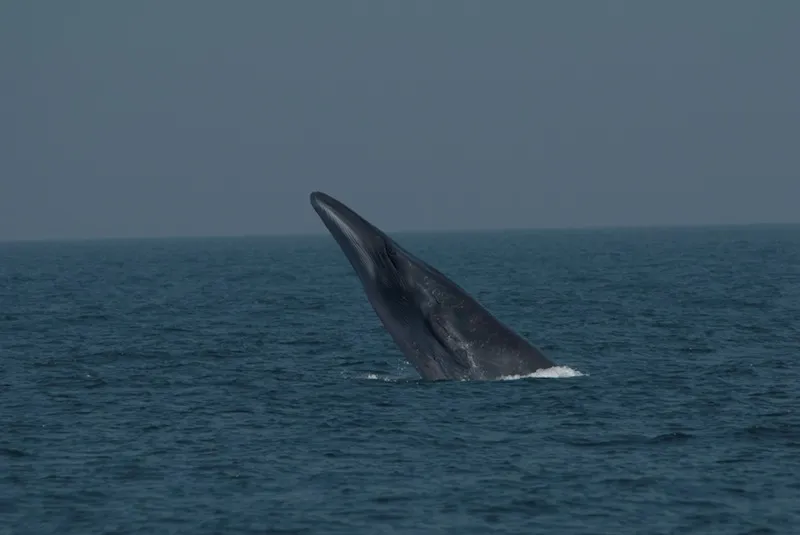
The poorly understood Bryde's whale presents a conservation conundrum for biologists, but genetic fingerprints could finally help researchers keep tabs on the species and protect vulnerable populations.
Bryde's whales (pronounced BREW-dus) are listed as "data deficient" by the International Union for Conservation of Nature (IUCN), the world's main authority for the conservation status of wildlife.
The 50-foot-long (15 meters) whales seem to be widespread; they can be found in tropical, subtropical, and warm temperate waters of the Atlantic, Pacific and Indian Oceans. But little is known about the distribution of their populations, their range, and their subspecies, which makes it difficult for scientists to determine whether they might be endangered by ship strikes, Japan's scientific whaling fleets or other environmental threats, according to the Wildlife Conservation Society. [Whale Album: Giants of the Deep]
Latest Videos From
Genetics could help bridge these gaps and help researchers identify which groups of Bryde's whales are in need of protection.
Columbia University researcher Francine Kershaw and colleagues took mitochondrial DNA samples from 56 whales from waters off Oman, the Maldives and Bangladesh. They did this by collecting skin samples from living whales using small biopsy darts and by harvesting samples from dead whales that had washed ashore. The researchers also examined existing data sets that were available from Java, Japan and the northwest Pacific.
In their study, the scientists found that there are actually two subspecies of Bryde's whales: a larger one that roams offshore waters and a smaller one that lives in more coastal marine habitats.
Among the larger offshore populations, there seemed to be genetically distinct groups in the Maldives, Java and the northwest Pacific, the study found. Though the differences may not warrant separate taxonomic distinctions, the researchers argue that each of these populations should be considered a discrete conservation unit for management purposes. Meanwhile, the more coastal Bryde's whales had extremely low genetic diversity, with just a single maternal line shared among the 45 whales sampled in Bangladesh and Oman. The authors say this group should be designated a separate conservation unit from inshore Bryde's whales off Japan.
"The ability to delineate different populations and subspecies of Bryde's whales — particularly ones threatened by low numbers and genetic diversity — will help management authorities prevent the loss of unique and distinct genetic lineages and distinct populations," study researcher Howard Rosenbaum, director of the Wildlife Conservation Society's Ocean Giants program, said in a statement.
The research was detailed in the latest edition of the Journal of Heredity.
Follow Megan Gannon on Twitter and Google+. Follow us @livescience, Facebook & Google+. Original article on Live Science.

 Live Science Plus