 Live Science Plus





You are now subscribed
Your newsletter sign-up was successful
Want to add more newsletters?

Delivered Daily
Daily Newsletter
Sign up for the latest discoveries, groundbreaking research and fascinating breakthroughs that impact you and the wider world direct to your inbox.

Once a week
Life's Little Mysteries
Feed your curiosity with an exclusive mystery every week, solved with science and delivered direct to your inbox before it's seen anywhere else.

Once a week
How It Works
Sign up to our free science & technology newsletter for your weekly fix of fascinating articles, quick quizzes, amazing images, and more

Delivered daily
Space.com Newsletter
Breaking space news, the latest updates on rocket launches, skywatching events and more!
Once a month
Watch This Space
Sign up to our monthly entertainment newsletter to keep up with all our coverage of the latest sci-fi and space movies, tv shows, games and books.

Once a week
Night Sky This Week
Discover this week's must-see night sky events, moon phases, and stunning astrophotos. Sign up for our skywatching newsletter and explore the universe with us!
Join the club
Get full access to premium articles, exclusive features and a growing list of member rewards.
When it comes to feet, the earliest known bird species had more in common with Velociraptors than cardinals.
Modern bird feet have a hind toe that points backward and helps the birds perch on branches, power lines, and pirates' shoulders. And until a recent discovery of an extremely well preserved skeleton of the earliest known bird species, Archaeopteryx, scientists believed it too had a "perching toe."
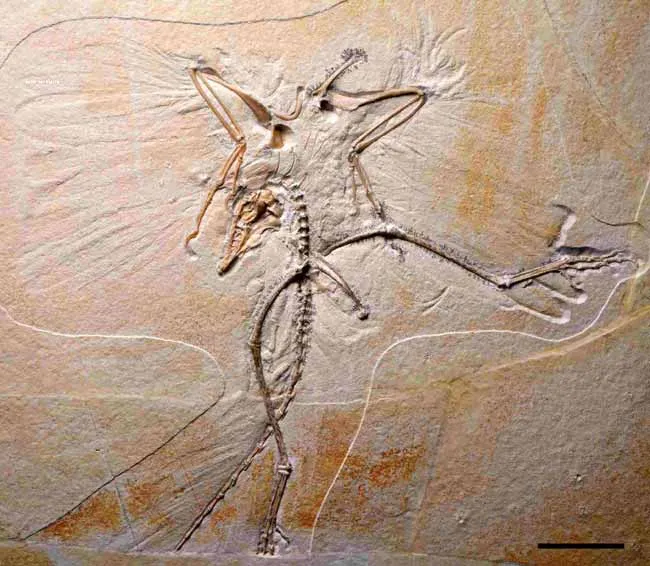
The new fossil, known as the "Thermopolis specimen," is incredibly well preserved. It left clear impressions of its wing and tail feathers in the limestone it was encased in, and the skull is the best preserved of all the ten specimens ever discovered.
But it may be the feet that prove to be the most important aspect of the find.
Scrunched up
"The feet of the new specimen are, by far, the best preserved," study co-author Gerald Mayr told LiveScience.
The feet of previously discovered specimens were sort of scrunched up, making it difficult for scientists to accurately determine toe configuration, resulting in reconstructions showing feet with a hind toe, typical of modern birds.
But the Thermopolis specimen, discovered in the Solnhoren region of southeastern Germany, clearly shows that Archaeopteryx's first toe extends from the side of its foot, like a human thumb, instead of backwards. The middle toe could be extended, and it had a large claw at its tip.
This configuration is similar to some late Jurassic dinosaur families, including the claw-footed Velociraptor and its cousins. As scientists consider Archaeopteryx as the first bird, this discovery strengthens the argument that modern birds evolved from dinosaurs.
Clumsy?
This new interpretation will force scientists to rethink how Archaeopteryx got around, however. Scientists previously thought that it and other early dino-birds such as Microraptor gui climbed to tree tops, hopped off, and glided to nearby trees. But in lacking the hind toe, Archaeopteryx would have had a hard time perching on a branch and might have made a clumsy show of hopping off and gliding away.
It is unclear exactly when the perching toe developed, but it was within 30 million years after Archaeopteryx lived. By this time – the early Cretaceous period, about 120 million years ago – all birds appear to have a perching foot with a hind toe.
This discovery is detailed in the Dec. 2 issue of the journal Science.
- Image Gallery: Spot Today's Dinosaurs
- Avian Ancestors: Dinosaurs That Learned to Fly
- The First Biplanes Were Dinosaurs
- A Brief History of Dinosaurs
