 Live Science Plus





You are now subscribed
Your newsletter sign-up was successful
Want to add more newsletters?

Delivered Daily
Daily Newsletter
Sign up for the latest discoveries, groundbreaking research and fascinating breakthroughs that impact you and the wider world direct to your inbox.

Once a week
Life's Little Mysteries
Feed your curiosity with an exclusive mystery every week, solved with science and delivered direct to your inbox before it's seen anywhere else.

Once a week
How It Works
Sign up to our free science & technology newsletter for your weekly fix of fascinating articles, quick quizzes, amazing images, and more

Delivered daily
Space.com Newsletter
Breaking space news, the latest updates on rocket launches, skywatching events and more!

Once a month
Watch This Space
Sign up to our monthly entertainment newsletter to keep up with all our coverage of the latest sci-fi and space movies, tv shows, games and books.

Once a week
Night Sky This Week
Discover this week's must-see night sky events, moon phases, and stunning astrophotos. Sign up for our skywatching newsletter and explore the universe with us!
Join the club
Get full access to premium articles, exclusive features and a growing list of member rewards.
The U.S. East Coast is sweating through a lingering heat wave this week. The sweltering heat and humidity have combined to keep temperatures hot even at night. But relief may finally be in sight.
Heat waves are marked by at least three consecutive days of temperatures of at least 90 degrees Fahrenheit (32 degrees Celsius). In New York and Boston, temperatures hit 90 degrees F or hotter Sunday through Wednesday, and are expected to do so again today (July 18). New York has already reached 96 degrees F (36 degrees C) by 1 p.m. EDT today. Baltimore reached a record high of 98 degrees F (37 degrees C) yesterday, the National Weather Service (NWS) said.
Today and Friday are expected to be the hottest days of the Northeast's extended heat wave, according to the NWS' Eastern Region Headquarters.
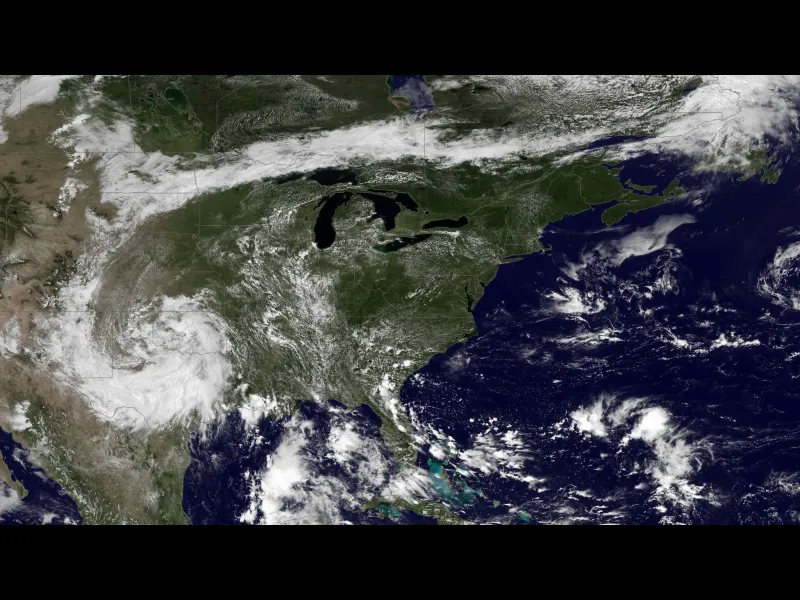
A giant high-pressure dome in the atmosphere, sitting over the Ohio Valley, is keeping the East Coast hot and humid. The high pressure blocks the jet stream's cooler air from reaching the region and, at the same time, pulls in hot, humid air from the Gulf of Mexico. The high pressure also keeps the skies clear, helping to raise temperatures, as can be seen from space in an image captured by the GOES East satellite.
However, an end is in sight: A cold front will come through starting Friday, bringing relief first to the Ohio Valley and Great Lakes and then finally to the Northeast by Sunday, the NWS said. But the collision between cold and warm air could cause thunderstorms and heavy rainfall in the Appalachians and the Carolinas next week, the NWS said.
Email Becky Oskin or follow her @beckyoskin. Follow us @livescience, Facebook & Google+. Original article on LiveScience.com.

