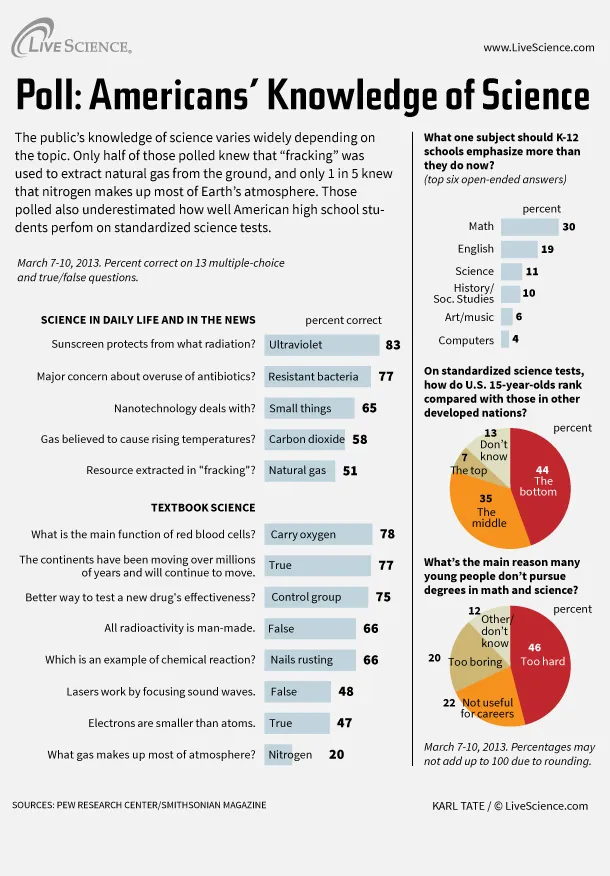
Can you identify the gas that makes up most of Earth's atmosphere? If yes, you may be surprised to be among the minority in the United States. (Hint: It's not oxygen.) But if you know which kind of radiation that sunscreen protects against, you're in good company.
The American public's knowledge of basic science and technology varies widely, according to the results of a 13-question survey by the Pew Research Center and Smithsonian magazine.
About 78 percent of the public know red blood cells carry oxygen to the body, whereas 83 percent know sunscreen protects the skin from harmful ultraviolet rays, the poll found. Most know the Earth isn't such a static place, with 77 percent choosing "True" over "False" when told that the continents have been moving for millions of years and will keep moving in the future. [Americans' Science & Technology Smarts (Infographic)]
Latest Videos From
Another 77 percent correctly answered that antibiotic-resistant bacteria is the main reason scientists are concerned about the overuse of antibiotics. That might be because superbugs like methicillin-resistant Staphylococcus aureus, better known as MRSA, get a lot of attention in the news. But even though the controversial drilling technique known as fracking has been emerging as a hot-button environmental and political issue, only 51 percent of the public know that natural gas (not coal, diamonds or silicone) is extracted in the process, the poll found.
Most people seemed to know that having a control group is the best way to test a new drug to treat a disease; 78 percent said they would give the drug to half of a group of volunteers with the disease, but not to the others, then compare how many in each group got better, rather than just giving the drug to all the volunteers. Another textbook-science question asked for an example of a chemical reaction, and 66 percent accurately chose nails rusting over water boiling and sugar dissolving.
There were generally big gaps (often 20-percentage-point differences) between those with a college degree and those who only had a high-school degree. And for a few questions, Americans with just some college education under their belts lagged far behind college graduates. For example, 76 percent of college grads knew carbon dioxide is the gas believed to cause atmospheric temperatures to climb; just 55 percent of those with some college experience got that question right.
Tech-related questions revealed an age gap in knowledge. Among people 65 and older, just 37 percent knew that nanotechnology deals with small things, compared with 76 percent of those ages 18 to 29. And just 27 percent of seniors knew that "Lasers work by focusing sound waves" was false (lasers focus light), whereas 50 percent or more of all the younger age groups said the same.
Women generally did not do as well as men on most of the questions, though they performed as well or better on health-related items, like the question about antibiotics overuse. And women (54 percent) were more likely than men (37 percent) to say that the main reason young people don't pursue math and science degrees is because they think these subjects are too difficult.
Generally the public doesn't seem to have great faith in the level of American students' science achievement compared with the rest of the developed world. A plurality of those surveyed (44 percent) believed 15-year-olds in the United States are lacking in science knowledge compared with their peers in other countries. In reality, the teens have an average standing. College graduates seemed to be most pessimistic about younger generations, with 56 percent saying American students rank near the bottom.
Pew says the survey was conducted March 7-10 through phone interviews with 1,006 adults. The complete results are here.
Follow Megan Gannon on Twitter and Google+. Follow us @livescience, Facebook& Google+. Original article on LiveScience.com.

 Live Science Plus