













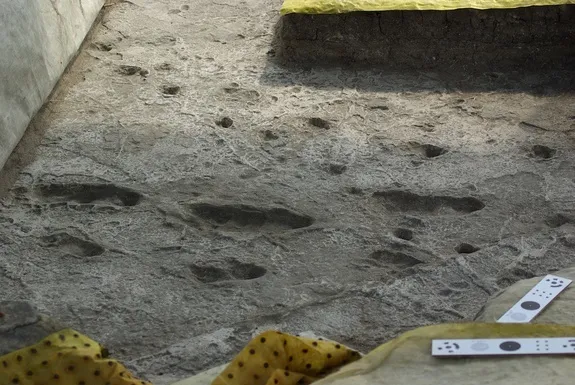
Fossil footprints could provide a skewed view of how ancient animals — including early human ancestors similar to the famous Lucy fossil — walked, new research suggests.
In the past, paleontologists and anthropologists assumed the depth of the footprint correlated with the pressure used to create it. But the analysis, published today (March 19) in the Journal of the Royal Society Interface, reveals that the heel tends to create a deeper indentation even when applying the same amount of pressure.
"We shouldn't necessarily expect the shape of a footprint to directly reflect the way the animal that made it walked," said study co-author Karl Bates, a biomechanics researcher at the University of Liverpool in the United Kingdom.
As a result, some conclusions about how early human ancestors walked upright may need some rethinking, Bates said. [10 Greatest Mysteries of the First Humans]
Walking pressure
Fossil footprints have the potential to reveal insights into how ancient animals and people moved. For instance, Laetoli, Tanzania, bears the traces of 3.6-million-year-old footprints of the first bipedal walkers, Australopithecus afarensis, the same species as the female skeleton nicknamed Lucy.
But deciphering the ancient marks to recreate human ancestors' gait is tricky. Historically, scientists assumed the depth of the indentation directly correlated with the pressure placed at that spot. But testing that experimentally was difficult, as the force plates that measure foot-strike pressure are made of materials that don't deform and leave footprints.
Get the world’s most fascinating discoveries delivered straight to your inbox.
Computer model
To get a more thorough look, Bates and his colleagues created a computer model that simulated the pressure of various sizes of feet as they depressed different types of soils with various strikes.
They then asked 10 people to walk along the beach in Brighton, on the south coast of Great Britain, and measured their footprints. The same people then walked on a force-measuring treadmill, and the researchers correlated the footprint depth with pressure during walking.
Both methods found similar trends: different parts of the foot create different size indentations even when striking the ground with the same amount of pressure.
"The heel is a more effective indenter than the forefoot and the toes," Bates told LiveScience.
The softer the walking surface, the more exaggerated this effect.
While the researchers focused on human gait, the new analysis should also apply to dinosaur prints and other extinct animal tracks, Bates said.
Ancient walkers
The study is impressive because it cleverly combined sophisticated computer models and experimental approaches, said Kristiaan D'Août, a biomechanics researcher at the University of Antwerp who was not involved in the study.
"They're two totally different techniques, but they both yielded overall rather similar results," D'Août told LiveScience.
The findings suggest there's a much more complicated relationship between foot pressure and footprint depth, which could force scientists to rethink their past assumptions about the gaits of early human ancestors, he said.
Follow Tia Ghose on Twitter @tiaghose. Follow us @livescience, Facebook & Google+. Original article on LiveScience.com

Tia is the editor-in-chief (premium) and was formerly managing editor and senior writer for Live Science. Her work has appeared in Scientific American, Wired.com, Science News and other outlets. She holds a master's degree in bioengineering from the University of Washington, a graduate certificate in science writing from UC Santa Cruz and a bachelor's degree in mechanical engineering from the University of Texas at Austin. Tia was part of a team at the Milwaukee Journal Sentinel that published the Empty Cradles series on preterm births, which won multiple awards, including the 2012 Casey Medal for Meritorious Journalism.