













Jaguar Facts: Biggest Cat in Americas

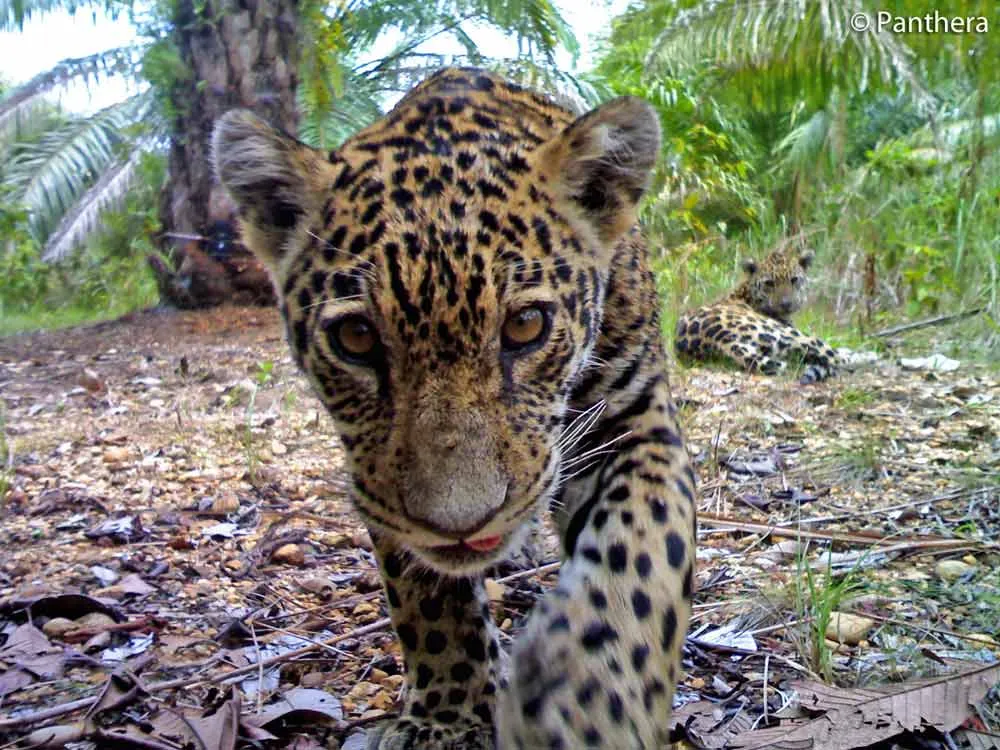
Jaguars are large cats that can be found in North, Central and South America. They are identified by their yellow or orange coats, dark spots and short legs. The dark spots on their coats are unlike any other cat spots. Each spot looks like a rose and are called rosettes.
Size
Jaguars are the biggest cats in the Americas and the third largest cats in the world, according to Defenders of Wildlife. From head to flank, these cats range in length from 4 to 6 feet (1 to 2 meters). The tail can add another 2 feet (60 centimeters) in length, though their tails are quite short when compared to other large cats. Lions' tails, by comparison, can grow up to 3.5 feet (105 cm).
Males are heavier than females. Males can weigh from 126 to 250 lbs. (57-113 kilograms), while females weigh 100 to 200 lbs. (45-90 kg), according to the Denver Zoo.
Habitat
Jaguars typically live in forests or woods, but they are also found in desert areas, such as Arizona. They tend to stay close to water and they like to fish. Jaguars will dip their tails into the water to lure fish, much like a fishing line.
Historically, jaguars roamed the southwestern United States from Texas to California. Famed mountain man James "Grizzly" Adams even reported seeing a female and two cubs in California's Tehachapi Mountains near Bakersfield sometime in the mid-1800s.
But anti-predator efforts of the early 1900s wiped out jaguars from the northern reaches of their range. Today, the northernmost breeding population is in the state of Sonora in Mexico. Still, the occasional jaguar does make a home in Arizona. Experts debate how important this habitat is for overall jaguar survival, but some conservationists in the state argue that Arizona could be important habitat for the big cats as the climate warms and prey move north.
The only known jaguar in the United States today is a young male nicknamed "El Jefe." He's been sighted in photos and video from camera traps in the Santa Rita Mountains near Tucson, where he has roamed for at least three years. Biologists have also tracked his movements using a specially trained scat-sniffing dog.
Get the world’s most fascinating discoveries delivered straight to your inbox.
The last jaguar known to have lived in the United States before El Jefe was Macho B, another male. Macho B was euthanized in 2009 after an attempt to trap and radio-collar the elderly jaguar went wrong. The death of Macho B was a major scandal for Arizona's Fish and Game Department and led to a criminal investigation for the killing of an endangered species.
Other jaguar sightings in the state have been few and far between. The last known female jaguar in the United States was shot in 1963 by a hunter who mistook her for a bobcat.
Habits
Jaguars are loners that only spend time with others of their kind when they are mating or taking care of cubs. To keep other jaguars at bay, they mark their territory with urine or by marking trees with their claws. Their territories can be up to 50 miles wide, according to the University of Michigan's Animal Diversity Web (ADW).
The jaguar is a top-level predator. It doesn't have any natural predators other than humans, who hunt them for their fur or sport.
Their name comes from the Native American word "yajuar." Yajuar means "he who kills with one leap." During a hunt, jaguars take advantage of their strong jaws and sharp teeth. They catch their prey by the head and chop down to make the kill. Other cats go for the neck when killing prey.
Diet
Jaguars are carnivores, which means they eat only meat. In the wild, jaguars will use their speed and stealth to take down deer, peccary, monkeys, birds, frogs, fish, alligators and small rodents. If wild food is scarce, these large cats will also hunt domestic livestock.
Their jaws are stronger than any other species of cat. With these strong jaws, jaguars will crunch down on bones and eat them. Their jaws are strong enough to crack a sea turtle's shell, according to the BBC. In fact, in the zoo, bones are part of a jaguars' regular diet.
They also don't like to share their food. Jaguars will only eat their prey after dragging into the trees, even if the trees are quite a distance away.

Offspring
In August and September, jaguars mate. After mating, the female will carry her young for around 100 days and will give birth to one to four young.
Baby jaguars are called cubs. They are born with their eyelids sealed shut. After about two weeks, the cubs are able to see for the first time. After six months, the cubs' mother will teach them how to hunt, and after their second birthday, the cub will leave their mother to live on their own.
Jaguars typically live around 12 years.
Classification/taxonomy
The taxonomy of jaguars, according to the Integrated Taxonomic Information System (ITIS), is:
Kingdom: Animalia Subkingdom: Bilateria Infrakingdom: Deuterostomia Phylum: Chordata Subphylum: Vertebrata Infraphylum: Gnathostomata Superclass: Tetrapoda Class: Mammalia Subclass: Theria Infraclass: Eutheria Order: Carnivora Suborder: Feliformia Family: Felidae Subfamily: Pantherinae Genus: Panthera Species: Panthera onca Subspecies:
- Panthera onca arizonensis (Arizona jaguar)
- Panthera onca centralis (Central American jaguar)
- Panthera onca goldmani (Yucatan Peninsula jaguar)
- Panthera onca hernandesii (West Mexican jaguar)
- Panthera onca onca (East Brazilian jaguar)
- Panthera onca palustris
- Panthera onca paraguensis (Paraguay jaguar)
- Panthera onca peruviana (Peruvian jaguar)
- Panthera onca veraecrucis (Northeastern jaguar)
Conservation status
According to the International Union for Conservation of Nature's Red List of Threatened Species, the jaguar is "near threatened" due to poaching and the destruction of the rainforest. The World Wildlife Federation estimates that there are only 15,000 jaguars left in the wild.
Other facts
Melanistic or all black jaguars occur due to a genetic mutation. This mutation causes the skin and fur to contain larger amounts of a dark pigment. These types of jaguars are found in rainforests because it is easier for them to blend into the dark shadows of the trees.
Jaguars can see six times better than humans at night or during darker conditions due to a layer of tissue in the back of the eye that reflects light.
Unlike most cats, jaguars are not afraid of water. They are also very good swimmers.
Additional resources
