














Expedition to Count Endangered Chinese Porpoises

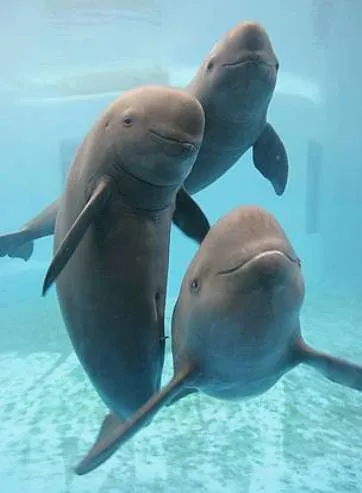
How many finless porpoises are left in China's Yangtze River? An expedition is under way to count how many of these endangered animals survive in the heavily polluted waterway.
There are less than 1,800 of the animals in the wild, mainly in the central and lower reaches of the 3,915-mile (6,300 kilometers) Yangtze River and two large adjoining lakes, Dongting and Poyang.
Two recent surveys found that populations of the endangered animal, the only freshwater finless porpoise in the world, had plummeted in Dongting Lake. Numbers in Poyang, however, remained relatively stable — 450 porpoises were counted there, the WWF, which is helping to organize the expedition, reported.
Nevertheless, estimates suggest the animal could go extinct within 15 years if major steps aren't taken to address the porpoise's plight. It's most threatened by water pollution, sand dredging, strikes by boat propellers and electro-fishing, a technique that stuns fish — and porpoises — by sending an electric current into the water, according to the WWF.
The expedition comes six years after a similar trek along the Yangtze that failed to find any surviving Baiji dolphins, a close relative of the finless porpoise that was subsequently declared functionally extinct.
"We are not optimistic about the estimated results in the mainstream investigation at this moment," said Wang Ding, a researcher at the Chinese Academy of Sciences' Institute of Hydrobiology, in the statement.
"As a symbol of the Yangtze ecosystem, the status of the finless porpoise is a reflection of the health of the Yangtze River," added colleague Wang Kexiong. "It has already lost the Baiji dolphin, and cannot bear losing the Yangtze finless porpoise."
Get the world’s most fascinating discoveries delivered straight to your inbox.
The expedition will cover a 1,055-mile (1,700 km) expanse of the Yangtze. Preliminary results will be announced in mid- to late December, and the complete report will be released in March 2013.
Follow OurAmazingPlanet on Twitter @OAPlanet. We're also on Facebook and Google+.
