 Live Science Plus





You are now subscribed
Your newsletter sign-up was successful
Want to add more newsletters?

Delivered Daily
Daily Newsletter
Sign up for the latest discoveries, groundbreaking research and fascinating breakthroughs that impact you and the wider world direct to your inbox.

Once a week
Life's Little Mysteries
Feed your curiosity with an exclusive mystery every week, solved with science and delivered direct to your inbox before it's seen anywhere else.

Once a week
How It Works
Sign up to our free science & technology newsletter for your weekly fix of fascinating articles, quick quizzes, amazing images, and more

Delivered daily
Space.com Newsletter
Breaking space news, the latest updates on rocket launches, skywatching events and more!

Once a month
Watch This Space
Sign up to our monthly entertainment newsletter to keep up with all our coverage of the latest sci-fi and space movies, tv shows, games and books.

Once a week
Night Sky This Week
Discover this week's must-see night sky events, moon phases, and stunning astrophotos. Sign up for our skywatching newsletter and explore the universe with us!
Join the club
Get full access to premium articles, exclusive features and a growing list of member rewards.
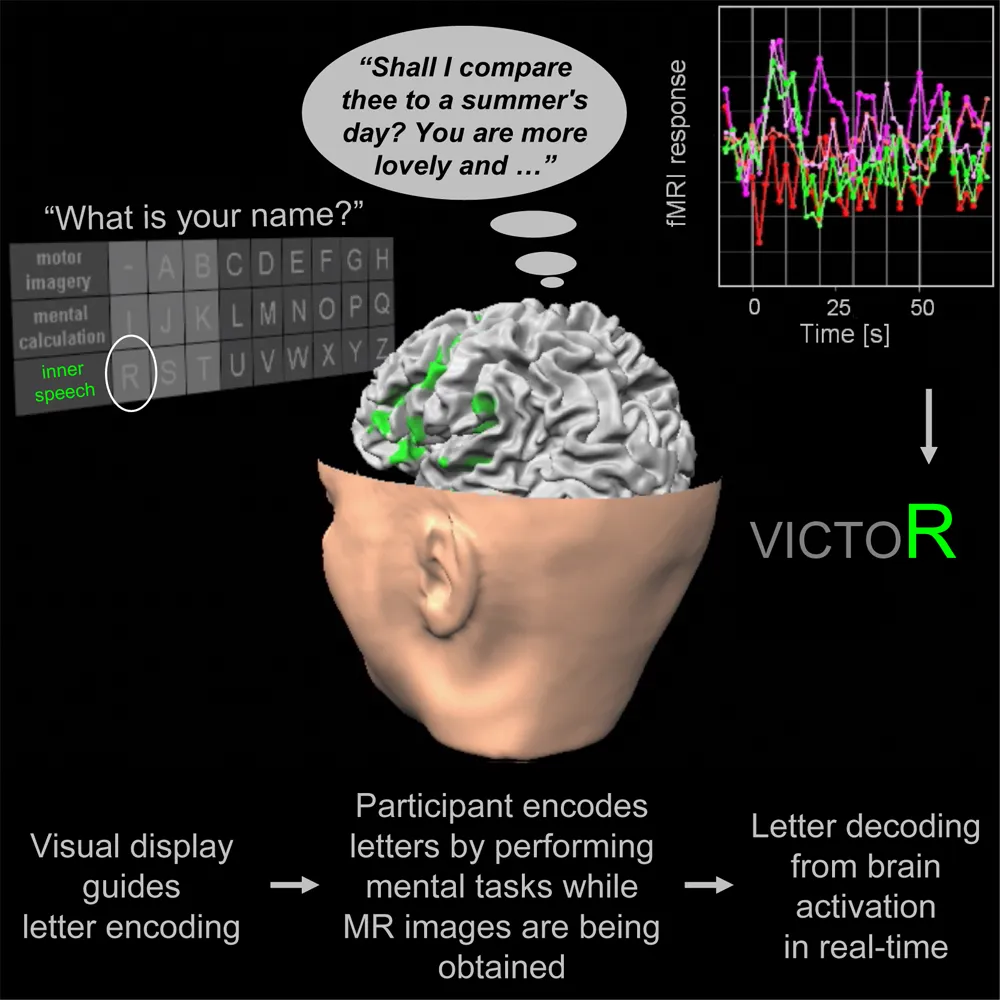
A new system allows paralyzed people to communicate by mentally selecting letters in the English alphabet. People trained to use the system think certain thoughts for each letter, which causes blood to flow to the brain in characteristic patterns. A functional magnetic resonance imaging (fMRI) scanner then captures and interprets what's happening in users' brains.
Right now, the system is still in its proof of concept stage, but it's a promising addition to research on letting people with so-called "locked-in syndrome" out again, Scientific American reported.
One reason the system isn't ready for widespread use yet is that it's a little cumbersome to use. People can't simply think of the letters they want while they're in the fMRI scanner. The system has a roundabout way of getting users to produce unique enough thought patterns for the fMRI to recognize. The 26 letters of the English alphabet, plus a "spacebar" function to separate words, are divided into three rows. To select a letter in a row, users have to wait for the computer to highlight the letter they want, then perform a simple mental task associated with that row. Scientific American has more detail on what it's like to use the system.
The system's creators, a team of neuroscientists in the Netherlands and Germany, tested the system successfully in six healthy adults. The scanner accurately captured the letters people wanted 82 percent of the time. Even when the scanner was inaccurate, researchers could often tell what people meant, anyway. In one example, researchers asked one volunteer tester, "Where did you spend your most recent vacation?"
The scanner interpreted the tester's reply as "INDCONERCA," from which they guessed the tester's intended answer, "INDONESIA."
People with brain injuries may have some trouble with the system as it is set up now, however. "The technique may need some adaptation to be widely applicable to patients who might have impaired awareness or ability to concentrate on the required task," Guy Williams, a University of Cambridge neuroscientist told the BBC.
Nevertheless, Elaine Snell of the British Neuroscience Association called the system "very exciting," saying, "This kind of technology can only get better." The scanner's creators published about their work yesterday (June 28) in the journal Current Biology.
Sources: Scientific American, BBC
This story was provided by InnovationNewsDaily, a sister site to LiveScience. Follow InnovationNewsDaily on Twitter @News_Innovation, or on Facebook.

