













Image Gallery: Shimmering Metallic Beetles

Ancient Beetle
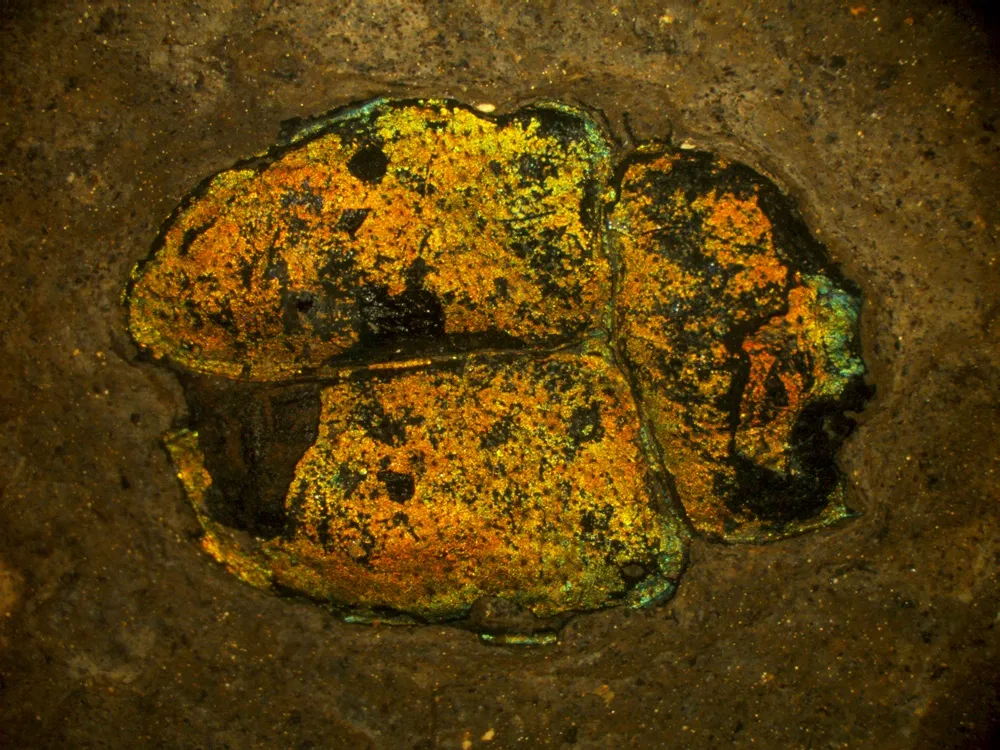
Specimen number MeI 15 552, a Chrysomelid beetle from Messel, Germany. The colors on the specimen have been preserved (though not perfectly) for 47 million years.
Blue Beetle

A blue chrysomelid from Eckfeld, Germany. The specimen (specimen NMM PE 2000 636) is about 40 million years old.
Green and Gold

A 47-million-year-old beetle fossil from Messel, Germany. Specimen number MeI 15 5553.
Shield Bug

Many modern insects have exoskeletons made of materials that scatter light, to brilliant effect. This is a shield bug nymph.
Idaho Bug

This 15-million-year-old beetle fossil was found in a deposit in Idaho. Specimen number YPM 2010 P37b 005.
Barely There Beetle

A few 40-million-year-old metallic remains from a chrysomelid beetle found in Eckfeld, Germany. Specimen number NMM PE 2000 385.
Leftover Lace

An unidentified beetle fossil (specimen YPM 2010 P37b 010) found in Idaho looks like metallic lace.
Get the world’s most fascinating discoveries delivered straight to your inbox.
Blue Dung Beetle

Even the humble dung beetle (Geotrupes stercorosus) takes on a blue sheen.
Green Rose Chafer

The green rose chafer (Cetonia aurata) has a striking metallic hue. Read the full story of what happens to these dazzling colors when beetles like these become fossilized.
Blue Jewel Beetle

Metallic jewel beetles are perhaps the prettiest beetles next to ladybugs. There are approximately 15,000 species of jewel beetles worldwide, according to United States Department of Agriculture, with new species discovered as recently as July. The above beetle was identified as an Anthaxia nitidula species of jewel beetles that belongs to the Buprestidae family.
Red Shimmer

The extraordinary coloring and pattern of this jewel beetle species (Chrysochroa buqueti rugicollis) makes it appear to have a yellow heart on its back. When it opens its wings, this beetle reveals a shiny, navy blue body.

Stephanie Pappas is a contributing writer for Live Science, covering topics ranging from geoscience to archaeology to the human brain and behavior. She was previously a senior writer for Live Science but is now a freelancer based in Denver, Colorado, and regularly contributes to Scientific American and The Monitor, the monthly magazine of the American Psychological Association. Stephanie received a bachelor's degree in psychology from the University of South Carolina and a graduate certificate in science communication from the University of California, Santa Cruz.