














Hurricane Irene Will Make 2011 a Record Disaster Year

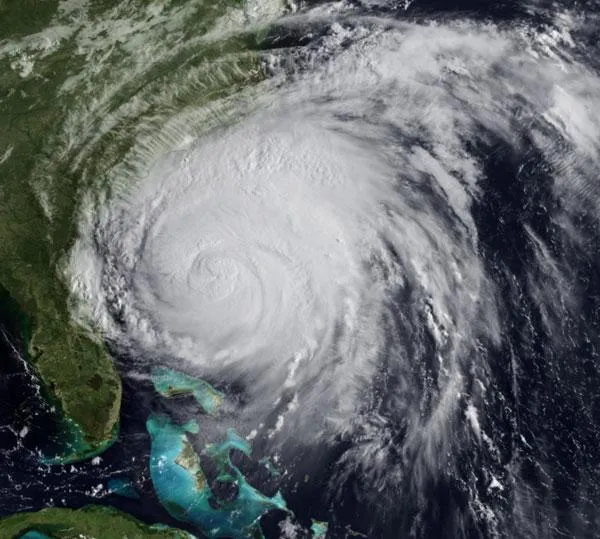
Hurricane Irene is very likely to be the 10th billion-dollar disaster of 2011, breaking 2008's record for number of billion-dollar disasters a year, according to preliminary estimates.
Between the summer floods, tornados, blizzards and drought, 2011 had already racked up nine natural disasters that cost at least $1 billion each, tying 2008's record. If damage estimates hold, Irene would make 2011 a record-breaker.
No one knows what the final toll of Irene will be, but estimates were high as the hurricane churned toward the Carolinas on Friday (Aug. 26) as a Category 2 storm with winds of up to 105 miles per hour (169 kilometers per hour). By 5:00 p.m. ET on Friday, the National Weather Service reported that winds were picking up speed along the North Carolina coast. Hurricane-force winds are expected in that region overnight Friday, with hurricane conditions arriving along the mid-Atlantic coast by Saturday afternoon.
The news agency Bloomberg reported Thursday (Aug. 25) that risk assessor Kinetic Analysis Corp. had estimated that Irene may cause $13.9 billion in insured losses and $20 billion in total economic losses when factors such as lost work hours and disruption of shipping are factored in.
Meanwhile, Roger Pielke, a professor of environmental studies at the University of Colorado, Boulder, wrote on his blog, "it does seem safe to say [Irene's] effects will be widespread and the damage total considerable."
Pielke looked up damage totals from previous storms that followed Irene's track and found inflation-adjusted damage estimates ranging from about $4.9 billion (Storm 8, 1933) to about $46.2 billion (New England storm, 1938). But none of the past storms are good analogues for Irene, Pielke wrote.
"We should expect to see damage along the entire eastern seaboard," Pielke wrote, "as well as a considerable amount of damage from inland flooding (not included in these numbers.)"
Get the world’s most fascinating discoveries delivered straight to your inbox.
Escalating costs of hurricanes
If storms seem more expensive in recent decades, they are. But that's not because storms are making landfall more often or becoming more severe. Rather, a growing population, more buildings along coastlines and a big economy mean that storm disruptions are more costly.
In a 2008 paper published in the journal Natural Hazards, Pielke and colleagues compared hurricane damage from 1900 to 2005, taking into account changes in wealth, inflation, population growth and coastal development. Holding those factors steady, the researchers found that there was no increasing trend of greater damage attributable to the storms themselves over the 20th century.
In other words, there's just more stuff in the way to get damaged, making hurricanes today more costly than in the past.
By the researchers' reckoning, the most damaging single storm was the 1926 Great Miami, which would have cost as much as $157 billion in 2005 dollars. The storm was a Category 4 storm that roared onshore with winds of up to 125 mph (201 kph). After devastating southern Florida, the storm made a second landfall near Mobile, Ala.
Preventing damage
If you're in the path of the storm, experts recommend boarding up windows and taking valuables along in case of evacuation. Damage by Irene may be reduced by as much as a quarter if people follow these steps, said Cecilia Rokusek, a project manager at the Institute for Disaster and Emergency Preparedness at Nova Southeastern University in Florida. [Hurricane Evacuations: Why Some Won't Go]
But Rokusek urged hurricane-threatened residents to keep their priorities straight.
"The most important thing in a disaster is to save your life," she told LiveScience. "The material things can always be replaced."
Previous 2011 disasters
Pre-Irene, economic damage from natural disasters in the U.S. exceeded $35 billion this year, according to a National Climatic Data Center report released in August 2011. Those disasters were:
- Upper Midwest flooding (summer): At least $2 billion of damage as of mid-August
- Mississippi River flooding (spring and summer): $2 billion to $4 billion in damage
- Drought, heat wave and wildfires in the Southern Plains and Southwest (spring and summer): Over $5 billion in damage
- Tornadoes (May 22-27): At least $7 billion in damage in central and southern states, including the tornado that struck Joplin, Mo., killing 141
- Tornados (April 25-30): At least $9 billion in damage in central and southern states
- Tornadoes (April 14-16): More than $2 billion in damage in central and southern states
- Tornadoes (April 8-11): Losses exceeding $2.2 billion in central and southern states
- Tornadoes (April 4-5): More than $2.3 billion in damage in central and southern states
- Groundhog Day Blizzard: $2 billion in damage after a massive winter storm dumped snow across the central, eastern and northeastern sections of the country.
LiveScience senior writer Wynne Parry contributed to this article.
You can follow LiveScience senior writer Stephanie Pappas on Twitter @sipappas. Follow LiveScience for the latest in science news and discoveries on Twitter @livescience and on Facebook.

Stephanie Pappas is a contributing writer for Live Science, covering topics ranging from geoscience to archaeology to the human brain and behavior. She was previously a senior writer for Live Science but is now a freelancer based in Denver, Colorado, and regularly contributes to Scientific American and The Monitor, the monthly magazine of the American Psychological Association. Stephanie received a bachelor's degree in psychology from the University of South Carolina and a graduate certificate in science communication from the University of California, Santa Cruz.