













Lions Kill and Go Away, to Kill Again Another Day

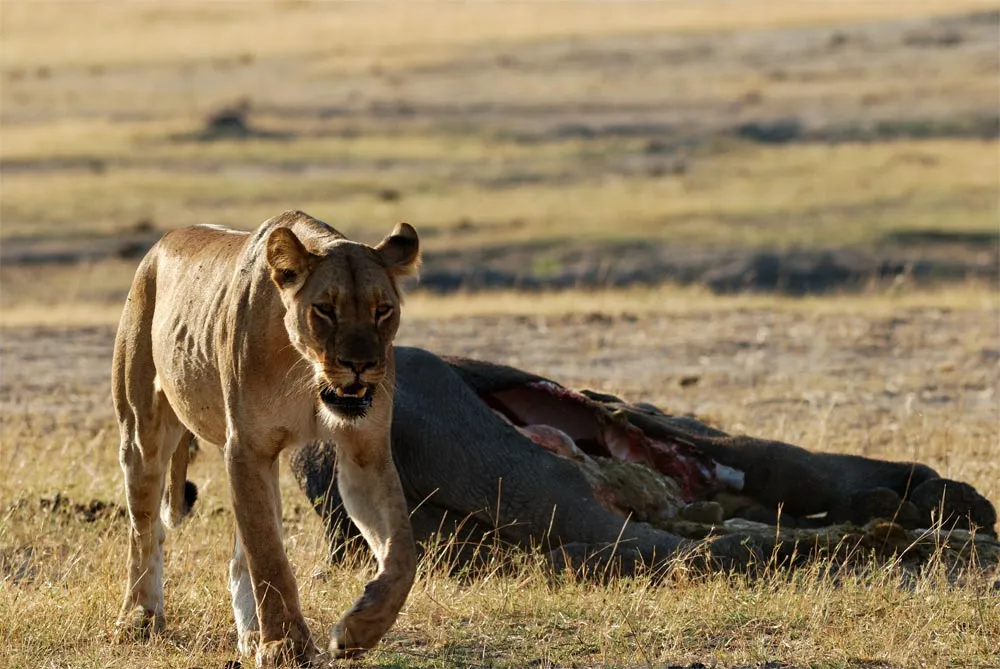
Lions apparently flee the scenes of their crimes, withdrawing after successful kills while other potential prey are still on high alert, researchers have found by using satellites to track some of the deadly African cats.
This research into the minds of lions sheds light on why and when large predators move on from one hunting ground to the next, a crucial decision when the stakes are survival or starvation. In turn, such insights could lead to better designs of protected areas for African lions, whose numbers have shrunk by half in 30 years.
Deciphering the strategies of predators is difficult enough when they are captive, not to mention when they are free to range far in the wild.
"Such fieldwork is time-consuming, difficult and potentially dangerous," said researcher Marion Valeix, an ecologist at the University of Oxford in England and the French National Center for Scientific Research.
Scientists have had two ideas regarding why large mammalian carnivores depart a hunting ground. In the "unsuccessful hunt" hypothesis, predators hunt everything they can and then move on. In the alternate "patch disturbance" hypothesis, hunters leave after a successful kill to give remaining prey time to lower their guard — allowing the predators to return and blindside them. [Lions Attack Humans When Full Moon Wanes]
To see which strategy lions adopted, researchers followed the movements of eight African lions wearing global positioning system collars and ranging over about 2,700 square miles (7,000 square kilometers) in Hwange National Park in Zimbabwe.
Scientists matched the whereabouts of these big cats with 164 lion kills tracked down between 2005 and 2007. They found that after 87 percent of kills, the lions traveled at least three miles (five kilometers) or more, suggesting they were departing the scenes of their crimes.
Get the world’s most fascinating discoveries delivered straight to your inbox.
"We showed the need for these animals to rotate their hunting between several hunting grounds — for example, waterholes in the Hwange ecosystem," Valeix told LiveScience. "This has implications regarding the configuration and size of lion home range and needs to be taken into account in the design of small conservation reserves."
Most studies focusing on large carnivores have considered them and large herbivores to be rather static variables.
"The most important implication of our findings is that they make a strong case for the crucial need to consider the behavior of large carnivores and large herbivores in a dynamic framework — lions continuously adjust to the behavior of their prey, which continuously adjust to the whereabouts of their predators."
In the future, the scientists plan to study both the behavior of predator and prey at the same time. They detailed their new findings in the August issue of the journal American Naturalist.
Follow LiveScience for the latest in science news and discoveries on Twitter @livescience and on Facebook.
